 Guide On Map
Kartavya Path: From Rashtrapati Bhavan to the War Memorials
From Raisina Hill through Vijay Chowk and India Gate to the National War Memorial
Guide On Map on your phone
Open the walk like a regular app
It takes about 10 seconds to install. No app store needed.
The whole path
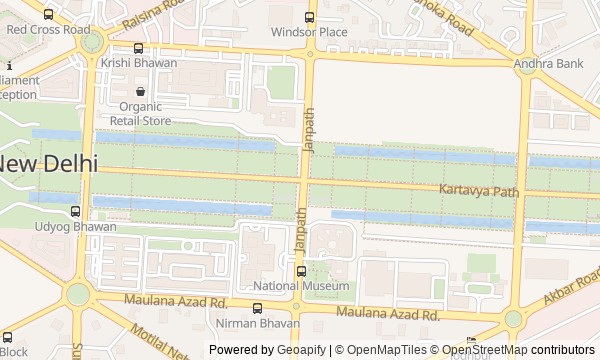
Route map
About the walk
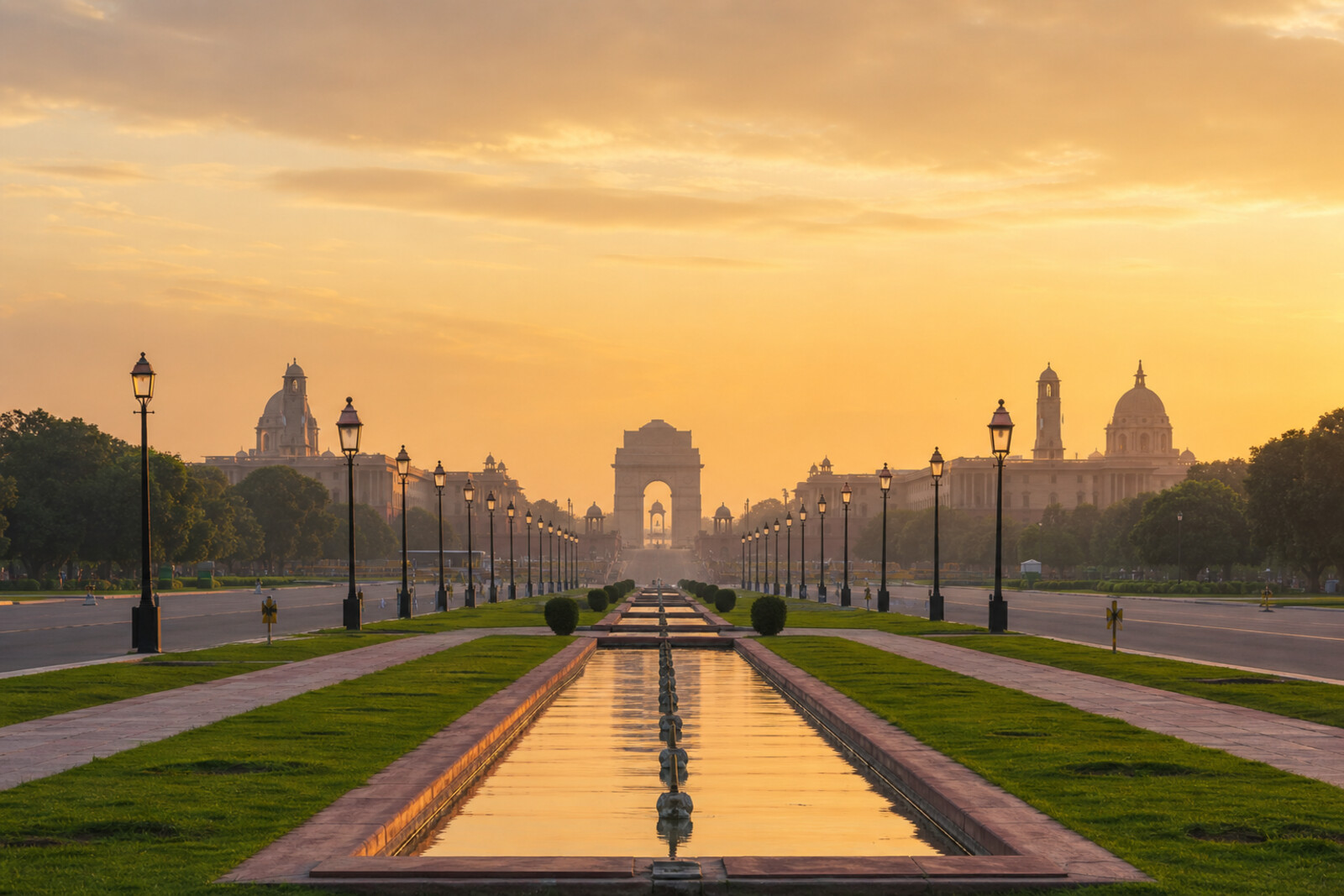
You will begin on Raisina Hill, beside the presidential residence and two symmetrical Secretariat buildings. From here, a straight road descends through Vijay Chowk, stretches between lawns and water channels, and leads to India Gate, the statue of Netaji Subhas Chandra Bose, and the round walls of the National War Memorial.
This is not the Delhi of forts, bazaars, and temples. It is the district where the state presents itself to the public. You will trace how a former imperial avenue acquired new names and ceremonies.
You will learn why one incline set two architects against each other; how a soldier invited to an opening went unnamed in the report; and what happened when spectators took over the field before the parade participants arrived. The story stays with documents, individual people, and visible details—without grand pronouncements.
By the end, you will be able to explain why one straight axis brings together an imperial arch, the leader of an anti-colonial army, and the names of the military personnel of independent India.
Why this order
At Rashtrapati Bhavan, the scale designed for an approach from below will become clear. Then the road between the Secretariat blocks will reveal the flaw in that plan: the residence disappears behind the ridge while the ministry buildings come forward. The descent naturally leads to Vijay Chowk, where an architectural vista became a site of state ritual. Only after the square does Kartavya Path open out in full—as a processional route to India Gate. Beyond the arch, the same straight line brings together 2 different ways of speaking about military history: a single figure beneath a former imperial canopy and thousands of individual names on the memorial walls.
First-time visitors who want to make sense of the ceremonial center of New Delhi Those interested in the history of independence, architecture, and state ceremonies Those who value documents and human episodes over a general overview
Those looking for narrow streets, markets, and everyday life in Old Delhi Those who want an easy walk without a conversation about colonial power and military memory Those more interested in interiors than urban spaces and monuments
Before you go
Most of the route is outdoors: treat the government hill and the Secretariats as an architectural ensemble, not as a promise of an interior visit. Zoom on your phone or binoculars will help with the details—the top of the Jaipur Column, the inscriptions on India Gate, and elements high on the facades are far from view. Slow down at the arch and at the memorial: their meaning only emerges when you read the individual names. If you want to see the changing of the guard at the presidential residence or the evening memorial ritual, check the arrangements separately in advance; the audio route does not depend on attending a ceremony.
When to go
Allow 75–95 minutes for an uninterrupted walk without interior visits. Most of the time goes to the long passage along Kartavya Path and an unhurried circuit of the memorial's rings; a fast pace especially diminishes the final 2 stops.
Backup plan
If access to part of the ceremonial axis is restricted, do not try to get closer through service areas or across the roadway: listen to the relevant section from the nearest permitted spot and continue only along the open pedestrian route. If you cannot walk the whole section, shift your focus to the compact eastern sequence—India Gate, the Netaji Subhas Chandra Bose pavilion, and the National War Memorial—keeping exactly that order. If the memorial itself is closed, finish at the pavilion, but do not substitute it for the ending: without the rings of names, the route tells of replaced symbols rather than the emergence of a new space of memory.
Route conditions
Surface. Paved — 1.7 km (data covers 63% of the route)
Stairs. Flights: 1, 19 m in total
Access. Wheelchair — no; stroller — limited (stairs)
Facilities. Toilets — 4
Elevation. Ascent — 6 m; descent — 17 m
OpenStreetMap extract of July 9, 2026: database data, not a check on the ground. Data © OpenStreetMap contributors, ODbL licence
Walk plan
Open in maps ↗- 1
Rashtrapati Bhavan and Jaipur Column
The palace approach will show how a man without office or an army achieved a conversation as an equal with a representative of the empire. - 2
North and South Secretariat Blocks
The steepness of the road will reveal the architectural mistake that broke up the friendship between the two creators of New Delhi. - 3
Vijay Chowk
The square links the cautious renaming of the imperial capital with the republic's annual military ritual. - 4
Kartavya Path
The avenue would become the setting for the first day of independence, when the public disrupted the ceremony's carefully prepared order. - 5
India Gate
The arch will show how an imperial ceremony tried to represent a huge army through one unnamed participant. - 6
Netaji Statue
Changing the figure beneath the canopy links the failed march on Delhi with the trial that changed the fate of the captured commanders. - 7
National War Memorial
The final stop will exchange grand state symbols for a single granite plaque and a family visit almost half a century later.
Route features
Everything you need stays in the browser
Progress, saves and your trip plan are stored on this device.
Add Guide On Map to your home screen so the walk opens outside the browser.
How we handle sources, maps and corrections: our editorial standards