 Guide On Map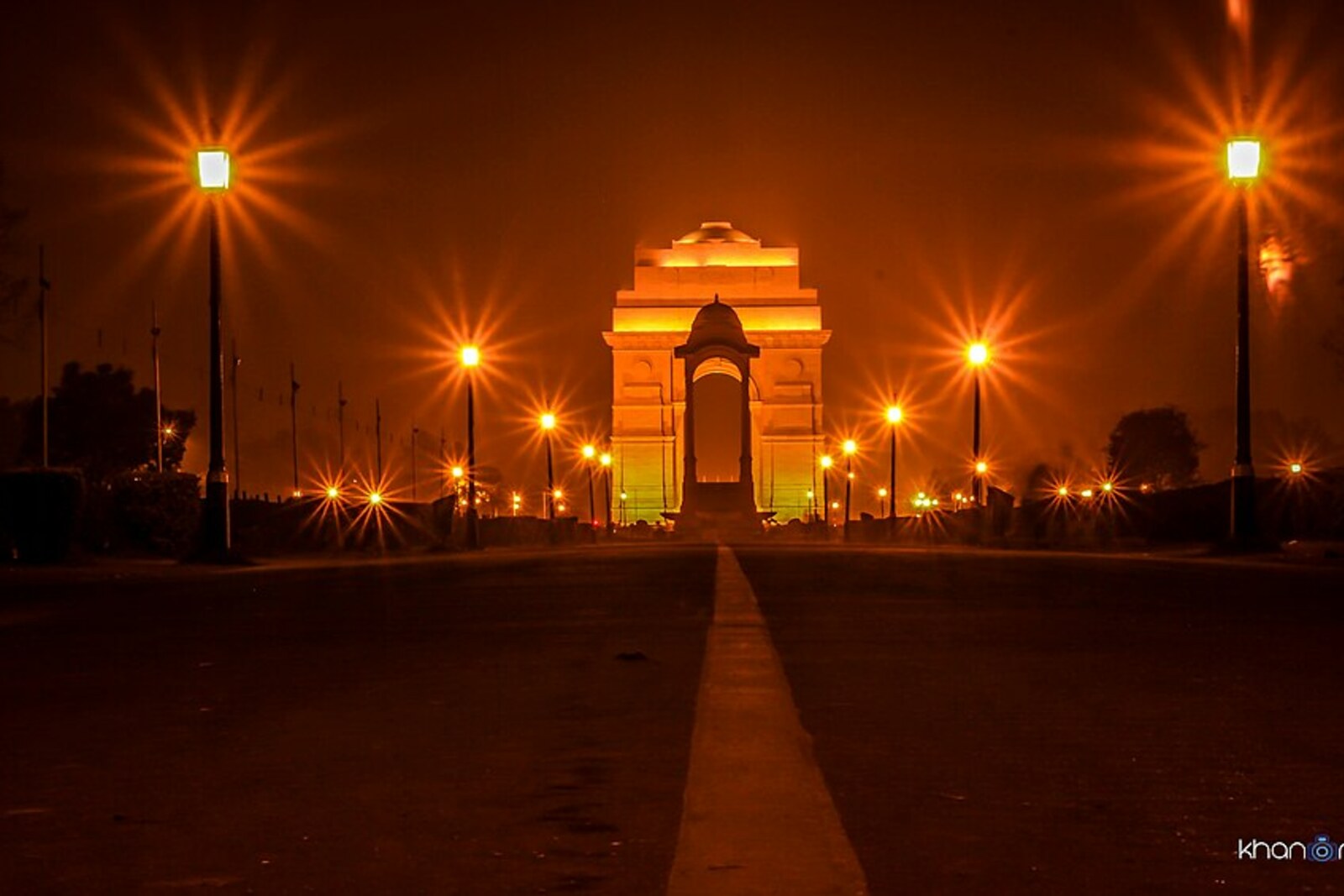
Look around first
What to notice
- The word “India” on the façade
- Names on the stone walls
- The war years on either side of the inscription
- The stone bowl above the arch
The story of the place
At the end of Kartavya Path, beneath a stone bowl, rises the enormous opening of India Gate: not a city gate, but a war memorial. It was originally called the All India War Memorial; its familiar name arose from the shape of the arch. Only part of the names of service members from undivided India who died between nineteen fourteen and nineteen twenty-one are carved on its walls. Today, people stroll and picnic nearby, while the word “India” and the war years remain visible on the façade.
On February twelfth, nineteen thirty-one, only invited guests were admitted to the new arch. After the speeches, a memorial flame was lit in the stone bowl at its top. A trumpeter played a military farewell call for the dead. Wreaths were laid by the viceroy, Lord Irwin, senior officials, and three service members: a British soldier, a British airman, and an Indian soldier chosen by lot. The description of the ceremony gives no name for him—only this designation remains: an Indian soldier chosen by lot.
He represented an army sent from undivided India during the First World War to France and Flanders, Mesopotamia and Persia, East Africa and Gallipoli. People endured the cold of European trenches, the heat of Middle Eastern campaigns, wounds, and captivity; many died thousands of kilometers from home. They were supported by army pay, and after their deaths, families often received only a notice and the name of a distant battlefield instead of a body.
Created after the war, the Imperial War Graves Commission sought to ensure that the dead would at least be commemorated by name if a grave could not be found or maintained. Fabian Ware, the head of the Commission, opened the ceremony at the arch. He wanted to present the service of Indian units as a strong bond between Britain and India. Irwin continued the same idea: in his words, the dead had defended a shared order. The stakes of this speech were quite practical. Five days later, the viceroy would begin negotiations with Gandhi at Viceroy's House.
More is written in stone than could be said at the ceremony. The arch is dedicated to about seventy thousand service members from undivided India who died between nineteen fourteen and nineteen twenty-one. Yet only around thirteen thousand three hundred names are carved here. Most belong to people who died on the North-West Frontier and in the Third Anglo-Afghan War and had no known grave. More than one thousand others were buried west of the Indus, in cemeteries that the Commission could not maintain permanently. Most of those who fell overseas are named on other memorials, closer to where they died. That is why the long inscription beneath the word “India” lists whole countries and fronts, while the walls carry only part of the names.
After laying the wreaths, the invited guests left through the archway to a march about Tipperary, played by British and Indian regimental bands. Thus the structure first fulfilled the literal role of a gate: the participants in the ceremony passed through it. There was never a city gate here. Its original name was the All India War Memorial; the familiar name “India Gate” became established because of the shape of the huge arch at the end of the avenue.
Now people stroll around it and hold family picnics on the lawns. There is no permanent flame in the upper bowl. The word “India,” the war years, and thousands of names remain on the façade. The Indian soldier whom the lot brought here to lay a wreath for the others left with the procession; the compilers of the report never named him.
Useful on site
Free exterior viewing; Delhi’s official portal gives hours from morning to night, every day, but access to individual areas depends on the security arrangements. Checked 2026-06-30.
Checked: June 30, 2026. Check the official source before visiting.Do not settle for a distant view: get as close as permitted to make out the names. Respect the barriers, and do not treat the arch as the end of the route.