 Guide On Map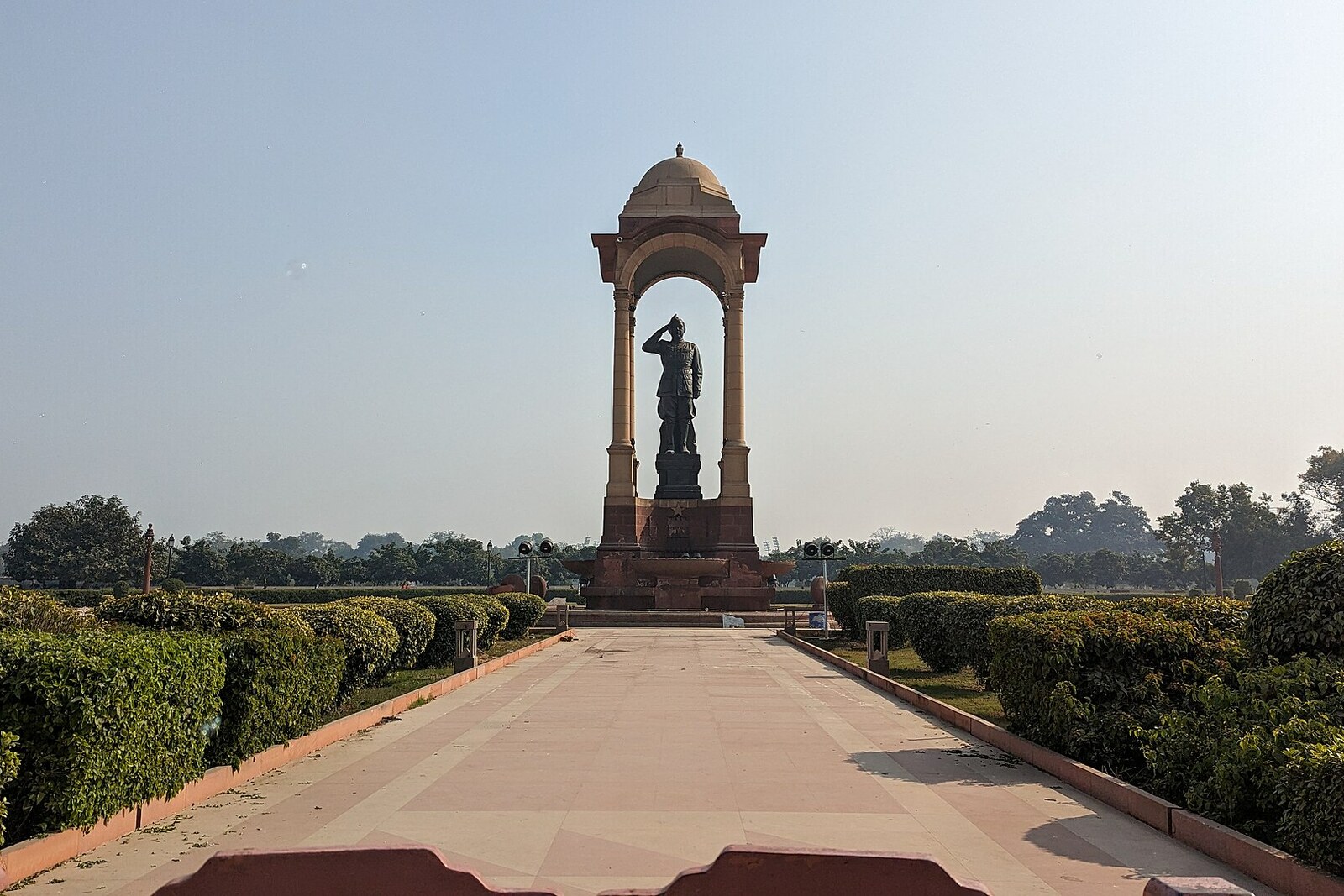
Look around first
What to notice
- Granite figure in military uniform
- Right hand raised in salute
- Field cap
- Canopy on four columns
The story of the place
Four columns support a separate canopy above the pedestal for a monumental figure. In nineteen thirty-six, a fifty-foot marble statue of King George V in coronation robes and an imperial crown was installed beneath it. This king now stands in Coronation Park, a place associated with the Delhi Durbar and the announcement of the transfer of the capital from Calcutta.
Beneath the canopy, Subhas Chandra Bose is depicted in a field cap and long military overcoat, with his right hand raised in salute. His supporters called him Netaji—“revered leader.” The military uniform matters here more than the ceremonial name.
On July fifth, nineteen forty-three, Bose reviewed the Indian National Army in Singapore. Many of its soldiers had only recently served in British Indian units and had become Japanese prisoners after the capitulation of Singapore. Bose now invited them to take up arms again—this time against their former commanders. Their pay, ranks, and entire military profession depended on the British Army; if they were defeated, joining Bose meant a treason trial.
Bose sought independence by military means and, to achieve it, allied himself with Japan. Before the ranks, he named the goal: Delhi. The command “On to Delhi!” was a plan for a campaign, not a figure of speech. In the spring of nineteen forty-four, Japanese units and the Indian National Army crossed the border of British India and moved toward Imphal. Bose expected Indian soldiers from British units to begin joining them after a breakthrough into the valley.
The breakthrough did not happen. The troops defending Imphal held out, the attackers’ supply system collapsed, and a difficult retreat through Burma began. Some of Bose’s soldiers died; others were captured. According to the findings of official investigations, Bose himself died of burns after an air crash in August nineteen forty-five; the circumstances of his death were later disputed many times.
His officers reached Delhi—under escort. The British command tried Shah Nawaz Khan, Prem Sahgal, and Gurbaksh Singh Dhillon at the Red Fort, commanders of the Indian National Army who wanted to prove that they had fought as soldiers of an independent country. The court found them guilty of waging war against the King-Emperor. But the trial made the story of Bose’s army known across India, and support for the defendants spread among Indian servicemen as well. Commander-in-Chief Claude Auchinleck revoked the prison sentences: he feared that carrying out the sentence would provoke disobedience in the army. The three officers were released, having lost their pay and their former service.
The canopy itself was originally intended for another military image. In nineteen thirty-six, a fifty-foot marble statue of King George V in coronation robes and an imperial crown was installed beneath it. In nineteen sixty-eight, the figure was taken to Coronation Park, where King George V took part in the Delhi Durbar and announced the transfer of the capital from Calcutta to Delhi. After that, the pedestal stood empty for more than half a century.
The marble King George V now stands in Coronation Park. Beneath his former canopy, Bose continues to salute. Bose himself did not reach Delhi; his commanders entered the city as prisoners and left the Red Fort free.
Useful on site
Open urban space near India Gate; access depends on the security regime, government events, and the condition of pedestrian approaches. Checked 2026-06-30.
Checked: June 30, 2026. Check the official source before visiting.An exterior view is enough for this stop. Choose a point where both the walking figure and the entire canopy are visible at once: the meaning arises precisely from their combination.