 Guide On Map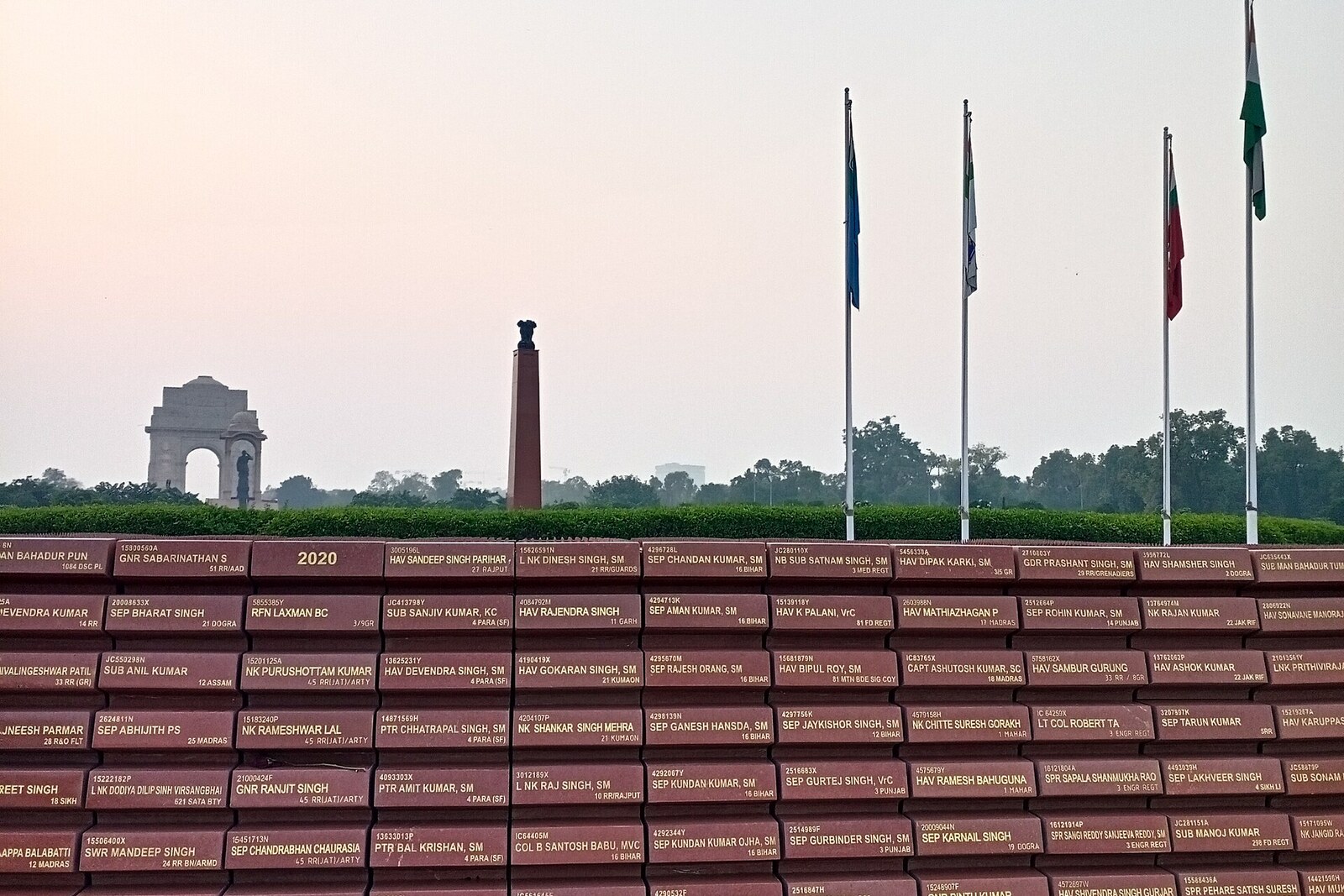
Look around first
What to notice
- Central obelisk
- Eternal flame
- Concentric granite walls
- Plaques with names in gold
The story of the place
The names of service members of independent India who died in wars and operations had not previously been collected in the capital on a single nationwide list. A memorial for them opened beside India Gate in two thousand nineteen; the walls of the arch itself bear the names of people from earlier wars of the British period. The architects set its main elements below the lawns so that the walls would not obscure the arch. In Tyag Chakra, the circle of sacrifice, granite walls form rings in which each person who died has their own plaque; an obelisk with an eternal flame stands at the center.
On December first, two thousand twenty-one, Phool Wati Devi came here to a single granite plaque. Its gold letters bear the surname S. S. Malhan, his military rank, and his service number. She placed petals at her husband’s name, then laid a wreath. By then, he had been dead for almost fifty years.
S. S. Malhan served as a senior ship’s mechanic aboard the anti-submarine frigate INS Khukri. On December ninth, nineteen seventy-one, the frigate was searching for a Pakistani submarine off the coast of Diu. The submarine torpedoed INS Khukri, and the ship began to go under quickly.
The frigate’s commander, Captain Mahendra Nath Mulla, ordered the crew to leave the ship and directed the rescue of the people. Having sent overboard those who could still be helped, he returned to the bridge. That was where he was last seen. The captain, eighteen officers, and one hundred seventy-six sailors died, including the mechanic S. S. Malhan. The wreck of INS Khukri remained about one hundred nautical miles from Diu, at a depth of around eighty meters.
The National War Memorial was opened here in two thousand nineteen for service members killed in the wars and operations of independent India. The arch of nearby India Gate bears the names of participants in earlier wars of the British period; before this, no separate nationwide list in the capital existed for S. S. Malhan and thousands of his fellow service members.
The designers set the memorial below the level of the surrounding lawns so that it would not block India Gate. The names were placed in Tyag Chakra, the “circle of sacrifice”: rings of walls with a separate plaque for each person who died. Closer to the center stands an obelisk with an eternal flame.
After the opening, military organizers began inviting relatives of the fallen here. Before the evening ceremony, one of them lays a wreath at the obelisk; then the flags of the army, navy, and air force are lowered. Phool Wati Devi followed the same route from the plaque bearing her husband’s name to the wreath by the flame. Three dry lines remained on the wall: S. S. Malhan, senior mechanic, his service number.
Useful on site
Free entry; seasonal hours on the official website: November–March from 09:00 to 19:30, last entry 19:00; April–October from 09:00 to 20:30, last entry 20:00; restrictions are possible. Checked 2026-06-30.
Checked: June 30, 2026. Check the official source before visiting.Walk through the memorial quietly and follow the marked direction of movement. The evening ceremony is not guaranteed; even without it, allow time for the names, the reliefs, and the separate area with busts.