 Guide On Map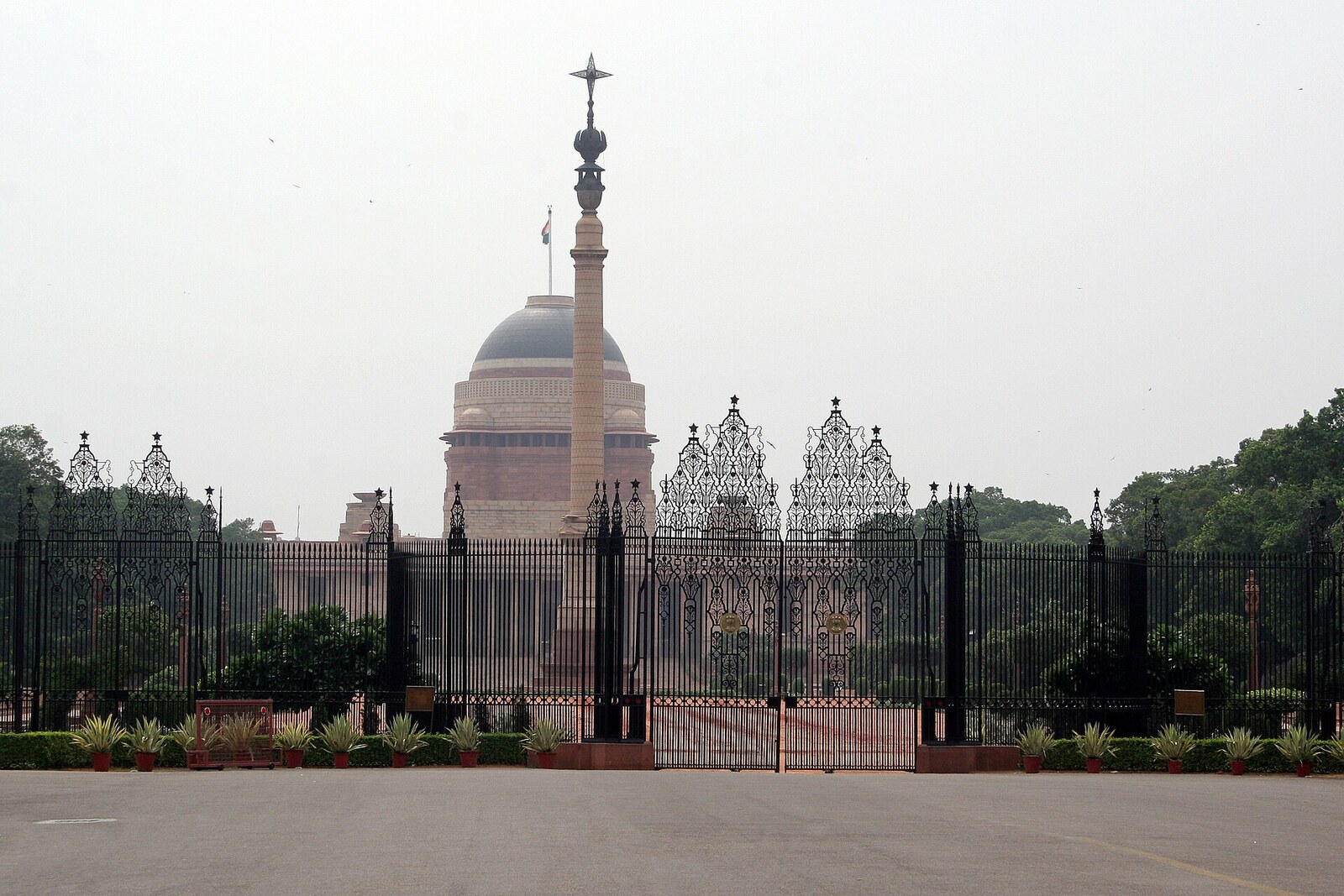
Look around first
What to notice
- Central dome
- 31 steps of the portico
- Column with a bronze lotus
- Glass Star of India
The story of the place
The long approach leads through the courtyard to a broad staircase and a portico beneath the central dome: this entire route was conceived to mark, even before a conversation, the difference between the one who receives and the one who comes with a request. Jaipur Column rises in the center of the courtyard, paid for by the ruler of the princely state of the same name to mark the transfer of the capital from Calcutta to Delhi and as a sign of loyalty to the British Crown. Above its sandstone shaft, a bronze lotus bears the six-pointed glass Star of India, while inside, a steel tube holds the heavy top connected to the foundation. The palace now houses the official residence of the President of India, where oaths of office, award ceremonies, and receptions for foreign leaders take place.
In February nineteen thirty-one, Mohandas Gandhi climbed the thirty-one steps beneath this portico. He led the civil disobedience campaign that sought the repeal of colonial restrictions and the release of arrested members of the movement. The palace was then called Viceroy's House. Lord Irwin lived here, as the representative of the British monarch and head of the administration of British India.
Gandhi arrived here directly from a political struggle in which an everyday product had become grounds for a prison term. In the spring of the previous year, he walked to the sea and publicly broke the state monopoly on salt. He was arrested, but the protests continued, and prisons filled with campaign participants. At the same time, the British government was trying to discuss India's future at a conference in London. Without the Indian National Congress, whose leaders were in prison, it proved almost impossible to agree on anything.
On January twenty-sixth, Gandhi was released from Yerwada Prison. Irwin needed to end the disobedience and bring representatives of the Congress to the next London conference. Gandhi wanted to secure the release of prisoners, the return of confiscated property, the right to make salt, and an end to repression. On February seventeenth, they began negotiations at Viceroy's House.
By March fifth, they had held eight meetings. They argued over the release of people, peasants' land, and an investigation into police actions. Irwin refused to order such an investigation. Gandhi yielded, although he regarded that very demand as a test of whether the government was truly changing course. Even a single verb had to be agreed separately. Gandhi did not want to promise a final renunciation of civil disobedience: for people without an army or public office, it remained the only means of pressure. The official text included the word “discontinue,” although Gandhi himself understood the agreement as a truce.
On March fifth, Gandhi and Irwin signed the pact here, at Viceroy's House. The Congress halted the campaign and agreed to take part in the conference. The government repealed the emergency ordinances connected with it, permitted residents of certain coastal areas to collect and produce salt, promised to return confiscated property that had not yet been sold, and to release prisoners not convicted of violence.
Gandhi's very appearance on these steps provoked fury in Britain. Winston Churchill was outraged that a man in a simple loincloth entered the palace and spoke as an equal with the representative of the King-Emperor. The architecture was designed to create the opposite impression: the long approach, the column in the center of the courtyard, the broad staircase, the portico, and the dome were meant to determine in advance who received and who came to make a request. Yet Irwin had to negotiate with a man whom his own administration had recently held in prison.
The truce proved short-lived. Gandhi went to London as the Congress's only official representative, but the conference did not settle the question of India's future governance. He returned disappointed, and on January fourth, nineteen thirty-two, he was arrested again. By then Irwin had already left India; his successor began a new campaign to suppress civil disobedience. The pact signed at the palace did not end the confrontation, but for several months it opened the prisons and brought the Congress to the negotiating table.
After independence was proclaimed, Viceroy's House was renamed Government House. On January twenty-sixth, nineteen fifty, India became a republic, Rajendra Prasad took office as president, and the building received its present name: Rashtrapati Bhavan, meaning the President's House. It is the official residence of the head of state, where oaths of office, award ceremonies, and receptions for foreign leaders take place.
The column in front of the palace retained the name of one of those involved in creating the imperial capital. It is called Jaipur Column because Sawai Madho Singh II, the Maharaja of the princely state of Jaipur, paid for its construction. He presented the column to mark the transfer of the capital from Calcutta to Delhi and as a sign of his loyalty to the British Crown. On December fifteenth, nineteen eleven, King George V and Queen Mary laid the first stone.
Above the column's sandstone shaft stands a bronze lotus weighing about five tons, and from it rises the six-pointed glass Star of India. A steel tube runs inside, linking the heavy top to a block in the foundation. On the eastern side, a map of the planned New Delhi of that time is carved. The Maharaja paid for the monument with his loyalty; his princely state disappeared from the political map, while the name Jaipur remained in the middle of the forecourt of the President's House.
Useful on site
Exterior viewing from the public axis is possible under normal city access; interior routes and ceremonies are only available according to current booking and security arrangements. Checked 2026-06-30.
Checked: June 30, 2026. Check the official source before visiting.View the ensemble from the accessible distance: approaching the presidential residence closely is not part of the walk. Conditions for visiting the changing of the guard are checked separately.