 Guide On Map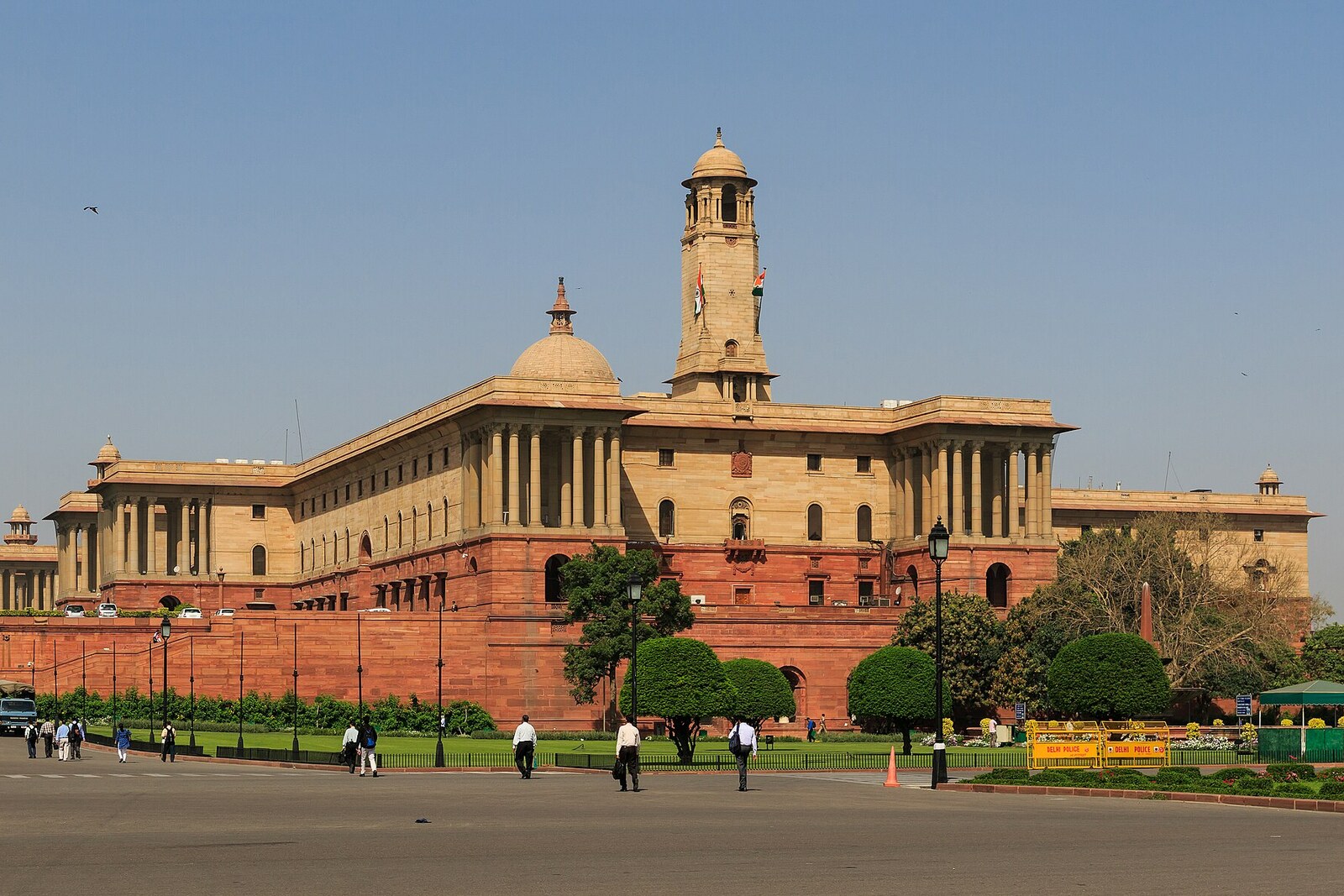
Look around first
What to notice
- The dome of Rashtrapati Bhavan above the ridge
- Two symmetrical buildings
- Chhatris on the roofs
- The steep gradient of the road
The story of the place
Between the North Block and South Block lies a short, steep ascent to Viceroy's House. Because of this ascent, two architects who began the work as friends parted as enemies.
When the British government moved the capital from Calcutta to Delhi, Edwin Lutyens, the chief planner of the new city, was assigned Viceroy's House. His partner Herbert Baker received the Secretariat—two buildings for the central departments. At first, the government buildings were to be placed lower down the slope. Baker secured a different arrangement: the North Block and South Block were to rise to the summit of Raisina Hill and form a single group with the residence. Lutyens agreed.
In early nineteen fourteen, he signed the detailed plans. They already marked the position of the road between the blocks, its width, and its gradient. Almost two years later, when the builders had made considerable progress, Lutyens understood what he had failed to notice on paper. The road rose so sharply that, from a distance, the lower part of his Viceroy's House disappeared behind the ridge. Above the Secretariat buildings, mainly the dome remained visible.
For Lutyens, this was a blow to the work on which his professional reputation rested. He had envisioned a long approach during which the residence would remain in view. Now Baker's buildings became the main spectacle, while Lutyens's own façade appeared only at the very summit.
Lutyens demanded that the road be lowered and the slope cut deeper. Viceroy Charles Hardinge, who was responsible for construction and costs, refused: the alteration would have cost too much, and a gentler cutting would have made communication between the two halves of the Secretariat more difficult. Hardinge reminded him that Lutyens himself had approved the plans and had discovered the obvious consequence too late.
Lutyens nevertheless placed the blame on Baker. He called his defeat “Bakerloo,” combining his partner's surname with Waterloo, and their friendship was never restored.
The North Block and South Block fulfilled precisely the purpose for which Baker had raised them onto the hill: they housed ministries and the offices of senior officials. After India gained independence, new civil servants occupied the same corridors. In two thousand twenty-six, departments began moving into other buildings, vacating the old Secretariat for a future museum. The steep ascent between the blocks has remained unchanged: the lower façade of Viceroy's House is still hidden behind the ridge, and the dome appears above it.
Useful on site
Exterior viewing from public areas; access and passage depend on the security regime, government events, and transitional-period works. Checked 2026-06-30.
Checked: June 30, 2026. Check the official source before visiting.This is an outdoor stop at the government complex. Do not look for an entrance; instead, change position and watch how the slope hides and reveals the palace again.