 Guide On Map
San Blas: Cusco's artisan hillside
From Hatun Rumiyoc through the square and workshops to Qosqo Qhawarina Viewpoint
Guide On Map on your phone
Open the walk like a regular app
It takes about 10 seconds to install. No app store needed.
The whole path
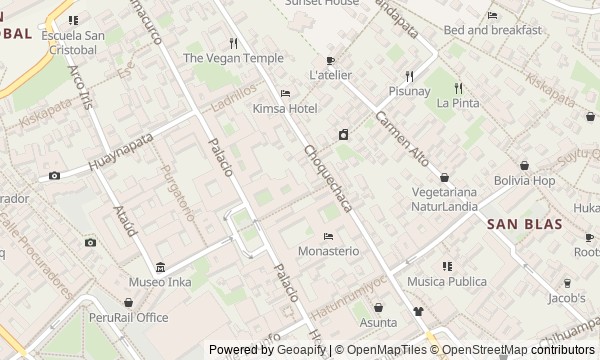
Route map
About the walk
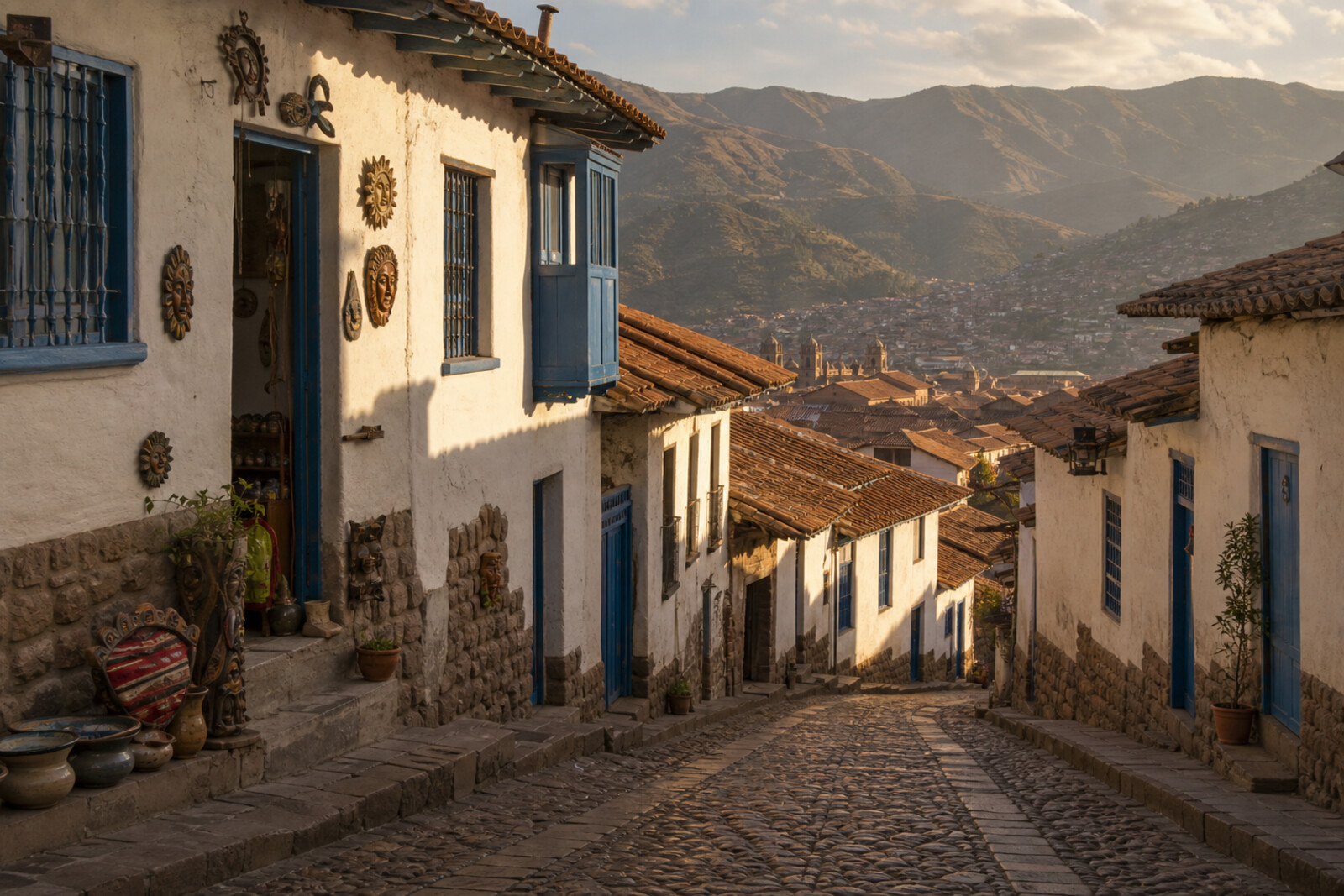
You will walk uphill from the Inca wall on Hatun Rumiyoc into San Blas, finishing on a public terrace above the city. At first, the way is narrow and steep: stonework, Cuesta de San Blas, the square, and a small church. Then it opens out into workshops, residential streets, and lanes with little angels and little devils.
This is not a walk through Cusco at its most ceremonial, but along a hillside that people have constantly remade and defended. Why does the famous stone bear fresh scars? What flows beneath an ordinary intersection? Whose skull ended up high on the pulpit, and why did one beautiful little figure make an artisan start again?
The story will calmly separate documents from legends. You will hear about craft, water, inheritance, and the right to a place in the city. By the end, you will read San Blas through its joins: between Inca stonework and colonial houses, family workshops and the street, private hillside and shared viewpoint.
Why this order
Hatun Rumiyoc marks the route's lower boundary: from the Inca wall, the path enters Cuesta de San Blas, its continuation, with the former river hidden beneath its beginning. The climb ends at the square; the vanished Inca layer here prepares the way for the pulpit—a work whose design survives, but not its maker's name. After the church's carving, neighboring workshops show how families brought sacred images into domestic craft. From the artisans' homes, Carmen Alto and Tandapata widen the story to the entire hillside—its water, terraces, and women's community. From Tandapata, the route enters Siete Angelitos and Siete Diablitos, where residents linked the names to a painted cornice and a neighborhood legend. Then Pasñapakana leads to Qosqo Qhawarina Viewpoint: from above, the whole hillside you have crossed appears as a place its residents remade and reclaimed.
Those interested in the living San Blas beyond its craft shops Those who enjoy stories of objects, families, and urban disputes Those ready to climb old streets for a satisfying finish
Those who avoid steep cobbled climbs Those looking for a route limited to Cusco's main squares Those expecting an overview of crafts without difficult episodes
Before you go
Cusco sits at roughly 3400 meters, so leave yourself some energy and do not turn the climb into a race. Bring water, sun protection, and shoes with good grip: the stone can be slippery after rain. On narrow streets, stay close to the wall when a car approaches, but do not block the doors of residential houses. The church and family workshops may be closed for services, restoration, or their own schedules; treat entry as a possible extra, not a condition of the whole walk.
When to go
1.5–3 hours
Backup plan
If the climb feels too demanding, end the meaningful short version at Plazoleta de San Blas after the first three stops. If the church is closed, view the facade and continue to the workshops; if family spaces are not receiving visitors, do not insist and focus on the street and the differences between the artistic traditions described in the story. In rain, shorten the loop through the lanes: wet stone calls for an especially slow pace. If you are tired, you can skip the side streets and continue to the final viewpoint only if you feel able to keep climbing.
Route conditions
Surface. Paved — 1.9 km; unpaved — 109 m (data covers 82% of the route)
Stairs. Flights: 5, 180 m in total
Access. Wheelchair — no; stroller — limited (stairs)
Facilities. Toilets — 2; drinking water — 1
Elevation. Ascent — 101 m; descent — 60 m
OpenStreetMap extract of June 25, 2026: database data, not a check on the ground. Data © OpenStreetMap contributors, ODbL licence
Walk plan
Open in maps ↗- 1
Hatun Rumiyoc and the Twelve-Angled Stone
Here, the route begins with Inca masonry, where ancient precision stands beside irreversible modern damage. - 2
Cuesta de San Blas
The climb shows how builders hid the water and turned the site of an old bridge into an ordinary intersection. - 3
Plazoleta de San Blas
The square will restore the route's Inca layer, of which almost nothing remains on the surface. - 4
The Church of San Blas and Its Pulpit
The pulpit makes it possible to distinguish a documented commission from the beautiful but unproven biography of its carver. - 5
The Mendívil and Mérida Workshops
Two neighboring workshops show how family work transformed religious figures and outlived their founders. - 6
Carmen Alto and Tandapata
Two streets will connect the everyday history of water with a women's community's struggle for closed doors and a good name. - 7
Siete Angelitos and Siete Diablitos
The alleys show how paintings on a cornice can displace an old city name. - 8
Qosqo Qhawarina Viewpoint
The final terrace explains why the open view of Cusco had to be returned to city residents twice.
Route features
Everything you need stays in the browser
Progress, saves and your trip plan are stored on this device.
Add Guide On Map to your home screen so the walk opens outside the browser.
How we handle sources, maps and corrections: our editorial standards