 Guide On Map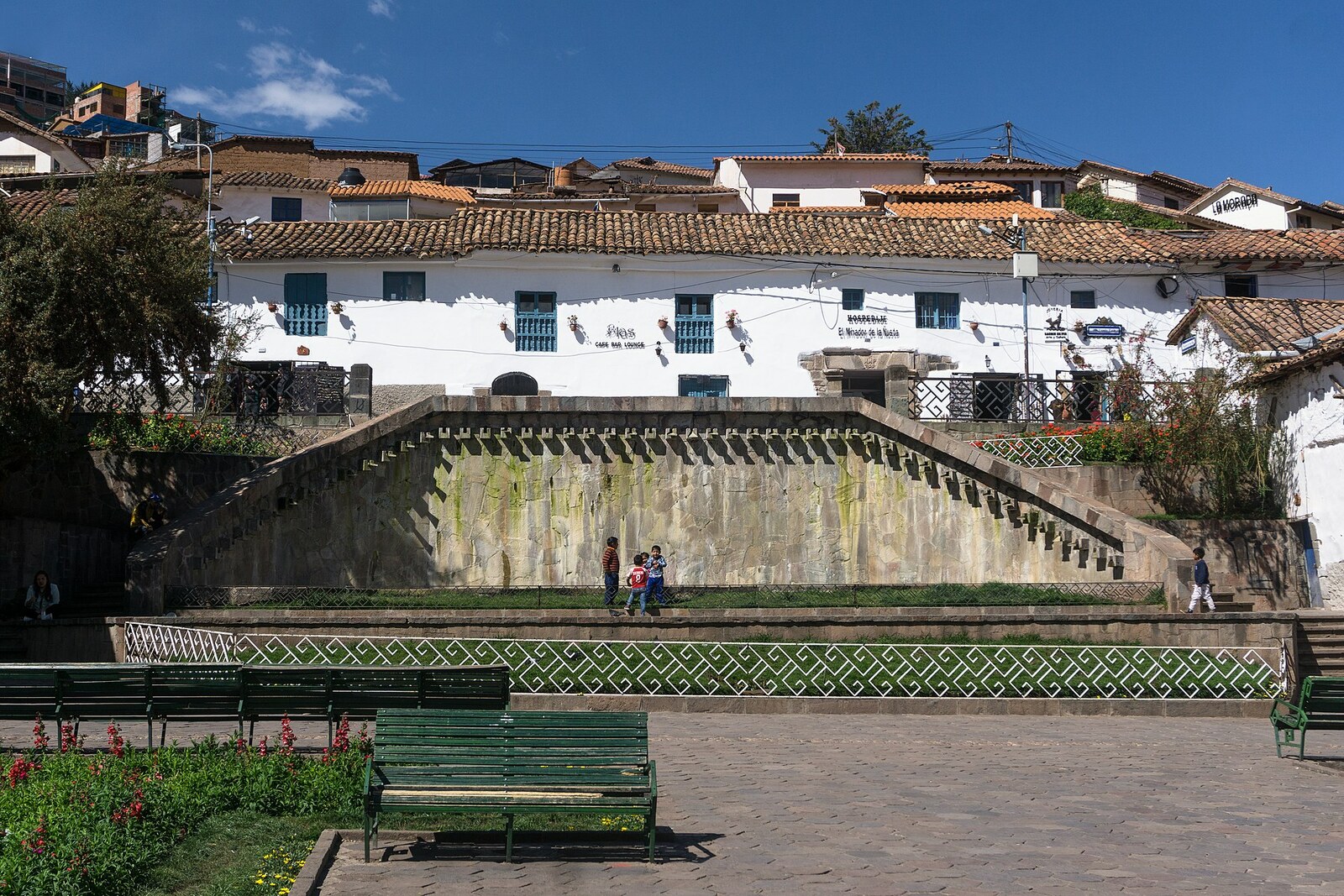
Look around first
What to notice
- The square's open space
- The façade of the Church of San Blas
- Stone paving
- The edge of the square by the church
The story of the place
Beside the church's stone façade opens a small square, which the parish made its public center and the endpoint of a festive procession. The entire district takes its name from the parish—in honor of Saint Blaise, bishop of Armenian Sebaste, executed for the Christian faith. Stone paving leads from here from the steep San Blas ascent to Tandapata and Carmen Alto; people arrange meetings here and display paintings and handicrafts. The old Rayampata once stood at the edge of the square now occupied by the church.
Between fifteen fifty-one and fifteen fifty-nine, custodians moved the mummy of Pachacuti here, to Tococachi—an Inca under whom Cusco became the capital of a rapidly growing empire. Chroniclers did not record who ordered the move.
For Pachacuti's descendants, this was a matter of family property and their own livelihood. The lands of a deceased ruler did not pass to the next Inca: they were managed by his kin community, the panaca. Relatives preserved the body, served it food and drink every day, addressed it through interpreters, and lived from the estates assigned to it. To lose the mummy meant losing the center of this economy and cult.
The body was placed in a sanctuary that stood in the area of today's square and church. Here stood a statue of Inti Illapa—the Solar Thunder—cast in gold. Pachacuti commissioned it himself and called it his brother. People asked the statue to preserve the strength of the Inca and his realm. Researchers suppose that this was precisely why the custodians chose Tococachi: the deceased ruler was hidden beside his golden double. It is a convincing version, but there is no direct evidence of the motive for the move.
In fifteen fifty-nine, the city magistrate Juan Polo de Ondegardo found the mummy in Tococachi and took it from the panaca. At the beginning of the following year, the body was sent to Lima together with the remains of other rulers. They were placed in San Andrés Hospital, intended for Spaniards, and shown to the Spanish public. Pachacuti was described as having gray hair, an old wound on his head, and thin gold plates in place of eyes. By the end of the sixteenth century, eyewitnesses were already calling the bodies damaged and worn away. They then disappeared; later searches beneath the former hospital produced no result.
After the parish was established, the open square became its public center and the endpoint of the procession on the patron saint's day. The current name derives from him. San Blas is the Spanish name for Saint Blaise, bishop of Armenian Sebaste, executed for the Christian faith. The parish was named for him, then the square and the entire district.
Today, paintings and handicrafts are displayed here, meetings are arranged, and people pass from Cuesta de San Blas to the streets of Tandapata and Carmen Alto. No confirmed physical trace of the Inca sanctuary, the golden Inti Illapa, or the mummy of Pachacuti remains in the square. Only their spatial connection is known: they were kept in the old Rayampata, at the edge of the square where the Church of San Blas was later built.
Useful on site
Open square; stalls, cafés, and fair stands operate on separate schedules.
Checked: June 28, 2026. Check the official source before visiting.Choose a place at the edge of the square without blocking the church entrance or residents passing through; during a festival, yield the way to the procession.