 Guide On Map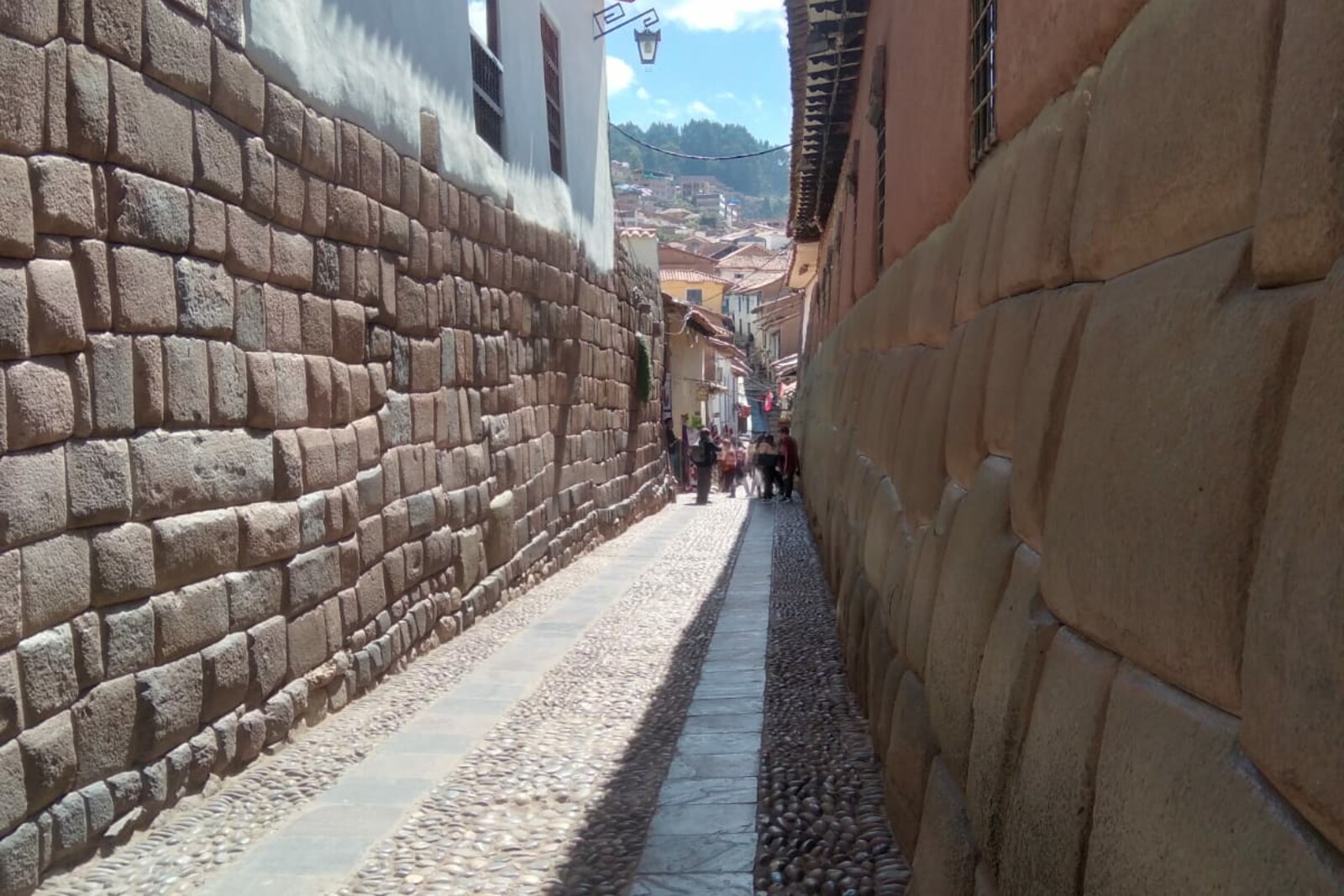
Look around first
What to notice
- Twelve-Angled Stone block
- Joints with neighboring stones
- Impact marks on the front face
- Colonial stories above the Inca wall
The story of the place
On the night of February eighteenth, two thousand twenty-five, Gabriel Mariano Roysi Melanio headed straight for the best-known stone in this wall. He made a living selling his own handicrafts: he sold them here, on Hatun Rumiyoc, and farther uphill, in the San Blas neighborhood. The stone and the groups gathering near it were part of his usual workplace. That night, Roysi Melanio was drunk. He took a hammer from his backpack and struck the front face of the block several times. The investigation established no clear motive.
This block belongs to an Inca wall traditionally associated with the Palace of Inca Roca, a ruler of Cusco who lived before the city became the capital of a vast empire. Stoneworkers shaped each boulder to fit its neighbors and joined them without mortar. The famous block's twelve angles are twelve turns in its outline, twelve areas of contact with the stones around it. They arose within the overall masonry, not as a separate symbol carved into the surface. Sources have preserved no reliable explanation for why this block ended up with exactly twelve angles.
The street's name also refers to the wall: in Quechua, Hatun Rumiyoc means “where there is a large stone.” After the Spanish conquest, Vicente de Valverde, the first bishop of Cusco, settled on the site of the palace. Later ecclesiastical owners built colonial stories above the Inca masonry. The Archbishop's Palace of Cusco and the Museum of Religious Art of Cusco are now here, but the stone itself has remained outside, in an open pedestrian passage. Guides singled out one complex block from the entire wall, travelers made it a must-see place for photographs, and craftspeople sell beside the stream of visitors.
Cameras recorded the attack. A passerby noticed the damage in the morning; vendors recognized the man in the recording as a local street craftsperson. About ten hours later, police found Roysi Melanio in San Blas, a few blocks from here. He still had the hammer with him. The detainee had no permanent address, and the court decided that he might flee: he was held in custody for six months pending the investigation. The Ministry of Culture of Peru demanded compensation of five million three hundred fifty thousand soles. In court, the defendant said that he regretted what he had done.
Specialists counted six visible impact zones on the stone. Fragments chipped off the surface, and in several places the old patina disappeared, exposing the inner rock. It is impossible to restore the removed layer with its former texture, so the damage was deemed irreversible. The twelve old joints still connect the block to neighboring stones; the hammer marks now lie within the same outline.
Useful on site
Exterior viewing from the street; no ticket or interior access required.
Checked: June 28, 2026. Check the official source before visiting.Do not touch the stone or hold up the flow on the narrow street; the details are clearly visible from a short distance.