 Guide On Map
Chicago Along the River: Bridges, Towers, and the Loop
From DuSable Bridge (formerly Michigan Avenue Bridge), along the Chicago River to LaSalle Street and the Chicago Board of Trade
Guide On Map on your phone
Open the walk like a regular app
It takes about 10 seconds to install. No app store needed.
The whole path
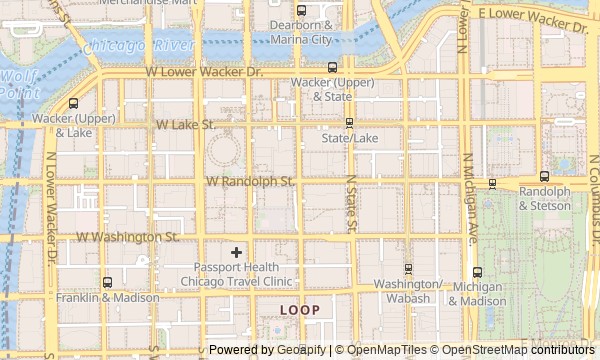
Route map
About the walk
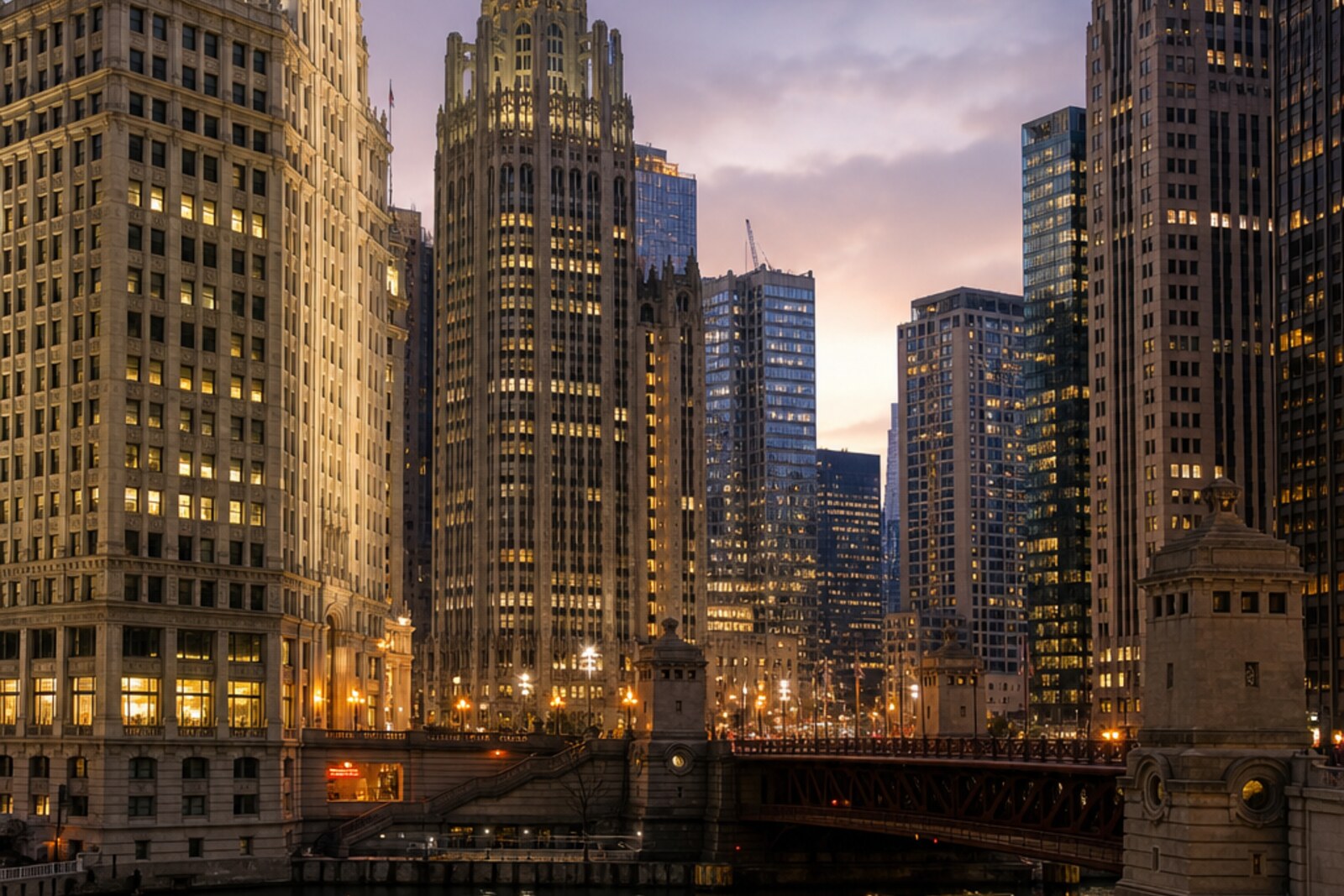
You will begin above the Chicago River, at a double-leaf bridge, then follow the water between a white clock tower, a Gothic crown, riverside steps, round residential towers, and an enormous commercial building. The route will then turn into the Loop and enter the stone corridor of LaSalle Street, where the view ends at the Chicago Board of Trade Building.
This walk is not about styles. It is about gambles. Why would an advertising man turn down a sign on the most conspicuous facade? Why would a union leader bring a railroad tie to a construction site? How could a building raised for a dying business make a fortune for later owners? And why would the entire continent have to reset its clocks after a meeting at a hotel?
The story runs on chases, competitions, failures, and rescues—without the polished legend of skyscrapers. By the end, you will see Chicago's skyline as a chain of risky decisions: who paid, who got it wrong, and who came away with the result.
Why this order
DuSable Bridge (formerly Michigan Avenue Bridge) comes first because it shows how the new crossing extended Michigan Avenue north. Just beyond the bridge, Wrigley Building reveals the first commercial gamble on that crossing, while Tribune Tower opposite shows how the neighboring parcel became an architectural competition. Crossing back over the bridge and descending to the Chicago Riverwalk shifts the story from facades to the river itself and its former docks. From there, the crossing to the north bank leads to Marina City: after office towers comes an attempt to bring residents back downtown. Continuing west toward theMART (formerly the Merchandise Mart) carries on the theme of a major investment, now on the scale of wholesale trade. Wells Street Bridge takes you from river projects to the institutions of the Loop. LaSalle Street first explains how the city agreed on a common time, and its enclosed perspective inevitably leads to the Chicago Board of Trade—the place where market rules were agreed as well.
Those interested in architecture through the fortunes of money and decisions Those who want to walk along the river, then enter the business Loop Those who prefer specific city stories to a list of styles
Those expecting an overview of all of Chicago's major skyscrapers Those looking for a walk only along the waterfront Those who prefer a light story without disasters, failures, and financial conflicts
Before you go
Almost the entire story is designed to be seen from the street: entry to the residential towers, offices, and exchange building is not expected. It is usually colder and windier by the river than between the blocks, so bring an extra layer even on a clear day. The Chicago Riverwalk has stairs, wet decking, and narrow points by the supports; after rain, move more slowly. A bridge opening, riverwalk maintenance, or temporary barriers may alter the passage—use the nearest open exit to the upper level and do not go beyond barriers.
When to go
Set aside about two and a half hours for the route. If you spend time studying the stones of Tribune Tower, the bridge reliefs, and the details of LaSalle Street, the walk will naturally stretch to about three. During the day, it is easier to make out small facade details; toward evening, the depth of the street canyon and the light on the water become more pronounced.
Backup plan
In strong wind, heavy rain, or on slippery decking, do not descend to the Chicago Riverwalk: see the bridge, Wrigley Building, and Tribune Tower from the upper sidewalks, then continue along the upper street level while keeping Marina City and theMART (formerly the Merchandise Mart) in view. After that, head into the Loop to LaSalle Street and complete the final two stops. If only one river section is closed, go up before the barrier and descend again only at a clearly open access point; the route's content will not be lost with this detour.
Route conditions
Surface. Paved — 1.9 km (data covers 63% of the route)
Stairs. Flights: 2, 15 m in total
Access. Wheelchair — no; stroller — limited (stairs)
Facilities. Toilets — 3
Elevation. Ascent — 150 m; descent — 89 m
OpenStreetMap extract of June 18, 2026: database data, not a check on the ground. Data © OpenStreetMap contributors, ODbL licence
Walk plan
Open in maps ↗- 1
DuSable Bridge (formerly Michigan Avenue Bridge)
Here you will understand how one crossing simultaneously changed the city's geography and gave a fugitive a few extra seconds. - 2
Wrigley Building
This stop will show how the building became an advertisement precisely after the decision not to put advertising on it. - 3
Tribune Tower
Here, an architectural competition becomes both a newspaper event, a calculation for rental income, and a turning point in the winner's career. - 4
Chicago Riverwalk
The quiet steps by the water will help reconstruct the story of a vessel that never had time to leave the dock. - 5
Marina City
The complex makes it possible to examine the dispute over whether workers' money can both save downtown and earn income for them. - 6
theMART
The enormous structure shows how the failure of an original plan became the foundation of someone else’s fortune. - 7
LaSalle Street Canyon
Here, a narrow banking street leads to the decision after which cities stopped setting their own noon times. - 8
Chicago Board of Trade Building
The final stop will examine the moment when the exchange made the largest buyer retreat and itself set the limit of an acceptable transaction.
Route features
Everything you need stays in the browser
Progress, saves and your trip plan are stored on this device.
Add Guide On Map to your home screen so the walk opens outside the browser.
How we handle sources, maps and corrections: our editorial standards