 Guide On Map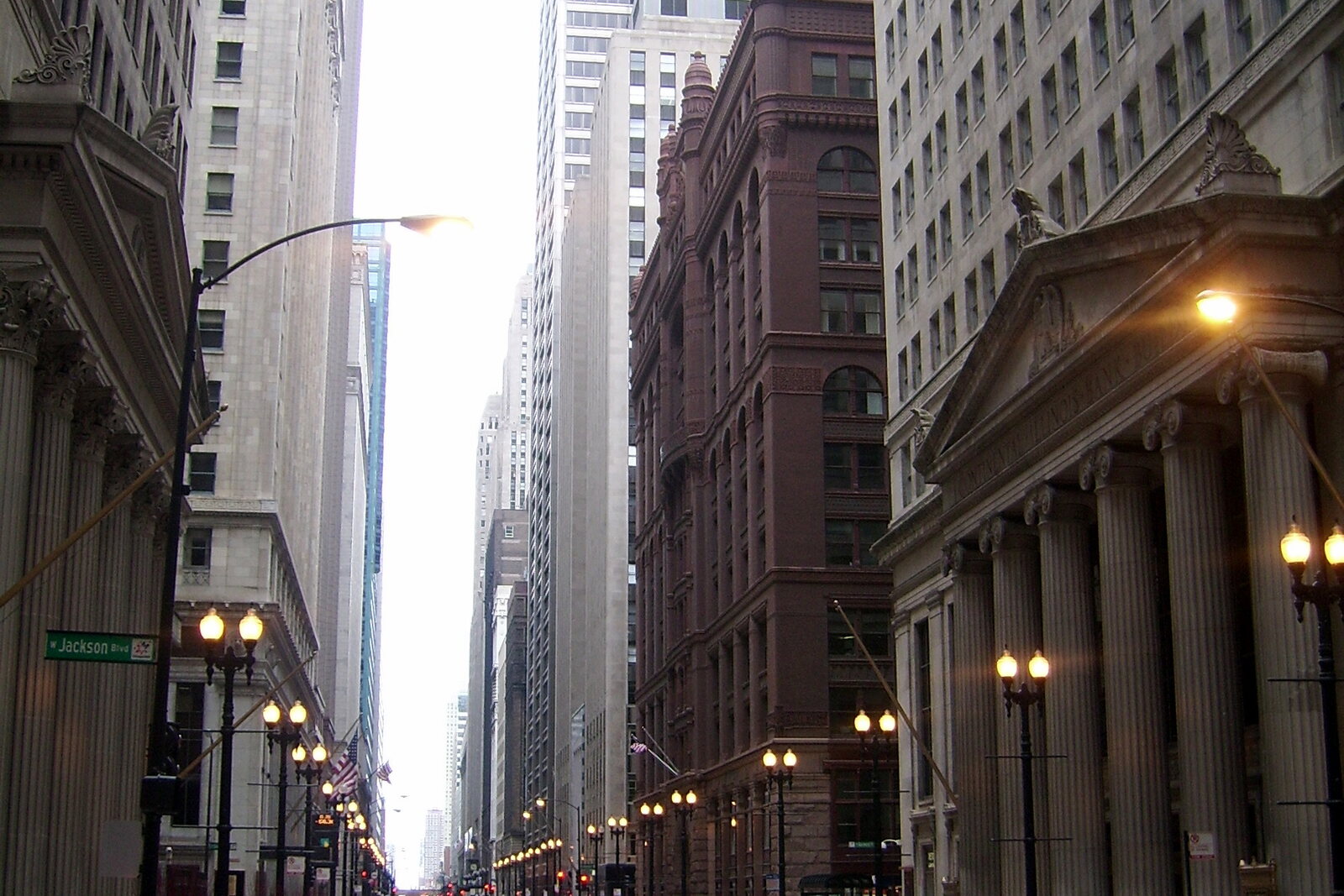
Look around first
What to notice
- Unbroken walls of tall buildings
- The enclosed view along the street
- The Jackson Boulevard facade
- The commemorative plaque
The story of the place
Where LaSalle Street reaches Jackson Boulevard, the banking building The Central Standard Building now stands in place of the Grand Pacific Hotel. The hotel accommodated railroad-line owners, their employees, and passengers: the country's most important routes passed through Chicago. The building became part of the wall of tall banking buildings that turned this section of the street into a narrow passage between facades. On the Jackson Boulevard side, a small plaque marks a room that no longer exists.
Tall banking buildings stand along narrow LaSalle Street like almost unbroken walls, while the Chicago Board of Trade closes off the view from the south. This three-block stretch is what they call the canyon. The street is named after the French explorer René-Robert Cavelier de La Salle, who visited the Chicago area in the seventeenth century. Yet the main decision made here concerned not space, but time.
The Grand Pacific Hotel once stood at the corner of LaSalle Street and Jackson Boulevard. In the fall of eighteen eighty-three, managers from about thirty railroad companies gathered here. Chicago was chosen because the country's most important lines converged here, and the hotel served their owners, employees, and passengers.
At the time, each city set noon by the sun. The railroads used about fifty different versions of time. A train could depart by one company's clock, cross onto a line that lived by another clock, and arrive in a city with its own noon. For dispatchers, this meant the risk of putting two trains on the same track.
William Frederick Allen, secretary of the railroad convention and publisher of a monthly guide to passenger schedules, was tasked with sorting it out. He made his living from the accuracy of those tables; discrepancies between clocks were his daily work and a professional risk. Allen surveyed the railroad managers and proposed calculating time by meridians fifteen degrees apart: neighboring zones differed by exactly one hour.
On October eleventh, eighteen eighty-three, the managers gathered at the Grand Pacific Hotel and adopted his plan. On November eighteenth, the companies reset their station clocks simultaneously. Chicago had to experience noon twice: the new Central Time lagged nine minutes thirty-two seconds behind the former local time. Allen's December issue of the guide had already appeared with a map of the zones and revised schedules. Cities quickly began to live by railroad time; the system was not established by federal law until nineteen eighteen.
The hotel was later demolished, and in nineteen twenty-four its site was taken by a huge banking building—one of the walls of the future canyon. It is now called The Central Standard Building. A small plaque hangs on the Jackson Boulevard facade: the room where Allen persuaded the railroad managers to put the continent on a common time stood directly beneath this building.
Useful on site
Public street; most striking during business hours and before sunset.
Checked: June 29, 2026. Check the official source before visiting.The overall effect is best experienced from the sidewalk along a long stretch of the street. Plan visits to lobbies or interior tours separately.