 Guide On Map
The Pyramids of Giza: From Khufu to the Sphinx
From the Great Pyramid of Giza across the plateau to the Great Sphinx of Giza
Guide On Map on your phone
Open the walk like a regular app
It takes about 10 seconds to install. No app store needed.
The whole path
Route map
About the walk
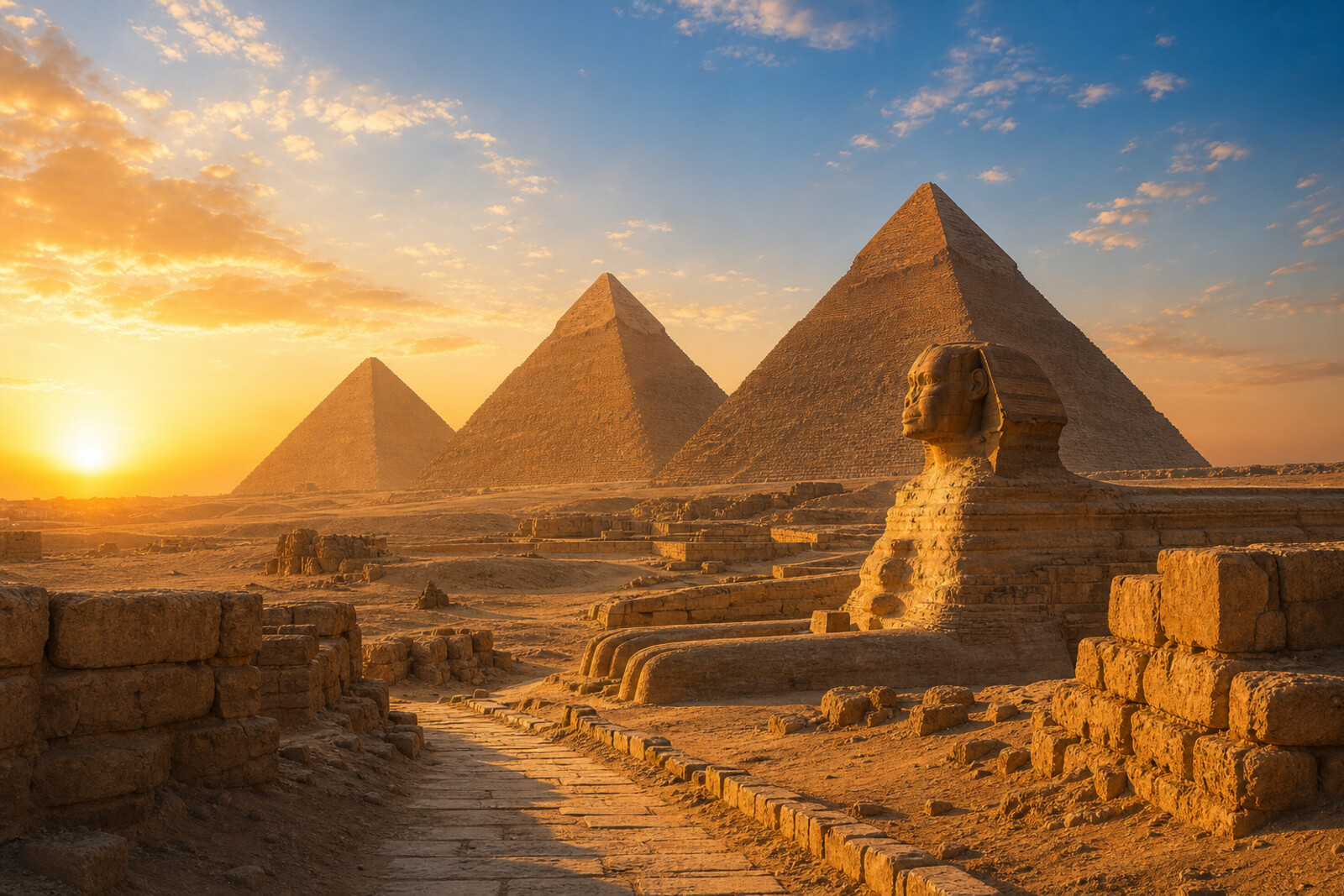
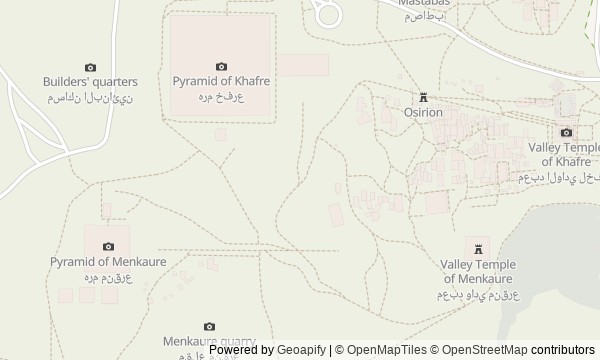
You will begin at the Great Pyramid of Giza, pass through the royal necropolis to the Pyramid of Khafre, reach the southwestern edge of the plateau, then descend to the temple and the Great Sphinx of Giza. The route will connect monumental silhouettes with things that are easy to miss: red workers' marks, empty spaces left by statues, a deep break in the stone, and a granite slab between the paws.
Instead of a general account of the wonders of the world, you will hear about the people who built, searched for entrances, photographed, dismantled, and reinterpreted these monuments. Why did workers think one explorer was mad? Why did a mother have to give her own sarcophagus to her daughter? What was discovered on the reverse of a royal stela? The answers wait at the stops.
By the end, you will see more than three pyramids and the Great Sphinx of Giza on the plateau. You will recognize several royal complexes and read the traces of ancient construction, later openings, and new interpretations.
Why this order
Beginning at the Great Pyramid of Giza introduces the upper part of the royal complex; the neighboring mastabas of the Eastern Cemetery immediately show who was allowed to rest beside the king. From the family burials, the route turns toward the next great pyramid, the Pyramid of Khafre. Its higher position and surviving casing make it possible to compare the two complexes before distance changes their scale. From Khafre, the walk continues to a southwestern panorama, where all three pyramids first align in a single row. The Pyramid of Menkaure, closest to the viewpoint, brings your eye back from the overall silhouette to its damaged northern face. The route then descends along Khafre's complex: the Valley Temple of Khafre explains the pyramid's connection to the lower plateau, while the neighboring Great Sphinx of Giza completes the walk between the temple, the ancient causeway, and the granite stela.
Those who want to walk the entire plateau rather than view the pyramids from one spot Those interested in archaeological discoveries and human mistakes Those who prefer specific stories to a broad overview of Ancient Egypt
Those looking for a short walk around a single monument Those who dislike long crossings over an open plateau Those expecting a detailed account of the whole history of Ancient Egypt
Before you go
Bring plenty of water, cover your head and shoulders from the sun, apply sunscreen, and choose shoes that grip well on dust and stone. Entering the pyramids is not necessary to understand the route: there is little space and almost no decoration inside, while access is arranged separately and may change. Bring a zoom lens or binoculars for details on the Great Sphinx of Giza and the upper casing of Khafre. Keep your camera and phone in a closable case, since fine sand easily gets into ports and mechanisms.
When to go
Start in the morning and save some energy for the second half of the route: the panoramic section and the descent to Khafre's complex take more time than the map suggests. In the midday heat, shorten listening at fully exposed spots and move pauses to places where you can safely step aside from the flow of visitors.
Backup plan
If individual tombs or passages are closed, do not change the idea of the walk: every stop has strong exterior features—the masonry of Khufu, the silhouettes of mastabas, the casing of Khafre, the granite of Menkaure, and the damage to the Great Sphinx of Giza. In severe heat, skip optional approaches to the faces and focus on several clearly legible viewpoints. If the official panoramic platform is unavailable, find a permitted spot from which all three pyramids can be seen at once; comparing their height and position matters more than reproducing a particular photograph.
Route conditions
Surface. Unpaved — 1.1 km; paved — 635 m (data covers 34% of the route)
Access. Wheelchair — limited; stroller — limited
Facilities. Toilets — 1
Elevation. Ascent — 43 m; descent — 96 m
OpenStreetMap extract of June 25, 2026: database data, not a check on the ground. Data © OpenStreetMap contributors, ODbL licence
Walk plan
Open in maps ↗- 1
Great Pyramid of Giza
Here, ancient workers’ markings will prove more convincing than treasures that were never found. - 2
Eastern Cemetery
A family tomb will show how kinship with the king continued to determine a person's fate after death. - 3
Pyramid of Khafre
The search for the entrance will lead to traces of two openings, separated by centuries. - 4
Panoramic Viewpoint
This stop explains how a working photograph made with a bulky camera became the familiar image of Giza. - 5
Pyramid of Menkaure
The damage on one face preserves the result of an eight-month attempt to destroy the structure. - 6
Valley Temple of Khafre
Empty spaces in the floor will help you reconstruct the building's connection with the statues, the causeway, and the pyramid. - 7
Great Sphinx of Giza
The final stop will connect the ancient statue with a royal promise recorded only after the throne had been obtained.
Route features
Everything you need stays in the browser
Progress, saves and your trip plan are stored on this device.
Add Guide On Map to your home screen so the walk opens outside the browser.
How we handle sources, maps and corrections: our editorial standards