 Guide On Map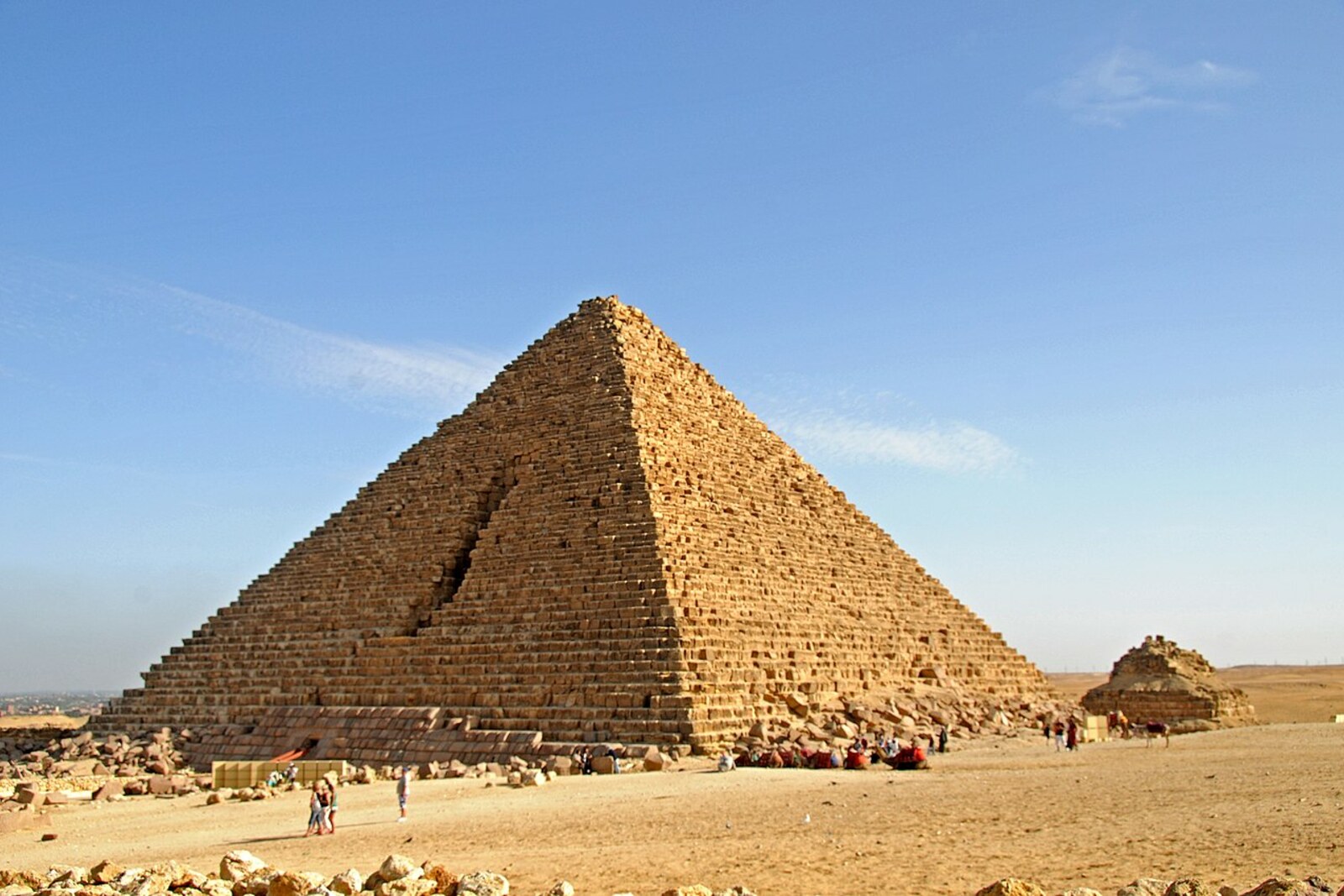
Look around first
What to notice
- Red granite facing
- Deep vertical gash
- Northern face
The story of the place
Red stone brought here from Aswan is still visible on the lower part of the masonry. It was built in the twenty-sixth century BCE as the burial place of King Menkaure of the Fourth Dynasty of Egypt. The red granite was so conspicuous that the medieval scholar Abd al-Latif al-Baghdadi called the structure the Red Pyramid.
In eleven ninety-six, the Egyptian sultan al-Aziz Uthman ordered the destruction of the pyramids of Giza. He was the son and successor of Saladin in Egypt; several courtiers persuaded him to undertake the enterprise. They began with the smallest one.
This tomb was built in the twenty-sixth century BCE for Menkaure, a pharaoh of the Fourth Dynasty of Egypt. That is where its present name comes from. The builders faced the lower courses with red granite brought from Aswan. Abd al-Latif al-Baghdadi, a scholar and physician living in Egypt at the time, therefore calls it the Red Pyramid in his account.
Al-Aziz Uthman sent stonemasons, miners, and laborers here under the leadership of court officials. They set up a camp at the foot of the pyramid, gathered people from different regions, and maintained them at great expense. Some drove in wedges and worked levers from above, while others pulled a block with ropes from below. They managed to remove one or two stone blocks a day.
A block's fall did not finish the work. The block sank deep into the sand; it had to be dug out, split with wedges, the fragments loaded onto a cart, and taken to the edge of the plateau. For eight months, people spent their strength on this operation, while the sultan spent money on the camp. Then the work was stopped. The workers dismantled only part of one face, and al-Aziz Uthman's plan to destroy the pyramid failed.
A deep vertical gash survives on the northern side, which researchers link to this order. Modern surveying has shown that it rises about twenty-two meters and in places reaches almost six meters in width. This is the entire section of the Pyramid of Menkaure that al-Aziz Uthman's men managed to remove in eight months.
Useful on site
Exterior access with a Giza Plateau ticket; the interior requires a separate ticket and may be subject to restoration restrictions.
Checked: June 28, 2026. Check the official source before visiting.The main evidence is outside, so you can skip an interior visit. View the damaged section from the permitted distance, and do not go beyond the barriers for a better angle.