 Guide On Map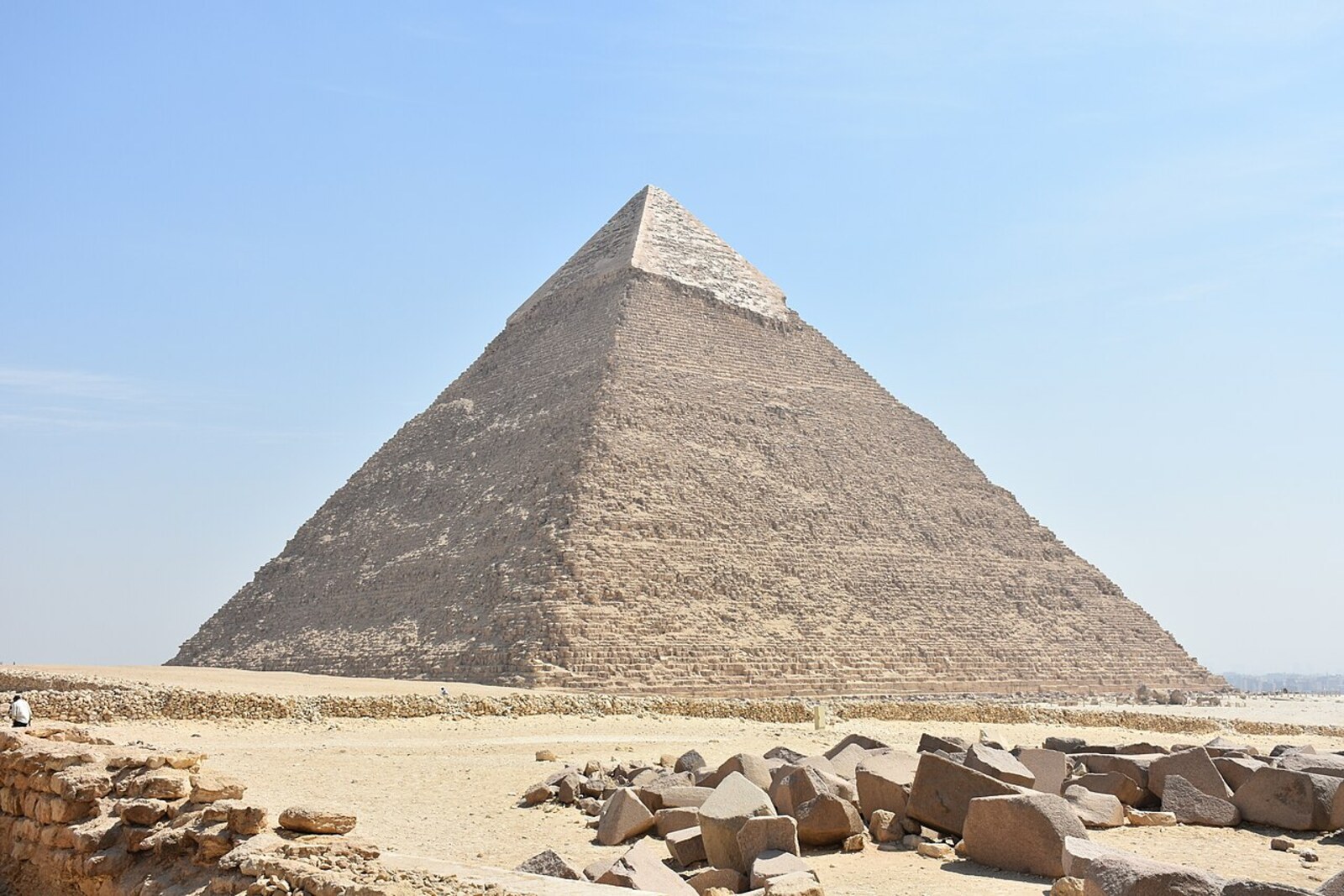
Look around first
What to notice
- Light-colored casing near the summit
- North face
- Ancient entrance
- Giovanni Battista Belzoni's inscription
The story of the place
The pyramid was erected for King Khafre together with mortuary temples where he was to be commemorated after death. A high part of the plateau raised it above the neighboring Great Pyramid of Giza, so from afar the two seem almost the same height. The light band near the summit preserves remains of the former smooth casing. The craftsmen cut the burial chamber into the rock beneath the masonry, and sank the granite sarcophagus into the floor and wedged it in with heavy blocks.
In early February eighteen eighteen, Giovanni Battista Belzoni pitched a tent at the north face of this pyramid and hired eighty local workers. The former circus strongman and mechanic was now seeking antiquities. He had less than two hundred pounds left for the excavation; he had obtained part of that money by selling two statues he had found. If his funds ran out sooner, someone with a fuller wallet could continue the work and claim the find.
The workers were paid one piastre a day; the boys and girls who carried away rubble received half as much. Giovanni Battista Belzoni also promised future tips from visitors. For sixteen days, people cut through hardened mortar and pulled out fragments of casing. Then they cleared an old breach leading inward. Loose stones hung above their heads. One block came free and trapped a worker in the passage; neighboring masses took the impact, and the man was pulled out bruised. Giovanni Battista Belzoni ordered everyone out: this tunnel could have buried the diggers and did not lead to the burial chamber.
After the failure, he compared the north face with the Great Pyramid of Giza and realized that he had been searching too close to the middle. He chose a new spot about nine meters farther east and missed by less than a meter. The workers kept digging for the pay, though under their breath they called their master majnun—a madman.
At noon on the second of March, three sloping granite blocks of the real entrance came into view. Beyond them was a corridor choked with stones, and farther on a granite barrier blocked the way. They raised it little by little with levers, placing stones in the side grooves. A worker with a candle crawled through the gap first. When he returned, he said that everything inside was very well arranged. Giovanni Battista Belzoni and the Italian traveler Angiolo Frediani squeezed through after him; Giovanni Battista Belzoni had kept Frediani there as an independent witness.
The burial chamber was cut into the pyramid's bedrock foundation. The builders sank the granite sarcophagus into the floor and surrounded it with heavy blocks so that it could not be taken out. Yet its lid already lay shifted aside, and there was earth and stone inside. On the wall, Giovanni Battista Belzoni read a medieval Arabic inscription: the master stonemason Muhammad Ahmad reported that he had opened the pyramid, and master Osman had been present at the opening. Giovanni Battista Belzoni managed to preserve a copy of the inscription before the charcoal marks crumbled away. His discovery turned out to be a return to an already looted tomb.
Khafre is the Greek form of the name of the pharaoh Khafre, son of Khufu. In the twenty-sixth century BC, this pyramid and the mortuary temples adjoining it were erected for him. The king's name survives on statues from the complex; inside the pyramid itself, Giovanni Battista Belzoni found not a single hieroglyph. The tomb was built on a higher part of the plateau, so it appears almost equal to the Great Pyramid of Giza, though it is slightly lower. The light-colored stones near the summit are the remains of the smooth casing whose fragments once covered the northern entrance.
Giovanni Battista Belzoni gained fame, and in England a medal was struck in honor of the discovery. In the burial chamber, he left his own inscription in huge black letters. It survives on the south wall: “Opened by Giovanni Battista Belzoni on the second of March, eighteen eighteen.”
Useful on site
Exterior access with a ticket to the plateau; the interior requires a separate ticket and is subject to restrictions on the day of your visit.
Checked: June 28, 2026. Check the official source before visiting.Compare it with the Great Pyramid of Giza from several permitted angles: the impression changes with the observer's position. You do not need to go inside to see the main architectural device.