 Guide On Map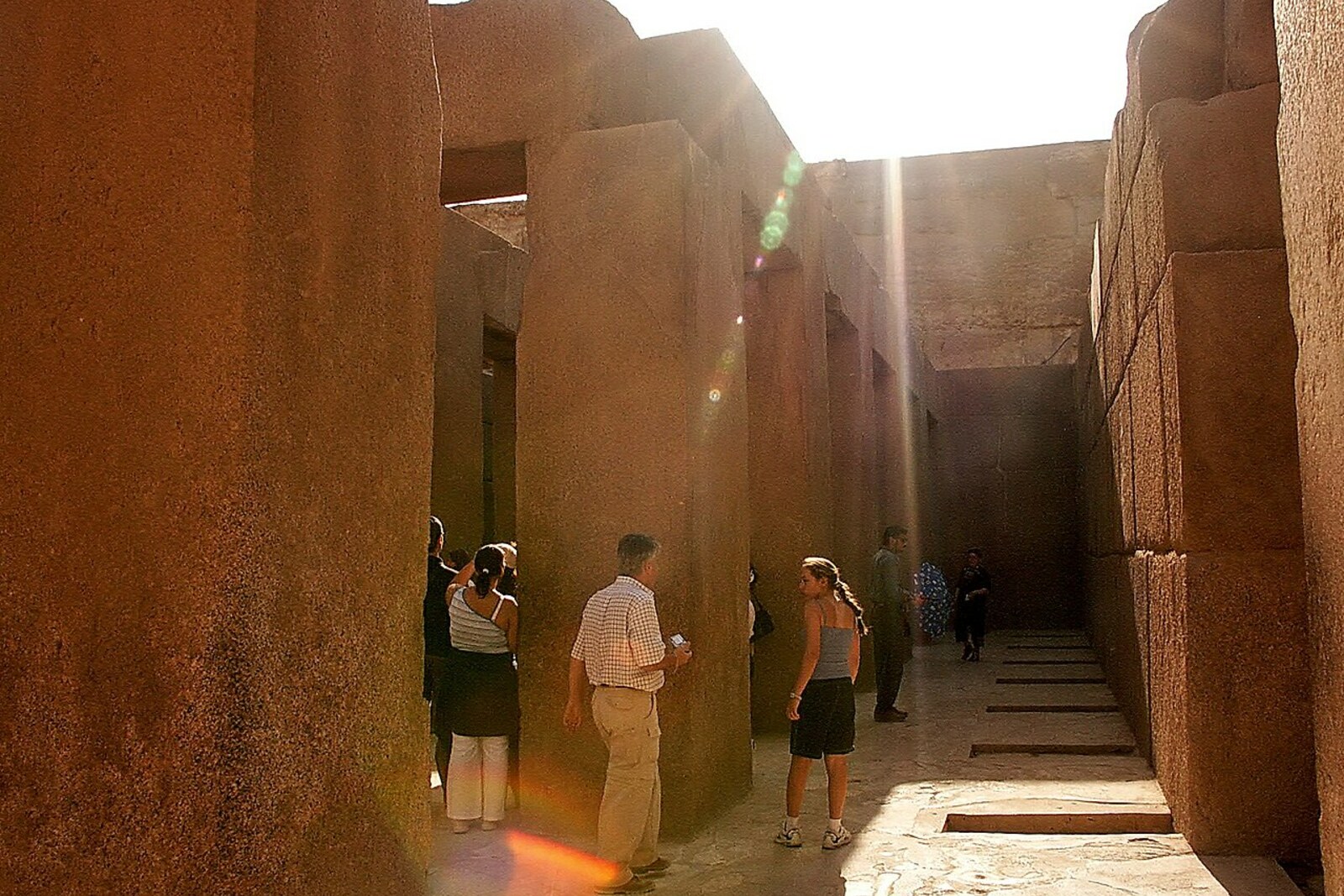
Look around first
What to notice
- Alabaster floor
- Recesses for statue bases
- Northern entrance
- Causeway to the Pyramid of Khafre
The story of the place
It is called the Valley Temple of Khafre because of its position at the bottom of the royal funerary complex, from where a covered causeway rises to the pyramid. In the twenty-sixth century BCE, the desert and the Nile floodplain met here, and a harbor stood by the eastern wall. The main hall has an alabaster floor. The body of the dead king was probably brought through the temple for part of the funerary rites, and then the procession followed the nearly half-kilometer causeway to his tomb.
In eighteen sixty, Egyptian workers under the direction of Auguste Mariette were clearing the northern entrance to this building. A deep pit containing statues and fragments was discovered in the alabaster floor of the corridor. One statue was lifted out almost intact: King Khafre sat on a throne. Later, the Greeks called him Khafre, which is where the Russian name for the pyramid and temple comes from.
Mariette had arrived here already as head of the newly created Egyptian Antiquities Service. He received a government salary and collected finds for the first museum in Cairo. A year later, the Louvre removed him from its staff: Mariette's further career remained in Egypt and depended on the Service and the future museum. The statue found here became one of the major acquisitions of his new collection.
Khafre is depicted life-size. Behind his head sits a falcon, the god Horus, embracing the king with its wings. From the side, the bird is fully visible; from the front, it is hidden behind the king's headdress. The sculptors joined the two figures so that the god both protects Khafre and merges with his appearance.
There were about twenty-three such statues here. Recesses for their bases remain in the preserved floor of the main hall. The priests stood before a whole row of Khafres, and each one represented the dead king as a participant in the ritual. Who removed the statues from their places, broke some of them, and placed them in the pit, and when, is unknown. It was there that the statue with the falcon survived.
The Valley Temple of Khafre is called Valley because of its position at the lower end of the funerary complex. In the twenty-sixth century BCE, the boundary between the desert and the Nile floodplain lay here, and a harbor stood before the eastern facade. The exact order of the ceremonies remains disputed. Khafre's body was probably brought here and some of the funerary rites were performed, after which the procession ascended the covered causeway, nearly half a kilometer long, to the temple by the Pyramid of Khafre. The statues remained below for the royal cult after the funeral.
Mariette found an image of Khafre, but he never connected the building itself with Khafre. Its proximity to the Great Sphinx of Giza led him to consider the structure part of another complex. It was only in nineteen oh nine and nineteen ten that the archaeologist Uvo Hölscher cleared the entire chain of structures and established the layout of the causeway between the lower temple and the Pyramid of Khafre.
Mariette's museum opened in Bulaq in eighteen sixty-three. The statue found here received catalog number fourteen; it is now in the Egyptian Museum in Cairo on Tahrir Square. In the Valley Temple of Khafre, empty spaces remain in the alabaster floor, along with the causeway that rises to the tomb of the king whose name Mariette had already read on the statue but had not yet managed to read in the layout of the plateau itself.
Useful on site
Access depends on the general ticket, security, and restoration restrictions; check on site.
Checked: June 28, 2026. Check the official source before visiting.Khafre's most famous statue is not here—it is in the museum, so focus on the spaces left for it and the layout of the hall. Do not linger in narrow passageways, obstructing the group's movement.