 Guide On Map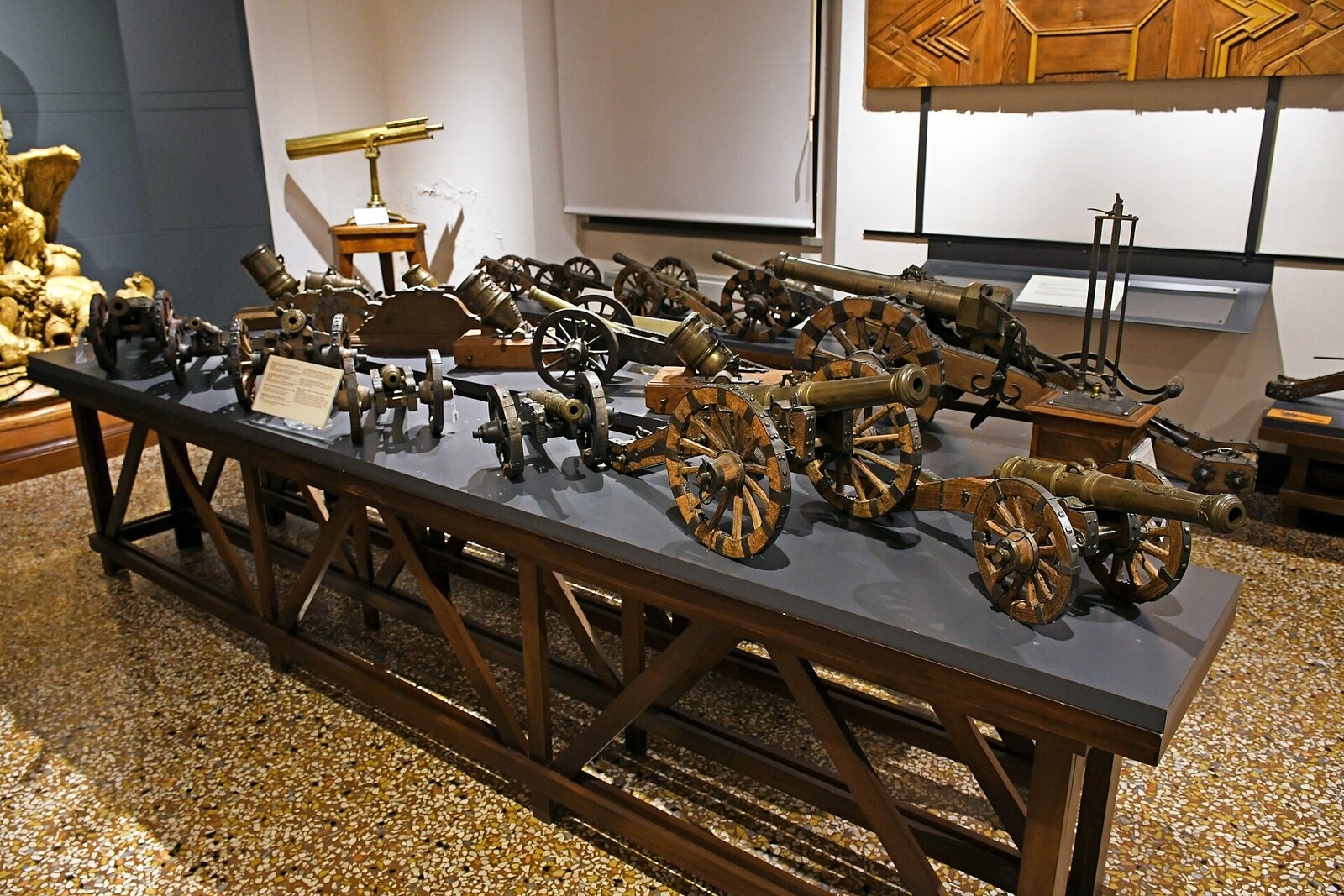
Look around first
What to notice
- Palazzo Poggi courtyard
- Frescoes in the grand rooms
- Wooden models of fortresses
- Observatory tower
The story of the place
The palace retains a courtyard and frescoed grand rooms: they once formed part of the Poggi family residence, expanded for a papal diplomat who became a cardinal. Later, the rooms were assigned to teaching spaces, a printing shop, a bookbinding workshop, and cabinets containing maps, instruments, and natural-history collections. Now some of these things have returned here in the museum, including thirty-nine wooden models of bastioned fortifications. An observatory tower rises above the building, preserving the memory of the observations and experiments that animated this palace.
In seventeen oh three, Luigi Ferdinando Marsili, a Bolognese count, naturalist, and general in the imperial army, was among the commanders who surrendered Breisach Fortress on the Rhine to the French. A military court stripped him of his rank, and his property was confiscated. For Marsili, this meant losing the service that had for many years given him the means and opportunity to travel through Eastern Europe, make maps, study rivers, and collect plants, minerals, books, and instruments.
The idea for a scientific institute had come to him a year before Breisach. The defeat did not create it, but after the collapse of his military career, Marsili made this project his main concern. In his own Bolognese home, he set up an observatory and admitted young scholars. Now he needed to hand the collections over to the city and establish permanent laboratories where nature would be studied through experiments rather than merely examined in old books.
The Senate of Bologna was in no hurry. The new center would have to be maintained, while the Archiginnasio—the university's home at the time—already required city funds. The senators feared having to pay for a rival. Marsili secured the support of Pope Clement the Eleventh, who was willing to finance the institute and insisted that the city accept the gift. In seventeen eleven, the Institute of Sciences was founded, and the Senate acquired this palace for its collections.
Poggi was the surname of the former owners. In the middle of the sixteenth century, the papal diplomat and future cardinal Giovanni Poggi expanded the family homes to create a residence befitting his new rank. The name, the courtyard, the grand rooms, and the frescoes remain from him. Marsili ordered these rooms to be filled quite differently: they housed cabinets of geography and navigation, physical instruments, natural-history collections, models of fortresses, teaching rooms, a printing shop, and a bookbinding workshop. By seventeen fourteen, the institute had opened.
The senators accepted the collection, but the dispute with its owner continued. Marsili accused them of failing to meet the obligations set down when it was founded, and he threatened to take back the manuscripts and drawings he had donated. In seventeen twenty-eight, he distributed a farewell manifesto throughout Bologna and left for Lake Garda, without ever achieving the working order he had envisaged. Before his death, he nevertheless transferred his remaining manuscripts to the institute.
Later, the old institute was closed, and its collections were distributed among university departments and other museums. In eighteen oh three, the university itself moved into Palazzo Poggi. At the end of the twentieth century, some instruments and exhibits were returned to their former rooms: this is why the museum displays reconstructed cabinets of the Institute of Sciences on the very site where they had been used.
The hall of military architecture displays thirty-nine wooden models of bastioned fortifications, already listed in the deed of gift of seventeen eleven. The fortress whose surrender cost Marsili his service and property remained far away on the Rhine. His models of fortresses remained in the building the senators had bought for his collections.
Useful on site
Tue–Fri 10:00–16:00; Sat, Sun and holidays 10:00–18:00 (last entry 30 min beforehand); Mon closed; full admission €10, reduced admission €6. Free for University of Bologna students.
Checked: June 28, 2026. Check the official source before visiting.The collections are inside and require a separate museum visit. If you are not going in, listen to the story by the palace facade.