 Guide On Map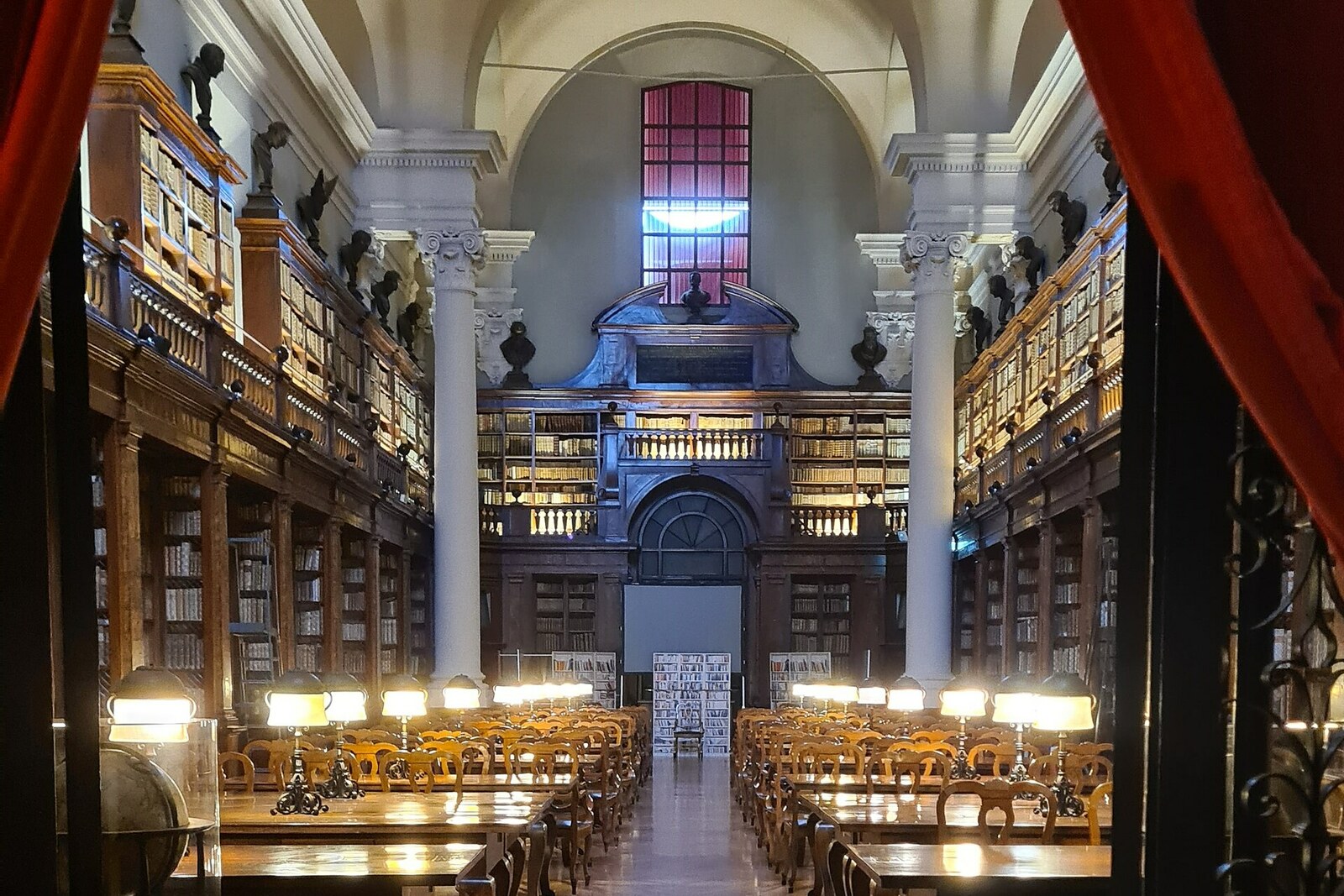
Look around first
What to notice
- Entrance to the Aula Magna
- Two-tier walnut bookcases
- Dedication to Pope Benedict XIV
- Built-in reading shelves
The story of the place
The personal library of a Roman pope arrived at Palazzo Poggi before the University of Bologna itself. In the eighteenth century, the palace was occupied by the Institute of Sciences, while the university taught at the Archiginnasio—an old academic building near Piazza Maggiore.
Prospero Lambertini, a Bolognese and a lawyer of the Roman Curia, spent decades collecting books as working tools. He dealt with canon law and canonization proceedings; his main work was used for almost two centuries when deciding whom the Catholic Church could recognize as a saint. In seventeen oh six, Lambertini persistently asked his brother to send more money for new books. Later, diplomats, church figures, and monarchs gave him editions as gifts: everyone knew what he most readily spent money on.
In seventeen forty, Lambertini was elected pope and took the name Pope Benedict XIV. He considered the old University of Bologna constrained by estate and corporate privileges, so he directed support to the Institute of Sciences at Palazzo Poggi. Collections and cabinets were already here; now they needed a library that could be continuously expanded.
On September sixth, seventeen fifty-four, Pope Benedict XIV transferred to the Institute by personal decree about twenty-five thousand printed volumes, four hundred fifty manuscripts, and part of his papers. For a pope of the modern era, such a removal of a personal collection from Rome was rare. He drew a precise boundary: materials concerning Inquisition cases and the administration of the Holy See were to remain in the Vatican. The Bolognese portion was not to be divided, sold, or distributed—even books held in multiple copies.
Lambertini paid for the expansion of the library and its monumental hall with two-tier walnut bookcases. The books arrived in batches from August seventeen fifty-five through February seventeen fifty-seven. In November seventeen fifty-six, the hall opened to the public. At the time, “the public” meant a rather narrow circle of people able to read scholarly works in Latin. There were still no tables in the room: small shelves were built into the bookcases, where a reader could place a volume.
Lambertini lived to see the library open and died in seventeen fifty-eight. After his death, Vatican officials demanded the return of papers connected with his pontificate. More than one hundred boxes and bundles of documents were sent from Bologna to Rome; they were later distributed among several Vatican collections. The books remained here. The catalogue compiled during Lambertini’s lifetime has also survived, making it possible to reconstruct almost his entire personal library.
In eighteen oh three, the university moved from the Archiginnasio to Palazzo Poggi, and the former library of the Institute of Sciences became the university library. It is now the central library of the University of Bologna, also open to people who do not study there: here they read, order manuscripts and early printed editions, and work with special collections. The historic Aula Magna is used for exhibitions and conferences, while the main reading rooms are housed in a newer part of the building.
Pope Benedict XIV required every Bolognese printer to provide a free copy of each book published here. Today, the library legally receives required deposit copies of publications from the entire Metropolitan City of Bologna. A dedication to the pope survives above the entrance to the Aula Magna, and the walnut bookcases he paid for stand behind the door.
Useful on site
Summer schedule from 4 June 2026: main reading-room/bibliographic services Mon–Fri 09:00–18:30, Sat 09:00–13:30; some rooms and special collections have separate hours; BUB is closed 8–17 August.
Checked: June 28, 2026. Check the official source before visiting.This is a working library, not an ordinary museum hall: keep quiet and find out in advance which spaces and collections are accessible to visitors.