 Guide On Map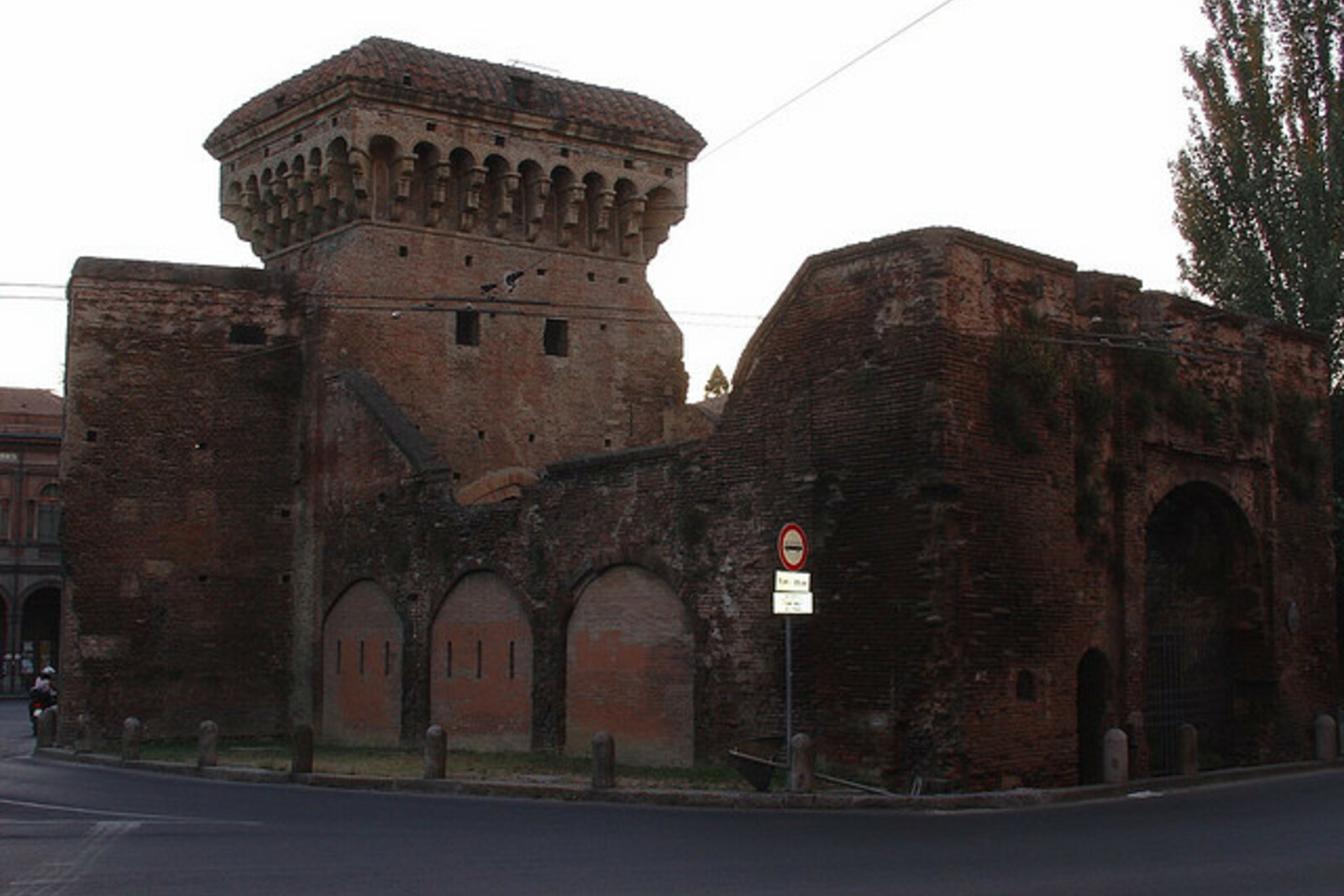
Look around first
What to notice
- The tall gate structure
- The elongated brick forework
- The bricked-up arches
- The short section of wall
The story of the place
When the city walls were dismantled, Porta San Donato remained as a separate brick landmark by the ring boulevard. A low defensive extension runs along the tall gate tower with its passageway; its bricked-up arches still reveal the former routes through it. The name came from the Church of San Donato on Via Zamboni: the saint's name first belonged to the road, then to the gate at its end. Of Bologna's two surviving medieval foreworks, this one has come down to us in the most complete form.
The red-brick gate consists of two parts. The tall structure with a passageway closed off the road from Bologna to the valleys of Argenta and Ferrara. The low, elongated forework contained the forward defense: in thirteen fifty-four, builders connected it to a drawbridge across the moat. Guards could detain someone who had entered between the outer passage and the gate tower; their living quarters stood nearby.
San Donato was Saint Donatus of Arezzo, a fourth-century bishop. Later church tradition calls him a martyr executed during the persecution of Christians. The church dedicated to him still stands at number ten on Via Zamboni. The former Strada San Donato took its name from the church, and the gate at the road's end and the continuation beyond the walls took theirs from the road. When the street inside the city was named after the revolutionary Luigi Zamboni in the second half of the nineteenth century, the gate acquired a second name as well: Porta Zamboni.
In nineteen oh three, builders dismantled the adjoining city walls. The isolated gate remained in the middle of a new transport hub, with the medieval forework projecting into the roadway of the ring boulevard. After the war, cars became more numerous, and the city administration decided to remove the obstruction. In nineteen fifty, the forward section of the neighboring Porta San Vitale had already been demolished; San Donato now faced the same fate.
Alfredo Barbacci, a state architect-restorer and custodian of monuments, opposed the project. He was paid precisely to protect old buildings while postwar cities made room for new construction. He had restored Bolognese structures damaged by bombing. Barbacci appealed to the Ministry of Public Education, which was then responsible for monument protection. On April twenty-first, nineteen fifty, the ministry authorized the demolition of the forework at Porta San Vitale but excluded San Donato from the permit. Three years later, officials who came to Bologna again refused the city.
Guido Zucchini offered a solution. He was an engineer, restorer, university drawing instructor, and museum director. He advised the Committee for Historic and Artistic Bologna free of charge. Zucchini approached the transport problem as an engineer: beside the gate stood a disused electrical kiosk, and a short stretch of repeatedly rebuilt wall adjoined it. If the kiosk and a little more than a meter of this masonry were removed, cars would have a passageway while the medieval forework would remain in place.
Zucchini did not live to see the dispute end. He died on May fourteenth, nineteen fifty-seven. Exactly two weeks later, the ministry formally notified the city that the forework had especially important historical and artistic value and must be preserved. The administration adopted Zucchini's proposed solution: the electrical kiosk and a small section of wall were dismantled. For several years, drivers passed directly through the arches of the forework; later, those arches were bricked up.
Today, the tower retains precisely the elongated forework that was at the center of the dispute. Of Bologna's two surviving medieval gate foreworks, this one is the most complete. The electrical kiosk and a little more than a meter of wall are gone, while the bricked-up arches mark the passageway the city once gave over to cars.
Useful on site
The exterior can be viewed at any time; the gate stands at a busy intersection by the ring boulevard, so be mindful of traffic.
Checked: June 28, 2026. Check the official source before visiting.Traffic moves around the gate; view the arch and memorial plaque from the sidewalk, and cross the roadway only at a permitted crossing.