 Guide On Map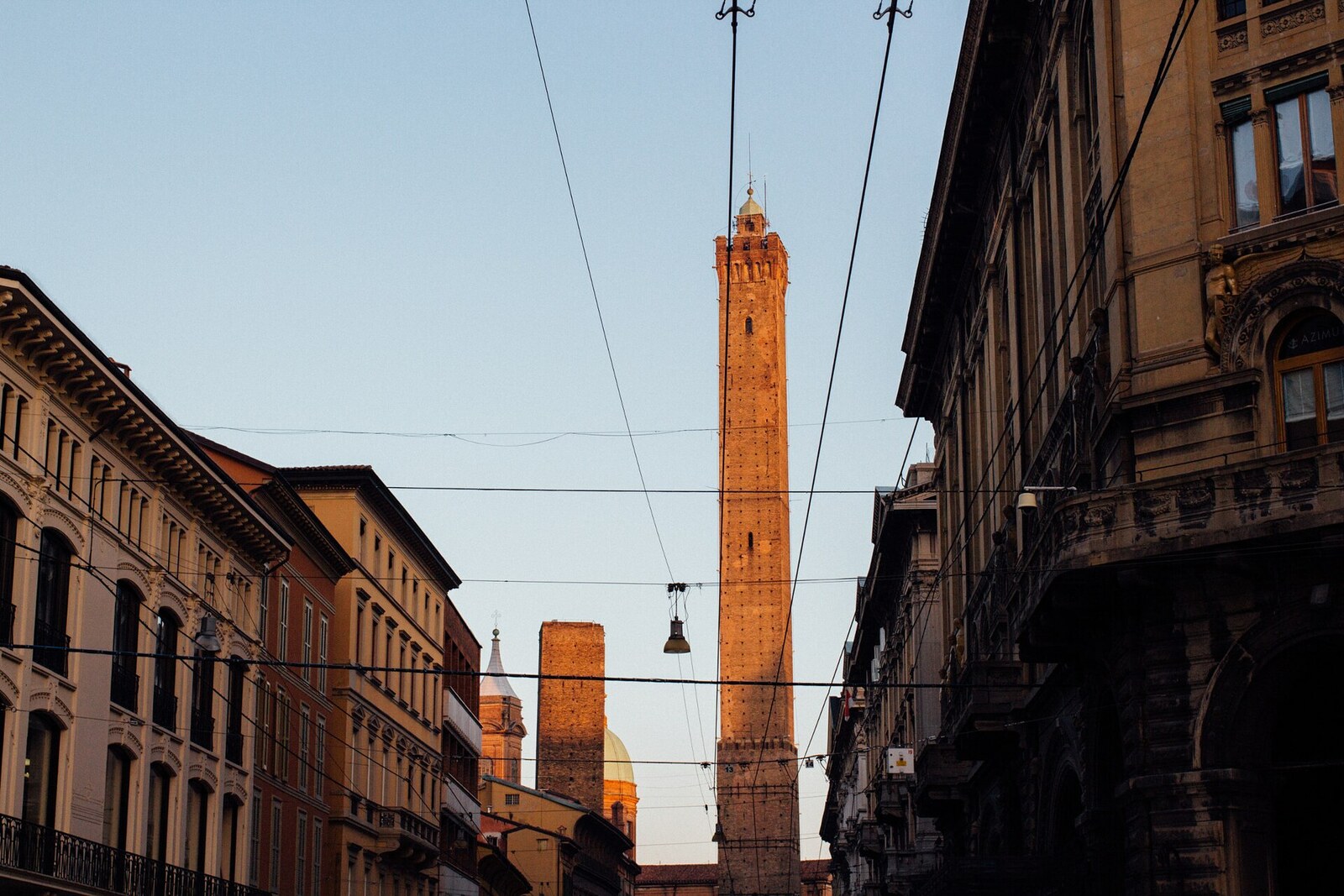
Look around first
What to notice
- Asinelli Tower
- Leaning Garisenda Tower
- Plaque by house # 6 on Piazza della Mercanzia
- The broad approach of Via Rizzoli
The story of the place
The tall tower bears the Asinelli name, and the short, leaning one the Garisenda name. In the early twelfth century, these Bologna families built towers beside their homes. Inside, they could take shelter and defend themselves during civic conflicts; outside, their height told neighbors how much money and how many people a family had. One of Bologna’s main crossroads was chosen for such a statement.
The square’s name preserves something that is no longer here. Porta Ravegnana was a gate in the early city wall: the road to Ravenna began there. The routes that now bear the names Via Rizzoli, Strada Maggiore, Via San Vitale, and Via Zamboni converged here. At the end of the thirteenth century, the city commune bought and demolished several houses so that the cramped road junction could become a square.
Garisenda Tower began to lean soon after it was built. In the middle of the fourteenth century, city craftsmen dismantled its upper section, fearing it would collapse. Engineers are now reinforcing this tower again, while Asinelli Tower is closed to visitors because of work nearby. In the spring of two thousand twenty-six, builders began installing seventy micropiles, up to twenty-one meters deep. Two metal machines are to rest on them: cables will make it possible to apply a small counterbalancing force to Garisenda Tower while specialists work on its foundations.
The broad approach of Via Rizzoli to the towers appeared after another decision. As late as the end of the nineteenth century, the narrow commercial street of Mercato di Mezzo—the Middle Market—began here. The municipal plan of eighteen eighty-nine proposed clearing it for a straight, modern avenue. That required removing the old houses between the center and Porta Ravegnana.
Alfonso Rubbiani, a restorer of Bologna’s medieval buildings and founder of a committee to protect the old city, wanted to build the new road without wholesale demolition. Restoration was his profession: he worked on palaces, churches, and gates that the municipal plan regarded as obstacles to traffic. Together with the architect Gualtiero Pontoni, he linked the existing lanes on a drawing in a way that would preserve the houses and towers of Mercato di Mezzo.
On June sixth, nineteen oh nine, Rubbiani presented the project to artists gathered in Palazzo dei Notai. They approved it, but the municipality took no action on the proposal. Rubbiani died in nineteen thirteen, three years before the demolition of houses revealed unexpected proof of his fears.
The remains of three more medieval towers emerged from later additions: Artenisi Tower, Guidozagni Tower, and Riccadonna Tower. Before the clearing, their brick shafts had been built into residential and commercial buildings. Now they stood separately, beside Asinelli Tower and Garisenda Tower, and the city could have preserved five towers at a single crossroads.
Rubbiani’s committee continued the fight. Giorgio Del Vecchio, a professor of philosophy, began collecting signatures to preserve the discovery. Protests came from different cities across Italy. The State Council for Antiquities ordered the towers freed from the additions and carefully photographed—but did not forbid their destruction.
Guidozagni Tower, which was in poor condition, was dismantled in April nineteen seventeen. By March nineteen nineteen, Artenisi Tower and Riccadonna Tower had disappeared. The municipality received a straight Via Rizzoli and plots for new buildings; the campaign’s participants received photographs of the three towers they had been unable to save.
Behind Garisenda Tower, by house number six on Piazza della Mercanzia, a plaque marks the site of Artenisi Tower, Guidozagni Tower, and Riccadonna Tower. Nothing of them remains above the pavement.
Useful on site
The square is open around the clock; access to Asinelli Tower is closed for restoration.
Checked: June 28, 2026. Check the official source before visiting.The story does not require climbing: both towers can be clearly seen from the square. Check separately whether it is possible to go inside.