 Guide On Map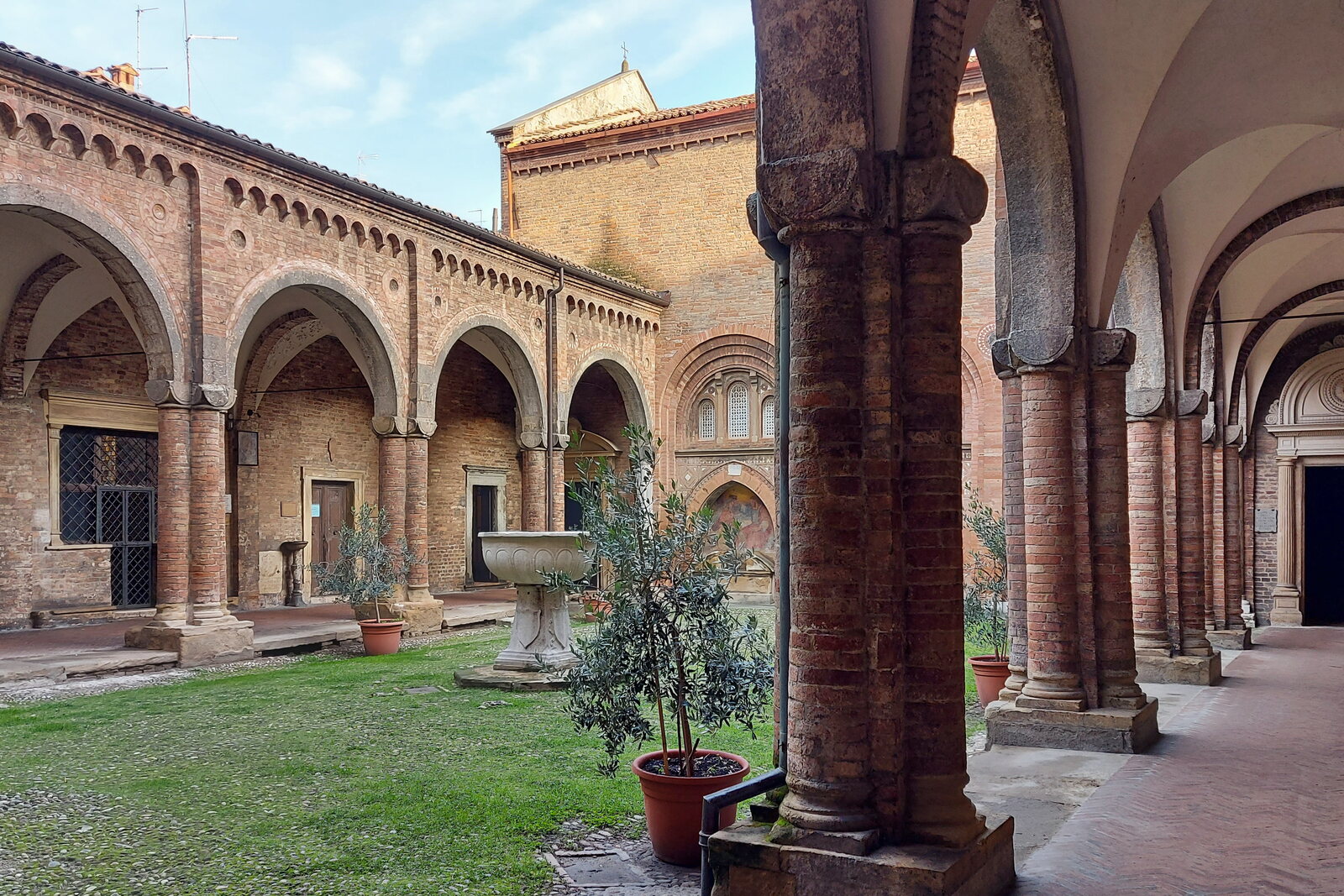
Look around first
What to notice
- Church of the Holy Sepulchre
- Stone tomb
- Pilate's Courtyard
- Connecting passageways
The story of the place
On August first, eleven forty-one, Bologna Cathedral burned down. Bishop Enrico, who needed to continue services without a cathedral church, probably moved his episcopal seat temporarily to Santo Stefano. Two months later, he and the local Benedictines began opening old relic repositories.
The monks did not happen upon an unknown grave by accident. They knew that Petronius, Bologna's fifth-century bishop, was buried somewhere in the complex, but the exact place of his burial had been lost. On October fourth, in the central Church of the Holy Sepulchre, Enrico and the monks opened a marble sarcophagus beside a stone copy of Christ's tomb in Jerusalem. It contained remains recognized as Petronius's body, along with several caskets holding other relics.
Before this, Petronius was little remembered. Two fifth-century authors confirmed that such a bishop of Bologna had existed, but Saint Peter was regarded as the city's chief patron. Enrico gave the discovery citywide scope: he established an annual feast with a procession and promised pilgrims a two-year indulgence—the remission of the corresponding period of church penance. The consuls of the Commune of Bologna guaranteed visitors protection for eight days before the feast and eight days after it, while merchants were exempted from duties for that period. The monastic tomb gained pilgrims, the market gained buyers, and the young city gained a saint of its own.
Around eleven eighty, one of the monks of Santo Stefano wrote a life of Petronius. It was there that the story appeared of how the bishop conceived of bringing Jerusalem's sacred geography to Bologna. This is a legend created seven centuries after Petronius's life, not testimony from his contemporary. But by then the Benedictines had in fact already arranged a miniature Jerusalem here: the Church of the Holy Sepulchre with its stone tomb, Pilate's Courtyard, and places associated with Christ's cross, burial, and resurrection. A pilgrim passed through them in sequence without leaving Bologna.
Santo Stefano bears the name of Saint Stephen, the first Christian martyr. The name “Seven Churches” took hold because passageways connect several churches, courtyards, and monastic rooms from different centuries. In places, the boundaries between them have almost disappeared: one door leads from a church into the next part of the sacred route. The body of a local bishop was found inside a copy of Christianity's principal tomb, and the monks made Petronius the founder of this entire Bolognese version of Jerusalem.
In twelve fifty-three, the Commune of Bologna recognized Petronius as Bologna's chief patron. In thirteen eighty-eight, the city council decided to build him an enormous basilica on Piazza Maggiore; work began two years later. Thus the church already visited on this route arose as a distant consequence of Enrico's excavations at Santo Stefano.
The monks kept the remains with them for many more centuries. In seventeen forty-three, Petronius's head was moved to the new basilica, while the main part of his body remained here until October third, two thousand. Petronius is no longer in the central stone tomb: his remains are united in the Basilica of San Petronio on Piazza Maggiore, and only a separate particle of the relic is kept in the Santo Stefano museum.
Useful on site
Basilica: Mon 18:00-19:30, Tue-Sat 07:30-12:30 and 14:30-19:30, Sun and holidays 08:30-13:00 and 15:00-19:30. Monumental section: Mon closed, Tue-Fri 09:30-12:30 and 14:30-19:00, Sat 09:30-12:30 and 14:30-19:30, Sun and holidays 09:30-12:30 and 15:00-19:30. Free admission with a voluntary donation; tourist access may be restricted during services.
Checked: June 28, 2026. Check the official source before visiting.Move quietly and follow the open sequence of rooms: during services or religious events, part of the complex may be inaccessible.