 Guide On Map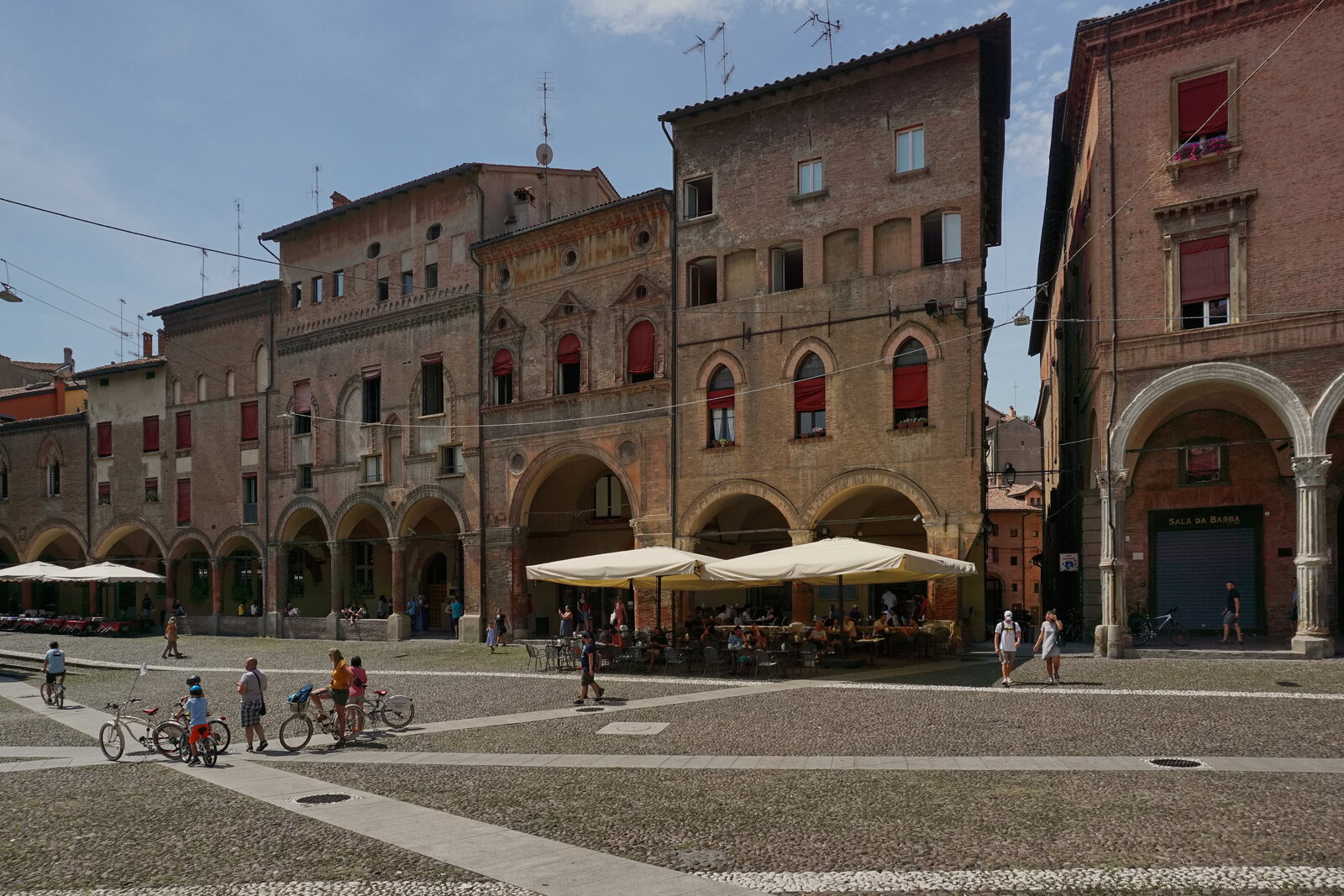
Look around first
What to notice
- Light-gray granite bands
- Red-amber cobblestone
- Gray-white river pebbles
- Ordinary paving at the point where the bands converge
The story of the place
Piazza Santo Stefano officially almost does not exist. It is a funnel-shaped widening of Via Santo Stefano, descending toward the church complex of the same name. The street takes its name from the complex; Saint Stephen, whose name it bears, is considered the first Christian martyr. Bolognese people called this widening either the little Piazza Santo Stefano or the Square of the Seven Churches, and the informal name proved more durable than the city registers. Concerts and cultural events are held here now, and on the second Saturday and Sunday of every month, except July and August, antique dealers occupy the paving.
This broad sloping surface took its present form thanks to the furniture manufacturer Dino Gavina. In the late nineteen eighties, he advised the city commission on street improvements, but he could not direct construction. Gavina made his living from objects: after the war, he began with theater sets, railway-carriage upholstery, and tarpaulins for Jeeps, then founded several well-known furniture and lighting companies. He brought the same experience to the municipal commission—the ability to find an architect and make sure an idea reached production.
At that time, Piazza Santo Stefano looked different. In nineteen thirty-four, a separate lowered courtyard was made in front of the church—a sagrato, meaning an open area directly before the entrance. The road surface around it was raised so that cars could go around the complex. Steps and curbs separated pedestrians, cars, and the church entrance; the natural slope had been cut into several levels.
In nineteen eighty-nine, utility lines beneath the square were being replaced. Gavina brought the Milanese architect Luigi Caccia Dominioni here; he had come for another city project. Seeing the excavated paving, the architect decided that the square was finally going to be put in order. The work concerned pipes only, but his remark gave Gavina a reason to act. He wrote to Mayor Renzo Imbeni and proposed entrusting the whole square to Caccia Dominioni. The reply came at once; the municipality and the heritage-protection authority hurriedly approved the project.
The architect removed the boundaries of the sagrato and again used the difference in elevation of about one meter twenty between Piazza della Mercanzia and the church entrance. Instead of several cut-off areas, there was now a single concave surface with no steps in front of the facade. It was opened on June sixth, nineteen ninety-one.
The light-gray granite bands underfoot are the routes of passage laid out by Caccia Dominioni. Between them lies red-amber cobblestone from Trentino, and along the porticoes, gray-white river pebbles from the Apuan Alps. The contractors altered part of the design: they added steps where the slope proved especially steep and abandoned the green marble lens planned by the architect. At the point where the gray bands converge lies ordinary paving—the place for the final detail that was never installed.
Useful on site
Open urban space; the square and porticoes are accessible as a street stop at any time. The nearby interiors keep their own schedules.
Checked: June 28, 2026. Check the official source before visiting.Walk around the edge and through the center of the square: the change in elevation is felt better in motion than from a single point.