 Guide On Map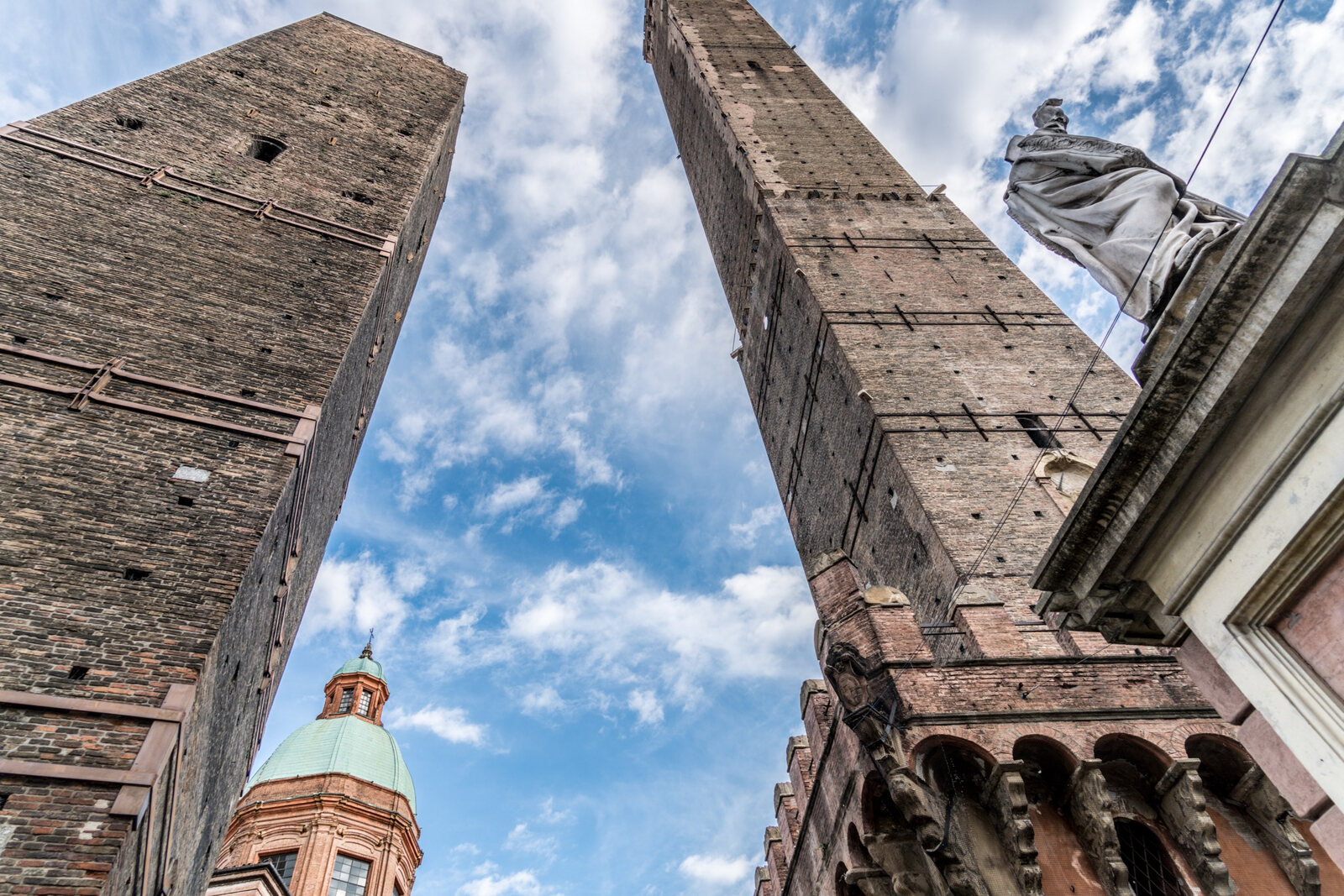
Look around first
What to notice
- Tall Asinelli Tower
- Shortened Garisenda Tower
- The lean of Garisenda Tower
The story of the place
In medieval Bologna, more than ninety towers rose above the rooftops, and a little more than two dozen have survived to this day. The tall brick tower later passed to the city: it served as a women's prison, and the first municipal mechanical clocks were installed at its top. The ground beneath its neighbor subsided, and the tower had to be shortened. Now, side by side, you can see an almost one-hundred-meter vertical and a short leaning tower.
Asinelli and Garisendi are the surnames of two noble Bolognese families. Late medieval chronicles attributed the construction of the towers to them in the early twelfth century, and the towers have borne their names ever since. No documents drawn up during the construction itself have survived, so the names of the patrons are less reliable here than the brick walls themselves. The towers were erected at the eastern entrance to the ancient Via Aemilia, beside a market: signals were sent from above, the approaches to the city were watched, and the size of each structure displayed its owners' means. Garisenda Tower had to be shortened after the ground subsided. Asinelli Tower retained its almost one-hundred-meter height.
In the sixteen-forties, this difference proved useful to Giovanni Battista Riccioli, a Jesuit who taught theology and mathematics in Bologna. He earned his living by teaching and was preparing a major astronomical work, so he could not take Galileo's calculations of falling bodies on faith. He found especially suspicious the claim that a heavy iron ball would travel one hundred cubits in five seconds. Galileo had not indicated from which tower the ball was dropped or how the time was measured. Riccioli decided to repeat the experiment so that the timekeeping could be checked.
Ordinary clocks were no good for such a short fall. Together with the young Jesuit Francesco Maria Grimaldi, Riccioli made a pendulum and checked its rate by the passage of stars across the meridian. One swing lasted one-sixth of a second. They rehearsed the count aloud with short Bolognese words, marking the tens on their fingers so as not to lose track.
Then Grimaldi and another participant in the experiment, the Jesuit Giorgio Cassiani, climbed Asinelli Tower with clay balls. Riccioli stayed below. Two pendulums were started simultaneously, at the top and at the base; the ball was released from the upper platform, and each participant independently recorded the number of swings until impact. The experiment was repeated. The discrepancy between the records did not even reach one swing.
Riccioli hoped to catch Galileo in an error. It turned out otherwise. During successive equal intervals of time, the ball covered distances related to one another as one, three, five, seven, and nine. This was precisely the pattern Galileo had derived: the speed of falling increases uniformly, while the distance traveled is proportional to the square of the time. Later calculations based on Riccioli's records showed that he obtained one of the first sufficiently accurate values for the acceleration due to gravity.
Riccioli did not hide the inconvenient result. Together with Grimaldi, he went to Bonaventura Cavalieri, a professor of mathematics at the University of Bologna and a former student of Galileo. Cavalieri suffered from gout and could not take part in the experiments; according to Riccioli, the news that his teacher's calculation had been confirmed delighted him. In sixteen fifty-one, the results appeared in Riccioli's “New Almagest.”
Nothing of the instruments or clay balls remains here. The distance of the experiment survives: almost the entire height of Asinelli Tower, from the upper platform to the base. The shortened Garisenda Tower no longer had such a line of fall.
Useful on site
This is an outdoor stop. Asinelli Tower is closed until further notice because of work in the area. Traffic arrangements and the nearest approaches to the Garisenda area may change because of the long stabilization project.
Checked: June 28, 2026. Check the official source before visiting.View the towers from permitted areas and do not go beyond the barriers; climbing, if it is unavailable, is not necessary for this stop.