 Guide On Map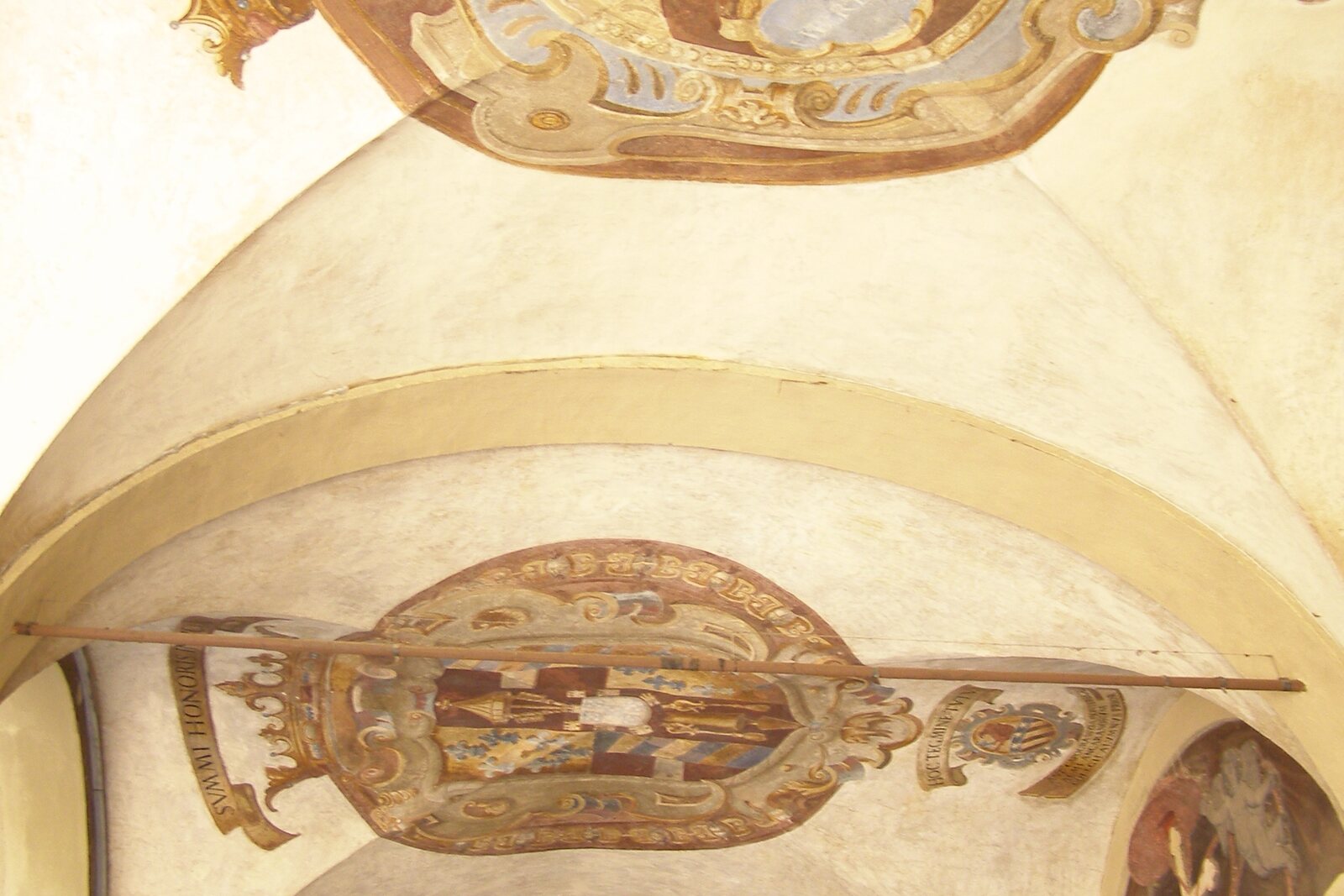
Look around first
What to notice
- Coats of arms on the walls
- Staircases and galleries
- Former university classrooms
The story of the place
Before the Archiginnasio of Bologna appeared, the University of Bologna had no common home: lectures took place in professors' apartments and rented rooms. Ten classrooms and two large halls were set aside here so that lawyers could study separately from those then called artists: future philosophers, physicians, mathematicians, and natural scientists. The staircases and galleries are covered with almost six thousand coats of arms; they record a student's name, home city, and fellow-countrymen's association that elected him as its representative. The university left the palace long ago, and the city library stores books in the former classrooms.
In this palace's first academic year, Torquato Tasso lost both his place in Bologna and the money for his studies. The young poet came here in fifteen sixty-three to continue his education. His patron, the Duke of Urbino, gave him a scholarship: without that support, Tasso would not have been able to study at the University of Bologna.
By then, the university had already existed for several centuries, but it had no common building. Professors gave lectures in their homes or in rented rooms. Students formed corporations according to their origins and took part in the administration of academic affairs.
In the middle of the sixteenth century, Pope Pius IV sought to reorganize the university according to the rules of the Counter-Reformation. His representative in Bologna, Cardinal Carlo Borromeo, and the cardinal's deputy, Pier Donato Cesi, were assigned to bring the scattered schools together under one roof. Between fifteen sixty-two and fifteen sixty-three, ten classrooms and two large halls were set up here: for lawyers and for the “artists”—as students of philosophy, medicine, mathematics, and the natural sciences were called.
Now it was easier to monitor academic programs and student behavior. Tasso experienced the new order almost at once. He circulated satirical texts that mocked the propriety of professors and fellow students. In fifteen sixty-four, he was expelled and his scholarship was confiscated. He could no longer continue his studies in Bologna. His new patron, Scipione Gonzaga, helped him move to Padua, and a year later the poet entered the household of Cardinal Luigi d'Este in Ferrara.
Archiginnasio of Bologna is an old designation for the main university school. The university occupied the palace until eighteen oh three; since eighteen thirty-eight, the city library has been here. The former classrooms now serve as book repositories.
About six thousand coats of arms from the student corporations remain on the staircases, in the galleries, and in the halls. Each bears its owner's name, home city, and “nation”—the fellow-countrymen's association whose other students elected him as their representative. Their coats of arms covered the walls precisely when the students themselves were losing the right to decide the university's affairs.
Useful on site
The palazzo is open Mon-Sat 09:00-19:00 and closed on Sunday. The Anatomical Theatre and the Stabat Mater Hall can be visited only with online booking and available time slots; the library is not a tourist area. Library: Mon-Fri 09:00-19:00, Sat 09:00-14:00, Sun and holidays closed.
Checked: June 28, 2026. Check the official source before visiting.The courtyard and galleries can be viewed separately from the tourist halls; it is best to plan and book a visit to the Anatomical Theatre of the Archiginnasio in advance.