 Guide On Map
Barcelona's Old City: From Barcino to La Ribera
From Plaça Nova via Plaça de Sant Jaume and Plaça del Rei to Santa Maria del Mar
Guide On Map on your phone
Open the walk like a regular app
It takes about 10 seconds to install. No app store needed.
The whole path
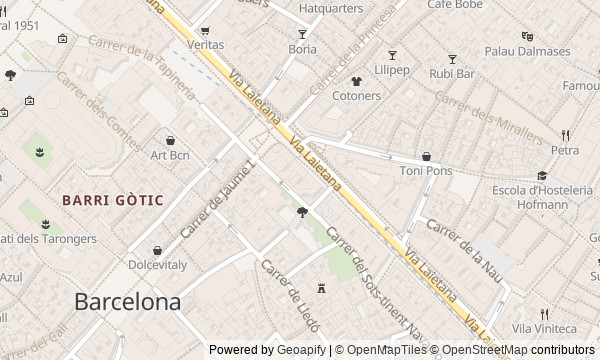
Route map
About the walk
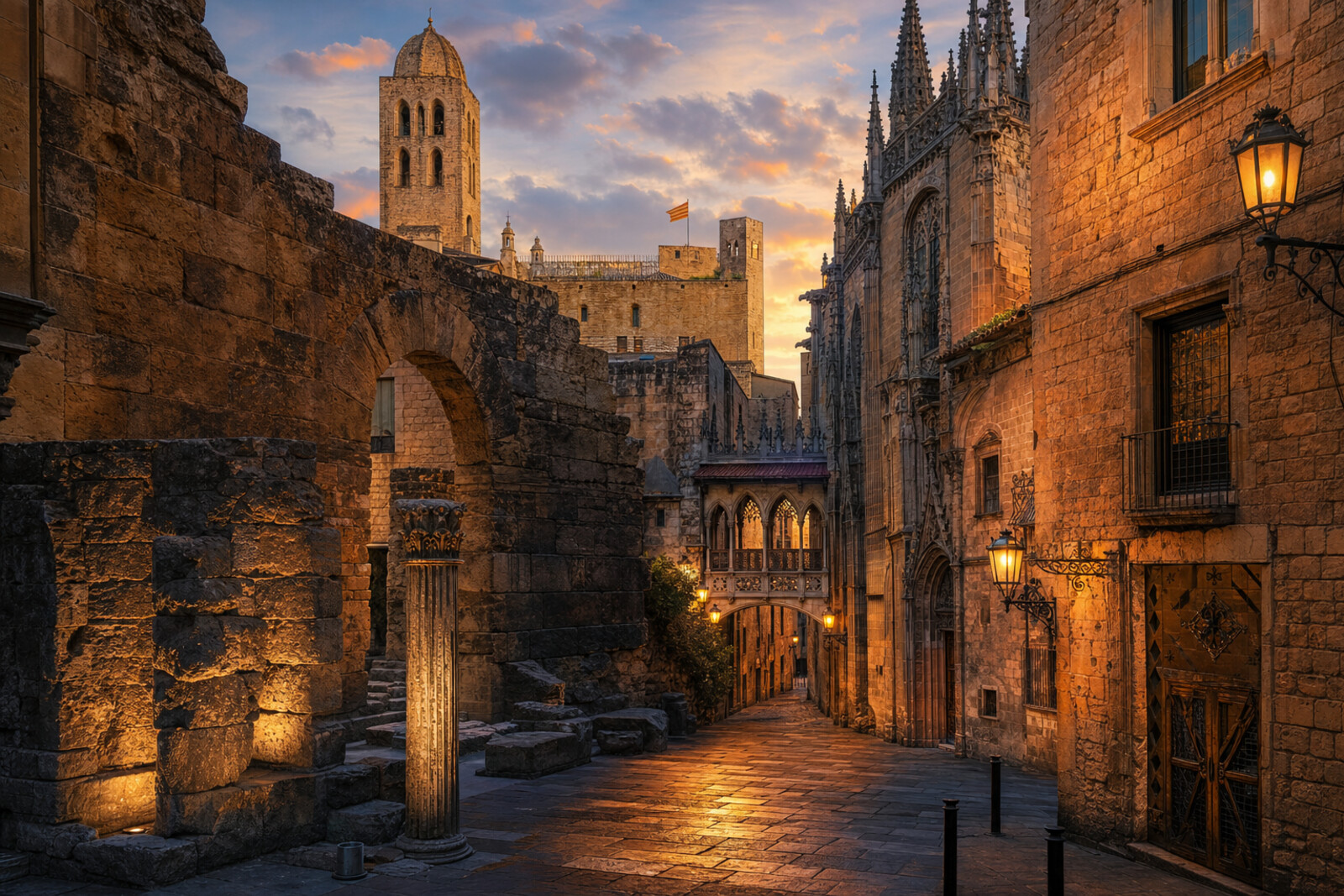
You will begin beside seven metal letters in front of the Roman gate. Then you will climb Mount Tàber, step into a courtyard with columns, and descend to the two balconies of Plaça de Sant Jaume. From there, the route runs beneath a Neo-Gothic bridge, alongside the cathedral, and through Plaça del Rei, ending at Santa Maria del Mar in old La Ribera.
This is not a walk through “Gothic scenery.” It is a walk through places people kept remaking and fighting for. Along the way, a few questions will surface: why did road barriers turn into a word? Why did ancient columns have to be defended from the owner of the house? How did an amphora stop construction already under way? And why did dockworkers appear on a church door?
The story stays with people's decisions, seams in the construction, and the qualifications in the sources. Legend will remain legend, and later stylization will remain later stylization.
By the end, you will be able to tell Roman Barcino and the medieval city apart from the alterations that now seem like part of a very old Barcelona.
Why this order
The letters on Plaça Nova place a contemporary urban work before the Roman gate. Beyond it, you will follow the direction of an ancient street and climb to the forum site, where the temple columns stand. From there, you will descend to Plaça de Sant Jaume, where the center of the Roman city meets the square of present-day power. Carrer del Bisbe carries that line from public balconies to the enclosed passage between the Palau de la Generalitat de Catalunya and the presidential residence. The neighboring cathedral shifts the story from government to church authority, while Plaça del Rei reveals their shared ancient quarter below ground. Then you will leave the administrative and episcopal center for La Ribera. At Santa Maria del Mar, the figures of dockworkers bring the story of the larger city to a close.
Those who want to connect Roman and medieval Barcelona in one route Those interested in archaeology, urban alterations, and the history of power Those who enjoy testing legends against visible details
Those looking for a walk focused only on modernism Those who value panoramic views over courtyards, facades, and underground ruins Those who do not enjoy a dense historical narrative
Before you go
Wear shoes that are comfortable on cobblestones and for standing a long time: much of the story unfolds in squares and in front of facades.
For the cathedral and basilica, choose clothing appropriate for an active church and do not disturb services.
Access to the underground quarter, palace rooms, and individual parts of religious buildings depends on each site's rules; check and arrange museum visits and tours of active institutions separately.
In narrow passageways, keep your belongings close and leave room for neighborhood residents.
When to go
It is best to go in the first half of the day, leaving several hours for interiors and the museum. If you stick to streets, facades, and squares, the walk will be considerably shorter; the underground section at Plaça del Rei usually takes the most time.
Backup plan
If a church or museum is closed, do not skip the stop altogether: at the Cathedral of the Holy Cross and Saint Eulalia, the Palau de la Generalitat de Catalunya, and Santa Maria del Mar, much of the story can be read from the facades, doors, and surrounding squares.
The Temple of Augustus reveals very little from the street, so if the courtyard is inaccessible, focus instead on the presumed forum space and continue to Plaça del Rei.
In rain, it is more comfortable to linger in accessible interiors; if they are closed, shorten the route to the Roman wall, Carrer del Bisbe, Plaça de Sant Jaume, and an exterior circuit of the basilica.
Route conditions
Surface. Paved — 1.3 km (data covers 91% of the route)
Facilities. Toilets — 3; drinking water — 9
Elevation. Ascent — 9 m; descent — 11 m
OpenStreetMap extract of August 12, 2026: database data, not a check on the ground. Data © OpenStreetMap contributors, ODbL licence
Walk plan
Open in maps ↗- 1
Barcino by Plaça Nova
You will learn why a modern work of urban art was placed in front of ancient gates. - 2
Roman Columns on Carrer del Paradís
You will see how a private renovation could have destroyed an ancient ensemble and at the same time helped reveal it. - 3
Balconies of Power on Plaça de Sant Jaume
Two facades make it possible to trace how a few dozen meters changed the scale of a political decision. - 4
Pont del Bisbe and Palau de la Generalitat de Catalunya
The transition will connect public authority in the square with a personal crisis inside the presidential residence. - 5
Cathedral of the Holy Cross and Saint Eulalia
The crypt will explain how the discovered remains strengthened the see and changed the church’s dedication. - 6
Underground Barcino at Plaça del Rei
The ruins will show why archaeologists had to stop and redo construction that had already begun. - 7
Santa Maria del Mar
The finale restores to the city’s history the labor of people usually left behind the façade of a great church.
Route features
Everything you need stays in the browser
Progress, saves and your trip plan are stored on this device.
Add Guide On Map to your home screen so the walk opens outside the browser.
How we handle sources, maps and corrections: our editorial standards