 Guide On Map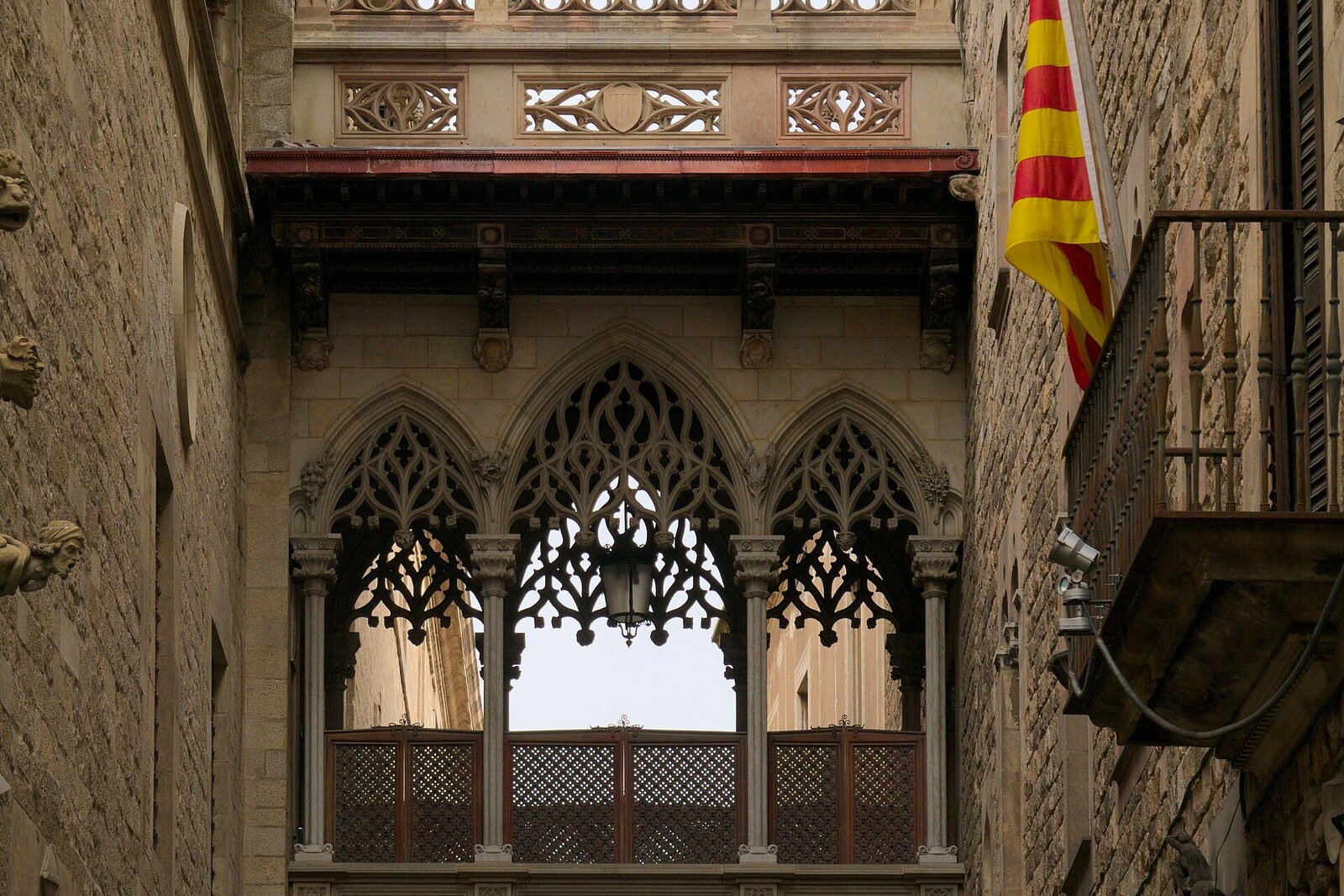
Look around first
What to notice
- Covered Neo-Gothic passage
- Star vault
- Skull pierced by a sword
- Façades of Casa dels Canonges
The story of the place
Casa dels Canonges on one side of the street arose in the thirteenth and fourteenth centuries for cathedral clergy; later, the scattered buildings were brought together for administrative premises. Opposite stands the Palace of the Diputació del General, from which today’s Generalitat de Catalunya inherited its name and its long-standing address. A covered passage with Neo-Gothic ornament connects the palace’s working rooms with the official presidential residence; it was built in nineteen twenty-eight, drawing on motifs from the palace’s Chapel of Saint George and the columns of the inner courtyard. A skull pierced by a sword remains on the star vault, but there are no documents explaining this symbol.
In December nineteen thirty-three, the surgeon Manuel Corachán came to Casa dels Canonges to save Francesc Macià. Seventy-four-year-old Macià was the first president of the restored Generalitat de Catalunya—a system of Catalan self-government—and was working to secure the recently acquired autonomy. Worsening appendicitis required urgent surgery. The doctors set up an operating room right in the presidential residence.
The first reports were encouraging, but the danger had not passed. On Christmas morning, Macià died here, among his family and closest staff. His death immediately turned the residential house into a site of state transition: on December thirty-first, parliament elected Lluís Companys as the new president.
The establishment of a presidential apartment here had been prepared several years earlier. Casa dels Canonges arose in the thirteenth and fourteenth centuries as housing for the cathedral’s clergy. In nineteen twenty-seven, provincial officials bought up the scattered buildings and commissioned Jeroni Martorell to radically remodel them into administrative premises and a residence for important guests. Under Macià, part of the complex became the president’s official home.
Across the street stood the palace that grew out of a house acquired as early as fourteen hundred by members of the medieval Diputació del General: they needed a permanent headquarters. Generalitat de Catalunya inherited both its name and its palace from that old institution; the presidential administration and the Catalan government are now housed here.
To connect the palace with Casa dels Canonges, the Council’s architect Joan Rubió i Bellver built a covered passage in nineteen twenty-eight. It only looks medieval. Rubió assembled its Neo-Gothic design from motifs of the palace’s Chapel of Saint George and the columns of the inner courtyard. A skull pierced by a sword appeared on the star vault. There is no documentary explanation for this symbol; stories of the architect’s curse and the city’s destruction belong to urban legends.
One end of the passage still leads into the palace’s working rooms, the other into the official presidential residence, where Macià died on Christmas morning in nineteen thirty-three.
Useful on site
Palau de la Generalitat de Catalunya: free visits by prior reservation on the second and fourth weekends of the month, except August; at other times the route relies on the façades and Carrer del Bisbe.
Checked: June 28, 2026. Check the official source before visiting.The palace remains a government building, so plan primarily for an exterior view. Visits to the interior spaces are arranged separately.