 Guide On Map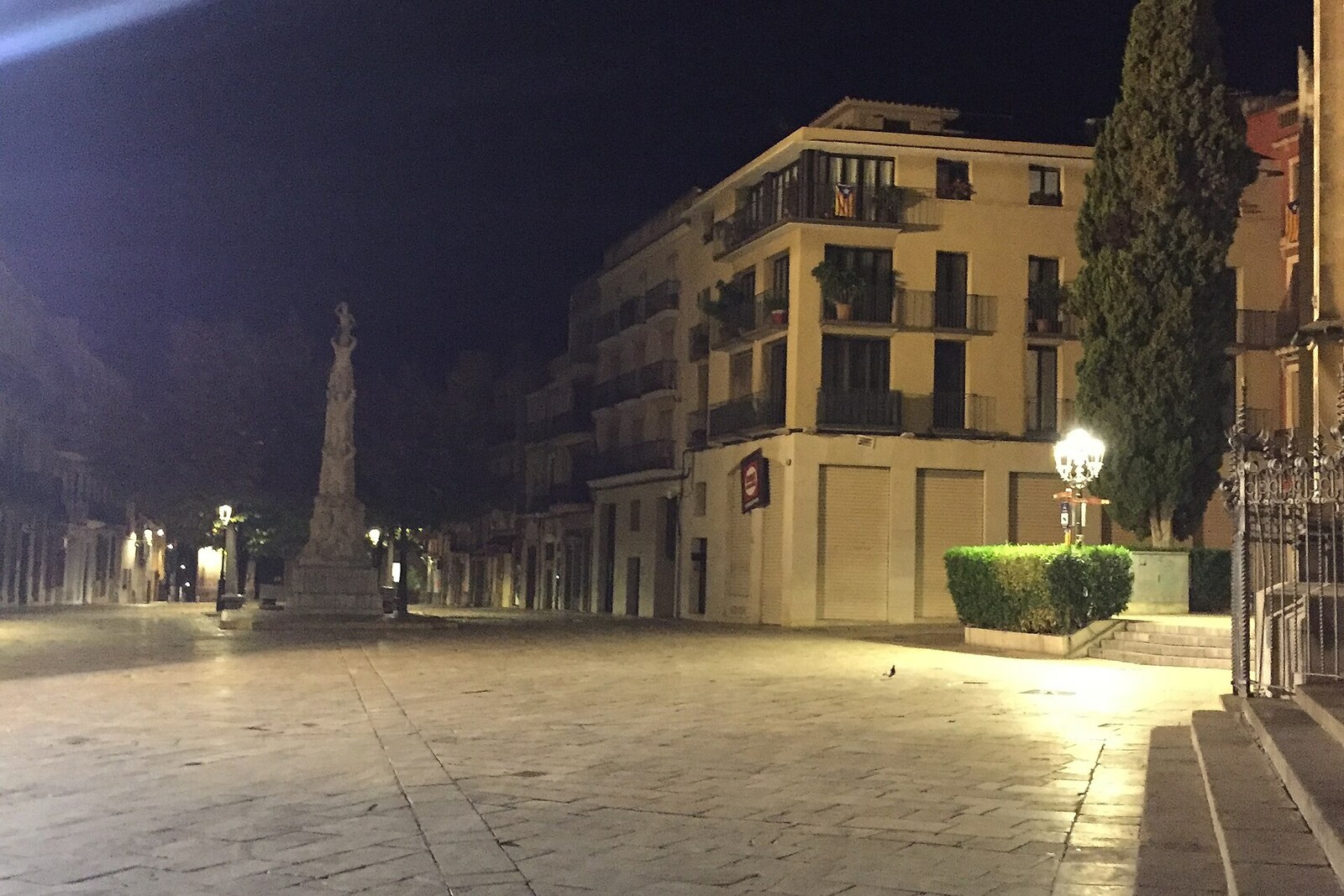
Look around first
What to notice
- The southern balcony of Barcelona City Hall
- The northern balcony of the Palau de la Generalitat de Catalunya
- The facades of the two palaces
- The square between them
The story of the place
Plaça de Sant Jaume means the Square of Saint James. The medieval Church of Sant Jaume stood where the open space between the two facades now lies. In eighteen twenty-three, the municipal authorities ordered the demolition of the church, the cemetery, and the neighboring houses. The church disappeared, but its name remained.
On April fourteenth, nineteen thirty-one, Lluís Companys, newly elected as a city councilor, entered Barcelona City Hall on the square's southern side. He was seeking the monarchy's immediate removal. Republicans had won the municipal elections two days earlier, but the king had not yet abdicated, a republic had not yet been proclaimed in Madrid, and a month remained before the lawful transfer of power.
The acting mayor, Antoni Martínez Domingo, agreed to leave only on the orders of the new government. Companys refused to wait. He was handed the mayoral staff lying on the table, and at about half past one he stepped onto the City Hall balcony, proclaimed the republic, and raised the tricolor flag. Behind him there was not yet a government, an army, or even a completed vote count—only a city councilor's mandate and the fear that delay would allow monarchist officials to retain the institutions.
Francesc Macià, leader of the victorious Republican Left of Catalonia, learned of what had happened on the radio. He sought a Catalan government of his own, while Companys's action could end in nothing more than a change of regime across Spain. Macià had already paid for that goal: the former lieutenant colonel and wealthy landowner had burdened the family estate with debt by financing an unsuccessful uprising against the dictatorship, and had spent several years in exile. He returned to Barcelona less than two months before the elections.
Macià hurried to Plaça de Sant Jaume and, soon after two o'clock, spoke from the same Barcelona City Hall balcony. He proclaimed the Catalan State, which he intended to include in a federation of Iberian republics, and announced the creation of a Catalan cabinet. He then crossed the square.
On the northern side stood the palace built for the medieval Generalitat de Catalunya. After that institution was abolished at the beginning of the eighteenth century, other institutions were housed here; in nineteen thirty-one, the palace was occupied by the Barcelona Provincial Council. Its president, Joan Maluquer, told Macià that Joan Maluquer would give way only to force. Macià placed a hand on his shoulder and asked whether that was enough. Maluquer recorded a protest and left.
Macià went up to the other balcony and announced that he was taking charge of Catalonia. Within a few dozen meters, his claim changed scale: at City Hall, the winners of the municipal elections took the city; at the Provincial Council's palace, they installed a new government.
Three days later, three ministers arrived from Madrid. After negotiations, Macià renounced the republic he had proclaimed. In return, the Spanish government recognized temporary Catalan self-government under the old name, Generalitat de Catalunya, and agreed to begin preparing a statute of autonomy. Macià became the first president of the modern Generalitat de Catalunya. Companys remained self-proclaimed mayor for only a few hours, then received the post of civil governor and, after Macià's death, was elected his successor.
Macià's republic lasted three days. The institution created by the agreement still occupies the northern palace today. The southern balcony belongs to Barcelona City Hall, the northern one to the residence of the president and government of Catalonia; between them remains the very route Macià walked on April fourteenth.
Useful on site
Open around the clock; sometimes closed during festivals and demonstrations.
Checked: June 28, 2026. Check the official source before visiting.This stop is intended for viewing the square: both buildings are active institutions. During official events, part of the space may be inaccessible.