 Guide On Map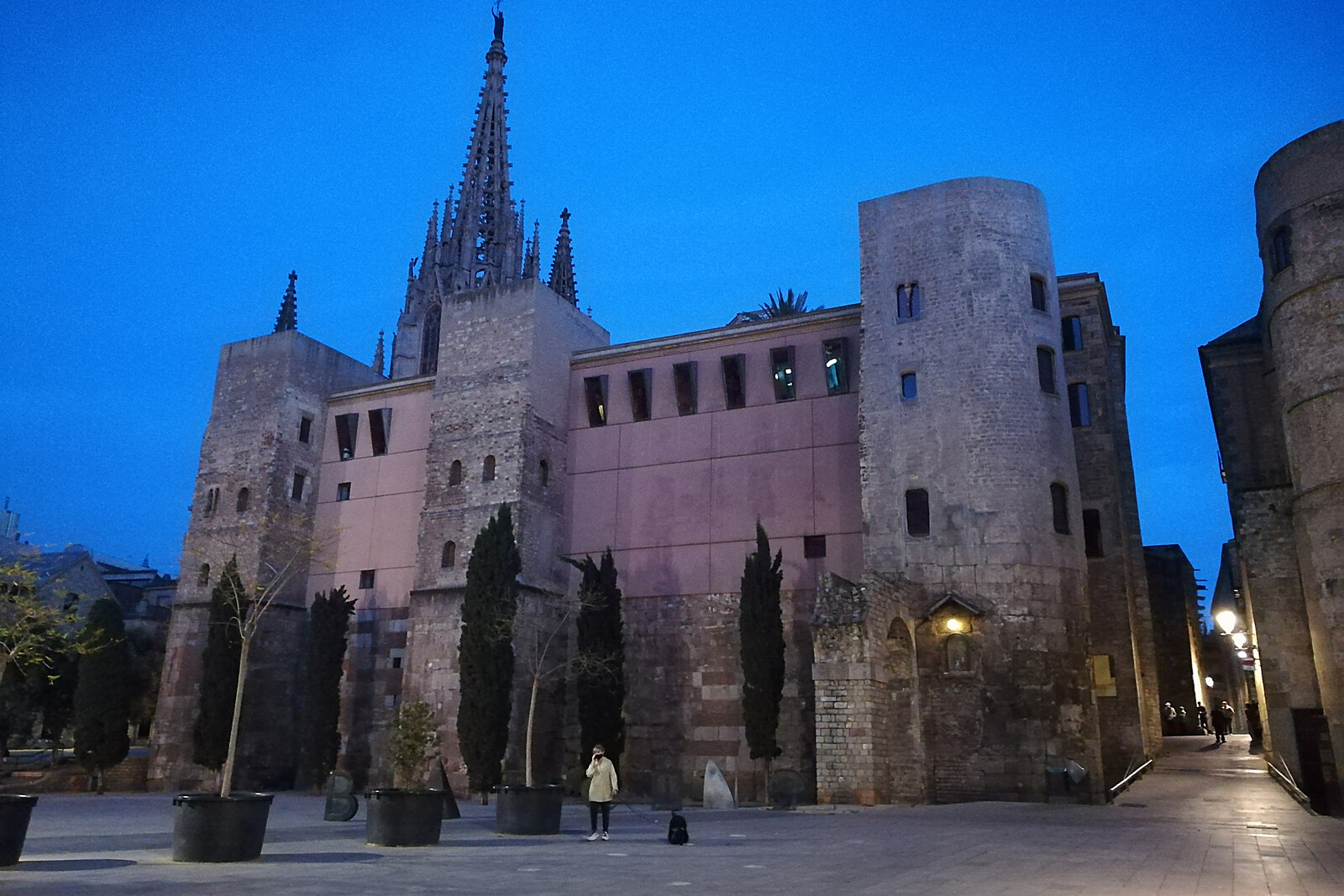
Look around first
What to notice
- Bronze and aluminum “Barcino” letters
- Roman towers and a section of wall
- The surviving side passage of the gate
- The stone arch of the aqueduct
The story of the place
Opposite Plaça Nova, two stone towers of the northwestern gate of ancient Barcino have survived. Carts entered through the middle, while two narrow side passages were left for pedestrians; one of them still exists today. From here, a Roman street led to the forum that occupied the site of present-day Plaça de Sant Jaume, and Carrer del Bisbe retains its direction. Two aqueducts also reached this spot, one from the Besòs River and the other from the slopes of Collserola; the arch by the left tower shows their route, although only its stones are ancient.
The seven letters in the square were intended as a barrier to cars. In nineteen ninety-one, Barcelona was preparing for the Olympic Games, and the architect Rafael de Cáceres, who headed the municipal department of urban projects, was looking for a replacement for ordinary stone bollards. His task was entirely practical: to separate the roadway from the pedestrian area. He proposed that the poet Joan Brossa solve it, since Brossa worked with letters as objects.
Brossa chose the city's name. Because Barcelona was being talked about especially much before the Olympics, he wrote its ancient name—Barcino. It was part of the long official title of the Roman colony founded under Emperor Augustus between the fifteenth and tenth years before the Common Era. For the seven letters, Brossa devised different forms: he turned the “A” into a pyramid and placed an accent mark above it, made the “C” a crescent moon, the “O” a sun, and gave the aluminum “N” the form of a Mediterranean sail. The remaining letters were cast in bronze.
The name was chosen specifically for this spot because of the stone towers opposite. Between them was the northwestern entrance to Barcino. Carts passed through its wide central opening, while pedestrians used the two side passages. One side passage has survived. Beyond the gate began a Roman street whose direction is repeated by present-day Carrer del Bisbe. It led to the city forum on the site of Plaça de Sant Jaume.
Two aqueducts also reached this place—one from the Besòs River, the other from the slopes of Collserola. The stone arch by the left tower shows their route, but it is ancient only in its material: the archaeologist Josep Serra-Ràfols proposed assembling this reconstruction in nineteen fifty-eight. Parts of the gate, wall, and towers remain Roman.
While Brossa was preparing the letters, the municipality decided not to use them for vehicle traffic and installed ordinary bollards. De Cáceres's plan as a traffic device did not come to fruition. Brossa was initially offered the option of arranging the work along the wall of the city archive and surrounding it with a lawn, but in the final version the letters were placed across the open space so they could be walked around from all sides.
In nineteen ninety-four, the metal word was installed at the boundary between Plaça Nova and Avinguda de la Catedral. Cars are stopped by separate bollards, while the seven former barriers stand before the gates of the city whose name they spell.
Useful on site
Open around the clock; the walls and aqueduct are accessible from outside.
Checked: June 28, 2026. Check the official source before visiting.The main details are visible from the square. Distinguish the reconstructed arch from the authentic fragments of wall.