 Guide On Map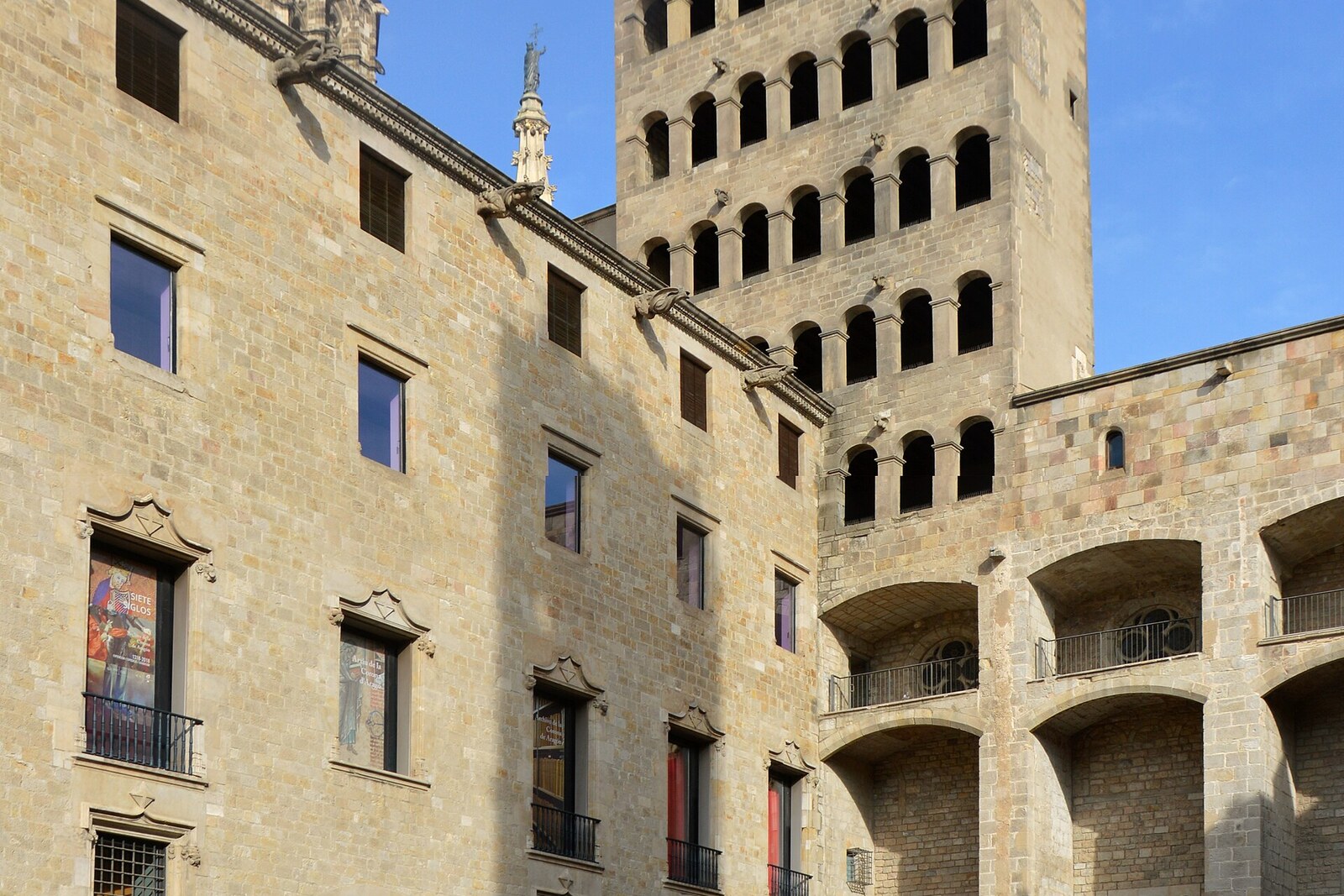
Look around first
What to notice
- Casa Padellàs
- Supports beneath the palace
- Roman street
- Basins of the laundry and dye works
The story of the place
Beneath the square lies a Roman quarter covering nearly four thousand square meters: a street runs between basins for washing and dyeing textiles, fish workshops, and a winery. North of the forum, fish traders, launderers, and dyers worked side by side here, salted the catch, and made garum. Later, buildings of the early episcopal complex appeared in the quarter. Supports and beams above the ancient walls hold up a city palace, which is why the ruins have remained where they were uncovered.
In nineteen thirty-one, workers found an intact Roman amphora in a foundation trench. The foundation was intended for a house that had formerly stood in another part of Barcelona.
Casa Padellàs, a merchant palace from the early sixteenth century, faced demolition during the construction of Via Laietana. The municipality decided to move it from Carrer dels Mercaders to Plaça del Rei. The façades and courtyard were dismantled, and the stones were numbered. A suitable plot had just become vacant on the square. The palace was to be rebuilt here and given to the municipal art school, Massana School.
Before construction began, Agustí Duran i Sanpere, director of the Barcelona City Historical Archive, asked permission to investigate the site. The Roman wall ran very close by, and streets of Barcino might lie beneath the square. Duran had been seeking a permanent museum of city history since nineteen twenty-five, but after the temporary exhibition he organized, the museum was once again left without premises.
Municipal officials provided no money for excavations. The builders hurriedly poured broad concrete foundation walls. Duran intervened beyond the scope of his position: he was paid to run the archive and risked being accused of meddling in someone else's work.
The discovery of the amphora forced the municipality to change its decision. The concrete already laid over the ancient quarter had to be broken up. Excavations continued, and beneath the future house appeared a Roman street, basins from a laundry and dye works, rooms for cutting up and salting fish, containers for garum, and a winery. Here, north of the forum, launderers, dyers, fish traders, and winemakers worked from the second century onward. Later, buildings of the first episcopal complex occupied part of the quarter.
The municipality ordered the walls and containers to remain where they had been found. Casa Padellàs was reassembled above them on columns and beams. Duran extended the excavations onto the square, but during the Civil War the exposed areas had to be backfilled so that they would not threaten neighboring buildings. In nineteen forty-three, the Barcelona History Museum opened in the relocated palace, and Duran became its first director.
The present underground route, covering around four thousand square meters, runs among remains that were not moved into museum galleries. The house was moved above them. Its supports still stand today over the very Roman walls for whose sake the already completed concrete had to be broken up.
Useful on site
Tue–Sat 10:00–19:00, Sun 10:00–20:00; closed on Mondays and holidays; free on Sundays after 15:00.
Checked: June 28, 2026. Check the official source before visiting.The Roman quarter is accessible only as part of a museum visit; plan it separately. Outside, only the square and the palace façades remain.