 Guide On Map
Acropolis and Two Agoras: How Athens Changed
From the Theatre of Dionysus through the Acropolis and Ancient Agora to the Tower of the Winds
Guide On Map on your phone
Open the walk like a regular app
It takes about 10 seconds to install. No app store needed.
The whole path
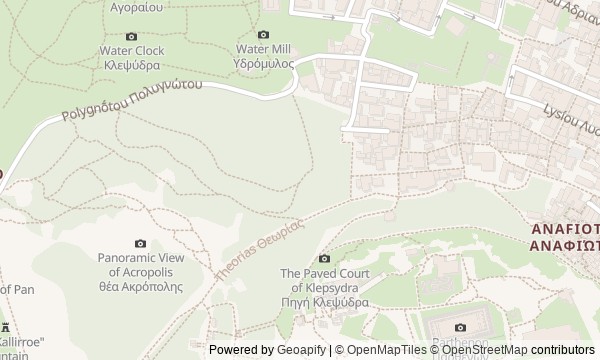
Route map
About the walk
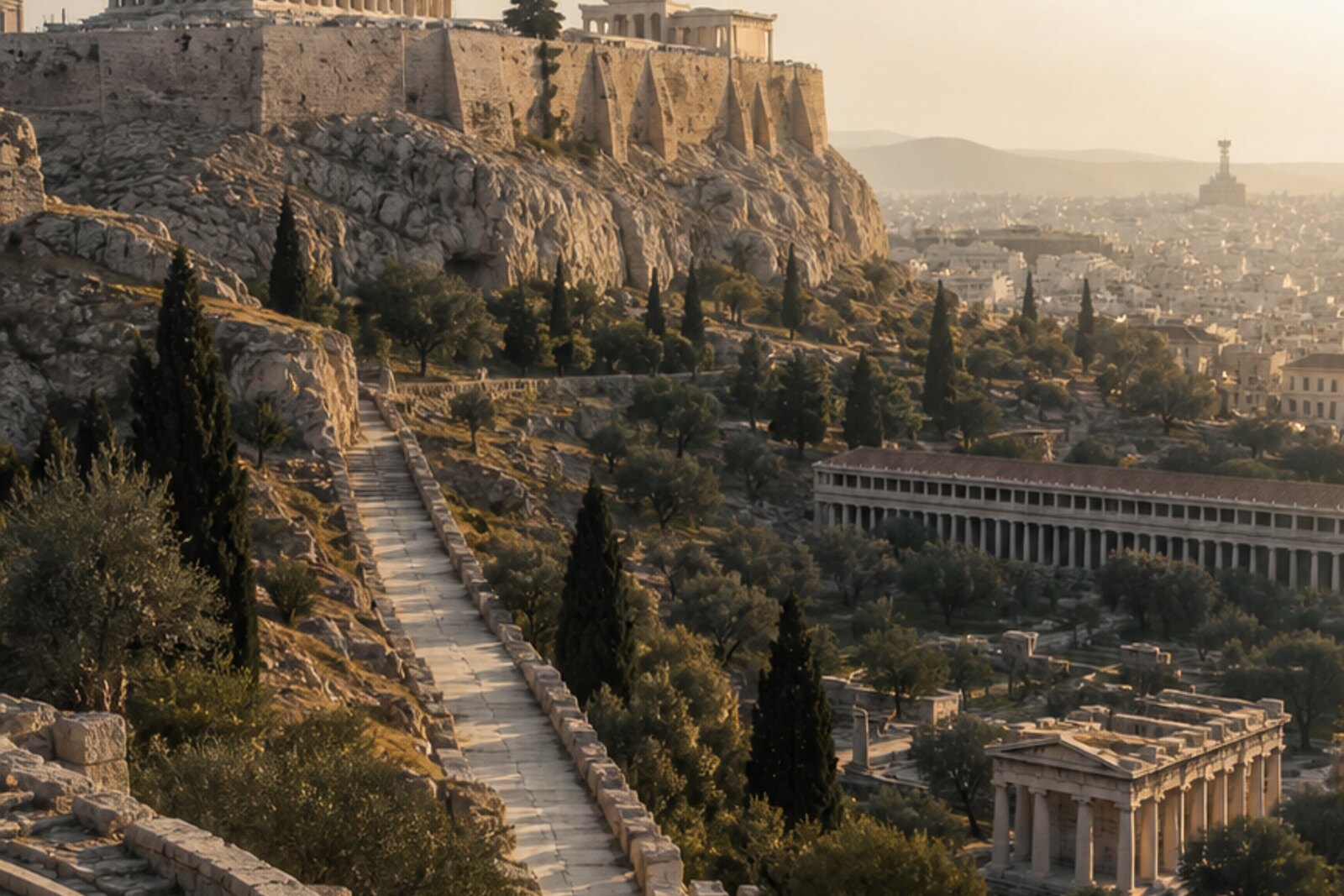
You will begin on the South Slope of the Acropolis, among the theatre seats, then climb to the Parthenon and Erechtheion. From the temples, the route descends to the rock of the Areopagus, crosses the Ancient Agora, and ends at the Roman market and the Tower of the Winds.
This is not Athens from a single age. At the summit, you will find a breach in a marble temple and six identical maidens, none of them an ancient original. Below are the round foundations of an official building, a temple with the wrong name, and an ancient inscription built into an almost new structure.
The story rests on people's decisions: to weep together in a theatre, refuse an order, remove a single statue, finish a father's work. The answers appear only on site, beside the objects that preserved them.
After the walk, you will be able to lead friends from the priest's seat to the eight winds and explain why a temple kept the wrong name, and why a restored stoa bears an ancient donor's inscription.
Why this order
The theatre on the south slope sets the route's first theme: how a personal experience became a civic matter. From the seats, the path climbs to the Parthenon, where the consequences of one military decision are visible in the building's very scale. The neighboring Erechtheion continues the conversation about the fate of marble: after an entire temple was destroyed, you will see the empty place that had to be filled with a copy.
Through the Acropolis's western exit, the route descends to the Areopagus. After the sanctuaries comes another way of resolving conflict—trial and reconciliation. At the foot of the rock begins the Ancient Agora: a mythic trial gives way to the preserved place where a real order demanded a personal response.
From the Tholos, the path climbs to the Temple of Hephaestus. From above, you can see just how closely state buildings stood to workshops and markets. The route then crosses the square to the Stoa of Attalos, where ancient trade sits inside a modern reconstruction bearing the genuine inscription of its donor.
The final stretch leads from the Ancient Agora to the Roman Agora. The new market continued the old commercial function, but its gate named Roman patrons instead. The Tower of the Winds completes the route where the city market needed wind direction and precise time.
Those visiting the Acropolis for the first time and wanting to continue their walk through the city Those who care about the human actions behind familiar monuments Those who enjoy checking legends against inscriptions and traces on site
Those who want to stick to panoramic views and the main photo spots Those who find long walks over stone and stairs difficult Those looking for a complete overview of ancient Athens
Before you go
The route passes through several archaeological sites, and access to them may be arranged separately. Before setting out, check the current entry rules and restrictions at the official sites, especially for the Acropolis, Ancient Agora, and Roman Agora. It is best to begin on the south slope; otherwise, the sequence of the story falls apart.
Wear shoes with grippy soles: the marble and rock are polished and can be slippery even without rain. Bring water and sun protection—the route is largely exposed. Do not expect a fully accessible passage: climbs, steps, and ancient surfaces require a reserve of energy.
When to go
Choose a part of the day with gentler light and less heat; allow time for stops along the whole route, not just for getting from place to place.
Backup plan
If access to the Acropolis is restricted or the climb proves too demanding, do not try to make up the route at a run. Save the upper stops for another day, and continue today's walk from the Areopagus through the Ancient Agora to the Tower of the Winds: the lower section holds its own thread of trial, market, craft, and time.
If you get tired, it is easy to split the route after the Areopagus or the Stoa of Attalos. If a separate site is closed, see only what is honestly visible from public space, and do not go beyond barriers for the angle you need.
Route conditions
Surface. Paved — 2.2 km; unpaved — 776 m
Stairs. Flights: 6, 72 m in total
Access. Wheelchair — no; stroller — limited (stairs)
Facilities. Toilets — 6; drinking water — 10
Elevation. Ascent — 26 m; descent — 73 m
OpenStreetMap extract of August 12, 2026: database data, not a check on the ground. Data © OpenStreetMap contributors, ODbL licence
Walk plan
Open in maps ↗- 1
The South Slope and the Theatre of Dionysus
Here the route begins with the moment when the theatrical competition became the business of the whole city. - 2
Parthenon
The breach at the center of the building reveals the outcome of a victory that did not help Venice hold Athens. - 3
Erechtheion
The porch will show how the removal of one original changed the fate of all six statues. - 4
Areopagus
The mythical trial explains why it was not enough for the city to deliver a verdict—it also had to reconcile the winners and the defeated. - 5
The Heart of the Ancient Agora
The round foundation shifts the discussion of power from a mythical court to one man’s refusal to carry out an order. - 6
Temple of Hephaestus
An error in the name will connect the ancient temple with the choice of a new capital and today’s map of Athens. - 7
Stoa of Attalos
Here, an authentic inscription makes it possible to distinguish an ancient royal gift from a modern reconstruction. - 8
Roman Agora and the Tower of the Winds
The finale will bring together a market square, a family obligation, and devices that measured wind and time.
Route features
Everything you need stays in the browser
Progress, saves and your trip plan are stored on this device.
Add Guide On Map to your home screen so the walk opens outside the browser.
How we handle sources, maps and corrections: our editorial standards