 Guide On Map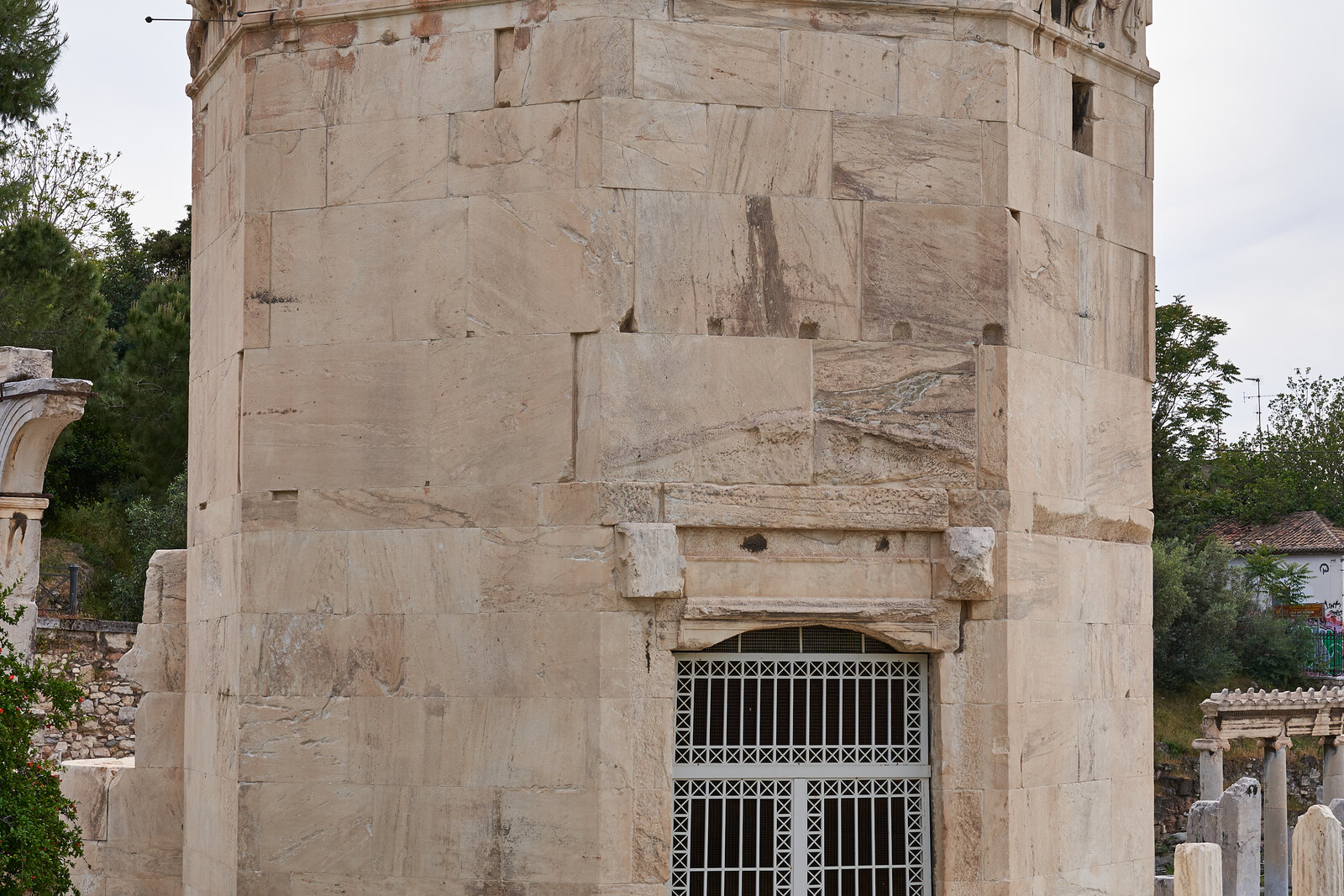
Look around first
What to notice
- Gate of Athena Archegetis
- Inscription on the architrave
- Eight wind reliefs
- Sundial lines
The story of the place
Olive oil producers gave the city a fixed share of the harvest, while merchants recorded their purchases. These rules were carved by the main passage of the Roman Agora. Covered stoas with shops and storerooms surrounded its rectangular courtyard. At the eastern exit stands the eight-sided Tower of the Winds: a relief of a wind survives on each side, with sundial lines below. The bronze Triton on the roof has disappeared, as has the water device inside; channels and openings where pipes entered remain in the floor.
Eukles of Marathon inherited from his father an unfinished civic building project and the obligation to bring it to completion. An inscription on the western gate calls him strategos of the hoplites—at that time the highest office in Athens—and explicitly says that he inherited the care of the market from his father, Herod.
Herod secured money from the Roman commander Julius Caesar: around fifty-one BCE, Caesar granted the Athenians fifty talents of silver. These funds were intended for a new market square east of the old Ancient Agora. Soon the Roman civil war began, the Athenians supported Caesar’s rival Pompey, and work stopped. It is unknown whether the first sum proved insufficient or whether the payments ceased because of that choice. Herod died, and the market remained unfinished.
Eukles took on his father’s obligation and went as an envoy to Augustus, Caesar’s adopted heir and the first Roman emperor. Augustus gave a second donation. The Athenians enclosed a rectangular courtyard with stoas, set up shops and storerooms beneath them, and gave the western entrance four Doric columns. This was how the Roman Agora appeared: the Athenians built it, and two Roman rulers paid for it.
The gate’s architrave lists the whole sequence. The people of Athens dedicate the structure to Athena Archegetis—Athena the Founder—with funds from “the god Julius Caesar” and “Augustus, son of a god.” By the time the market opened, Caesar had already been killed and deified, which is why his successor is called the son of a god. Eukles’ name is carved next: he inherited the responsibility from Herod and served as an envoy. Several decades of one family’s efforts became a line above the entrance.
Beyond the gate, people traded in covered galleries, stored goods, and settled disputes under the supervision of market officials. Later, Emperor Hadrian ordered a law on the sale of olive oil to be carved here. Producers had to yield the city a fixed share of the harvest, and merchants had to register their purchases. The text was placed by the main passage, where those involved in transactions could see it.
Near the market’s eastern exit, there already stood a structure by the engineer and astronomer Andronicus of Cyrrhus. The exact date of its construction remains disputed, but Andronicus erected it before Eukles completed the Agora. He gave the tower eight sides and carved above each one a wind blowing from the corresponding point of the compass. The winds’ names were carved beside the figures—hence its present name, the Tower of the Winds.
On the roof, Andronicus installed a bronze figure of the sea god Triton. The wind turned the figure, and the staff in its hand pointed to the appropriate relief. Below, sundials were marked out: metal rods cast shadows on lines calculated separately for each side of the tower. A water mechanism operated inside. Archaeologists reconstruct its exact design in different ways; channels and openings for pipes remain in the floor, but the vessels and moving parts themselves have disappeared.
Eukles’ name can still be read on the western gate. The tower retains its eight winds and the sundial lines; the bronze Triton, the shadow-casting rods, and the water mechanism are no longer there.
Useful on site
Follows the Roman Agora’s seasonal schedule; check hours, last entry, and access to the Tower of the Winds on hhticket/ODAP.
Checked: June 28, 2026. Check the official source before visiting.The Roman Agora may require separate admission; if you cannot get inside, the tower and the gate are partly visible from the surrounding streets.