 Guide On Map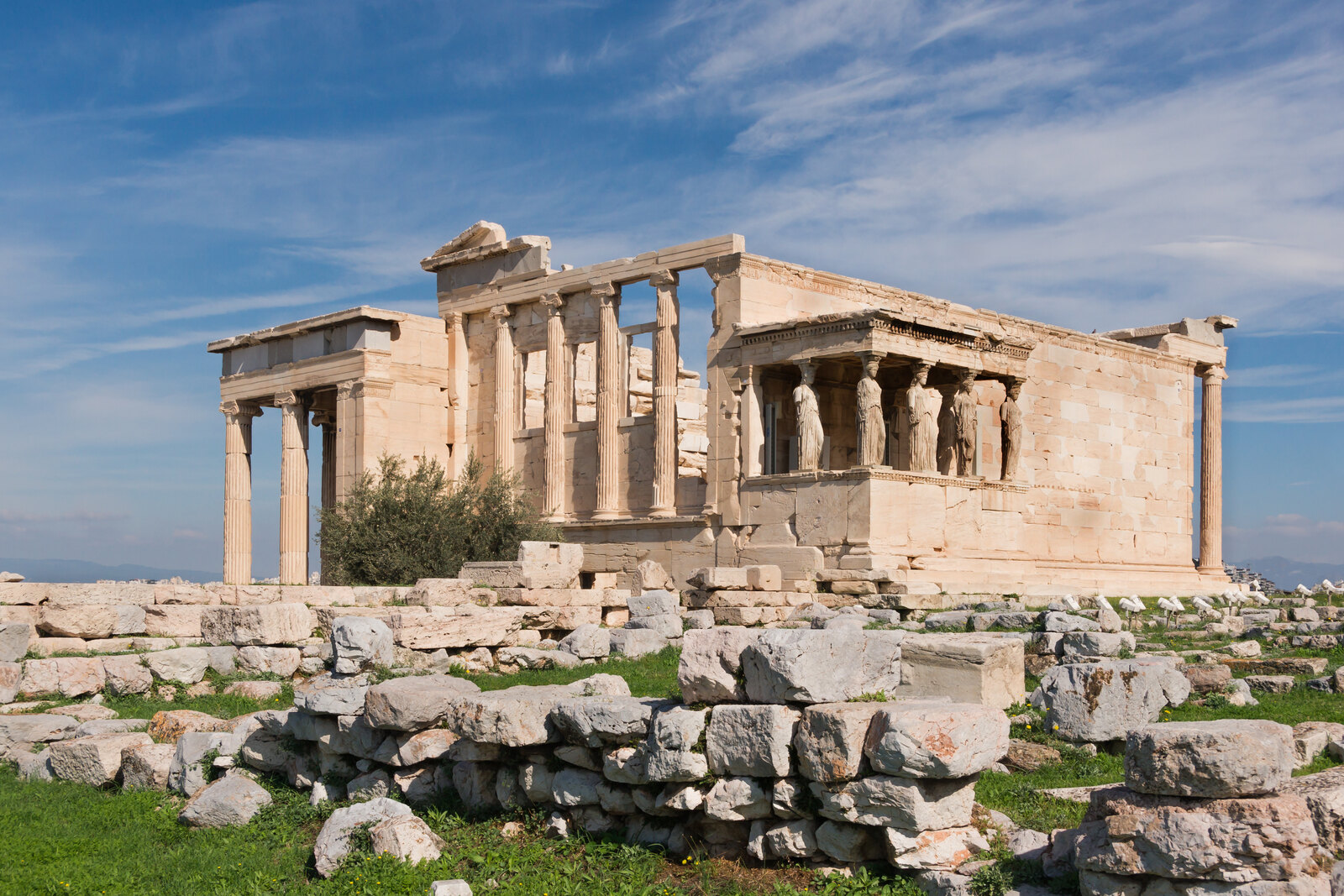
Look around first
What to notice
- Southern porch
- Six Caryatids
- Northern porch
- Different levels of the foundation
The story of the place
The Erechtheion was built around several ancient Athenian shrines, which is why it has no even, symmetrical plan. The northern and southern porches stand at different levels: the architects had to reckon with the uneven rock and with places associated with an olive tree, a saltwater spring, and trident marks. The eastern part housed a wooden image of Athena Polias, while the other part was assigned to the cults of Poseidon-Erechtheus, Hephaestus, and Butes. Even the steps of the foundation here grew out of what was sacred to the Athenians.
At the end of eighteen oh one, Giovanni Battista Lusieri, an Italian artist and manager of the British ambassador's work on the Acropolis, informed his employer that the five marble maidens on the southern porch looked very much alike. He was comparing them in order to choose one to send to Britain.
His employer, Thomas Bruce, 7th Earl of Elgin, served as ambassador at the court of the Ottoman Empire, which then governed Athens. At his own expense, he maintained artists, casters, and workers: first they measured the antiquities and took casts, then they began removing the originals. Members of the team suggested dismantling the entire porch with its six maidens if a suitable ship could be found. No such ship was found.
Lusieri's men dismantled a later wall that almost concealed the figures, in order to determine which one was best preserved and make its removal easier. One Caryatid was detached from the roof structure, lowered, and sent to England. In the vacant place, they built a rough support of stone and mortar: the other five figures continued to hold up the roof beside it.
Each Caryatid here was both a statue and a real support. The six maidens bore the southern porch of a temple in which the Athenians had gathered several ancient shrines. The eastern part housed a wooden image of Athena Polias, the city's protector. The western part was assigned to the cults of Poseidon-Erechtheus, Hephaestus, and Butes. The builders had to take account of the uneven rock and the places that the Athenians considered traces of Athena's dispute with Poseidon: an olive tree, a saltwater spring, and marks of a trident. Hence the different floor levels, the projecting porches, and the unusual plan.
The name now used for the entire building derives from Erechtheus. According to legend, he was an Athenian king who defended the city against the army of Eumolpus, son of Poseidon. Erechtheus killed Eumolpus, and Poseidon avenged his son and destroyed the king. After Erechtheus's death, the Athenians worshipped him here alongside Poseidon under the double name Poseidon-Erechtheus.
Elgin spent about seventy-four thousand pounds on the entire collection he removed. In eighteen sixteen, the British Parliament paid him thirty-five thousand—less than half of his claimed expenses—and handed the marbles over to the British Museum. The Caryatid ended up in the British Museum.
The five remaining originals stood on the porch until nineteen seventy-nine. Then Greek conservators removed them because the marble was deteriorating outdoors and transferred them to the Acropolis Museum. All six figures above the southern wall of the Erechtheion are now made of artificial stone. A copy also stands in the place of the maiden chosen by Lusieri's men.
Useful on site
Follows the seasonal schedule of Acropolis and Slopes; check access to the plateau and the last entry at hhticket/ODAP.
Checked: June 28, 2026. Check the official source before visiting.The figures on the porch are copies; five originals are in the Acropolis Museum, and the sixth is in the British Museum.