 Guide On Map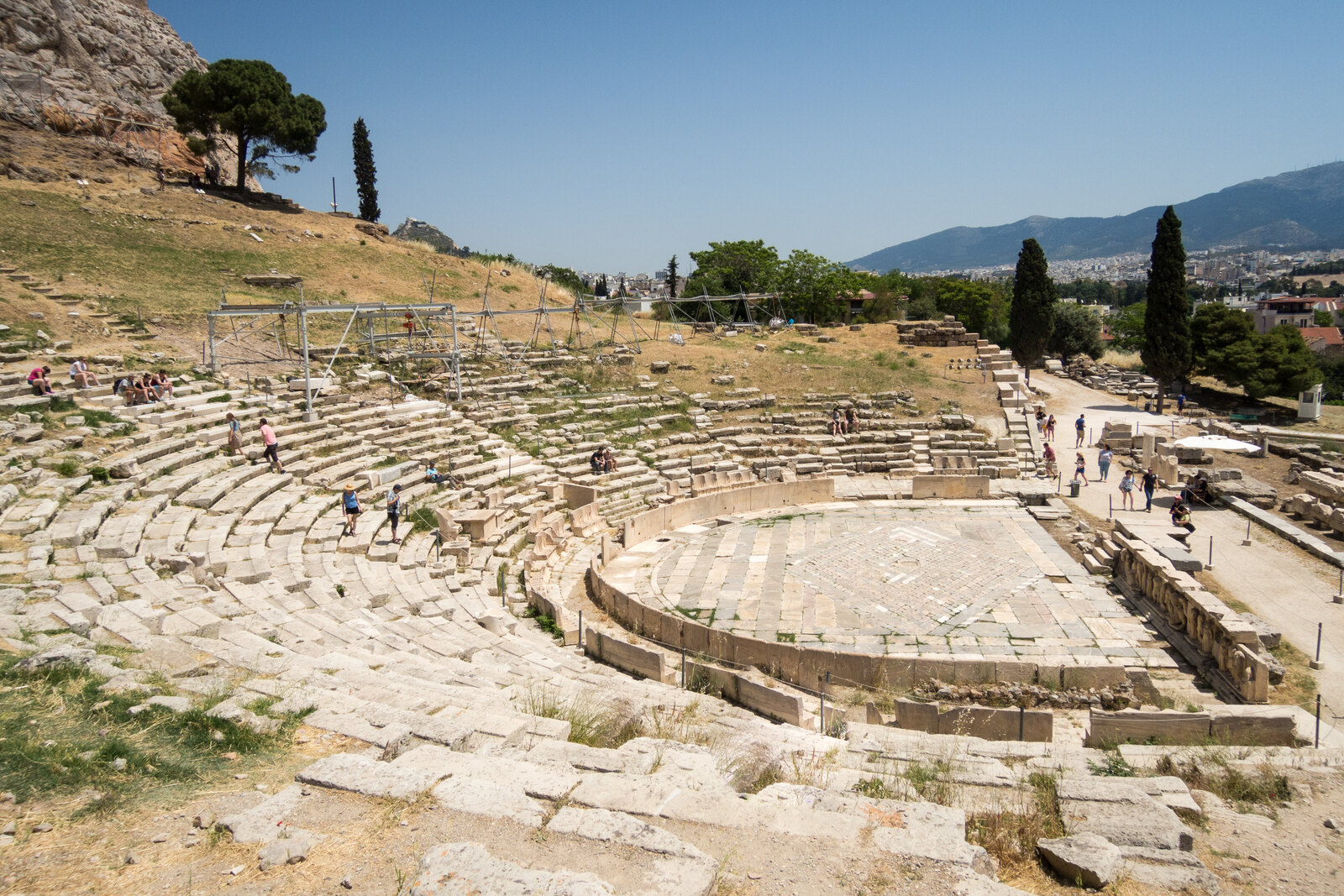
Look around first
What to notice
- Stone seating rows
- The circular orchestra
- The priest’s marble chair
- The foundations of the sanctuary of Dionysus
The story of the place
The stone rows before you appeared about a century and a half after the main story of this theatre. At the beginning of the fifth century BCE, spectators sat here on wooden tiers reinforced on the South Slope of the Acropolis. Below stood the altar and sanctuary of Dionysus Eleuthereus. The epithet meant Dionysus from Eleutherae, the border settlement from which, according to Athenian tradition, an ancient image of the god was brought. During the spring festival in his honor, the city held competitions for choruses and playwrights. That is why the theatrical space arose directly above the sanctuary, while the slope served as the foundation for the spectators’ seats.
Soon after the fall of Miletus, the Athenian playwright Phrynichus presented the tragedy “The Capture of Miletus” here. He was seeking victory in the city competition: the costs of the chorus were borne by a choregos, a wealthy citizen appointed to pay for the performers’ preparation, and the author’s name could, by the judges’ decision, make the list of winners.
Miletus was a Greek city on the Asia Minor coast of the Aegean Sea and a center of revolt against the Persian king. The Athenians themselves made its fate their own concern: the popular assembly sent the rebels twenty warships. After one campaign, the ships were recalled, while the revolt continued without Athenian help. In four hundred ninety-four BCE, the Persian army captured Miletus. Most of the men were killed, the women and children were enslaved, and the surviving captives were resettled at the mouth of the Tigris.
Phrynichus turned this recent catastrophe into a tragedy. The text of the play is lost, so it is unknown whom he made its main character and exactly what he showed on stage. An account by Herodotus, written several decades after the performance, has survived. According to him, the whole theatre wept.
After the performance, the Athenians fined Phrynichus one thousand drachmas and prohibited this play from ever being staged again. Herodotus also gives the reason: the playwright reminded them of their own misfortune. He does not specify whether those tears included remorse over the recalled ships. It is enough that people who had voted to help Miletus saw the consequences of a war from which they themselves had already withdrawn.
One thousand drachmas was a severe penalty. For a rough sense of scale, later in the fifth century one drachma could equal a skilled worker’s daily wage. It makes no sense to convert ancient money directly into modern currency, but this was a sum comparable to several years’ earnings.
The fine did not end Phrynichus’s career. In four hundred seventy-six BCE, he won the tragedy competition here again. The choregos for his production was Themistocles, an Athenian politician who paid for the chorus and shared the poet’s struggle for victory. Plutarch later cited the inscription on their commemorative plaque: Themistocles, choregos; Phrynichus, poet.
The wooden seats from which the Athenians watched “The Capture of Miletus” are gone. Archaeologists found holes in the ground from rectangular supports and impressions of timber. The stone tiers belong to a later reconstruction, and at the center of their later first row a marble chair survives, inscribed for the priest of Dionysus Eleuthereus. Not a single line remains of the banned play that made the theatre weep.
Useful on site
Follows the seasonal schedule of Acropolis and Slopes; book a timed slot and check the last entry on hhticket/ODAP on the day of your visit.
Checked: June 28, 2026. Check the official source before visiting.Stop where the entire bowl can be clearly seen; do not go down into closed areas for a photograph.