 Guide On Map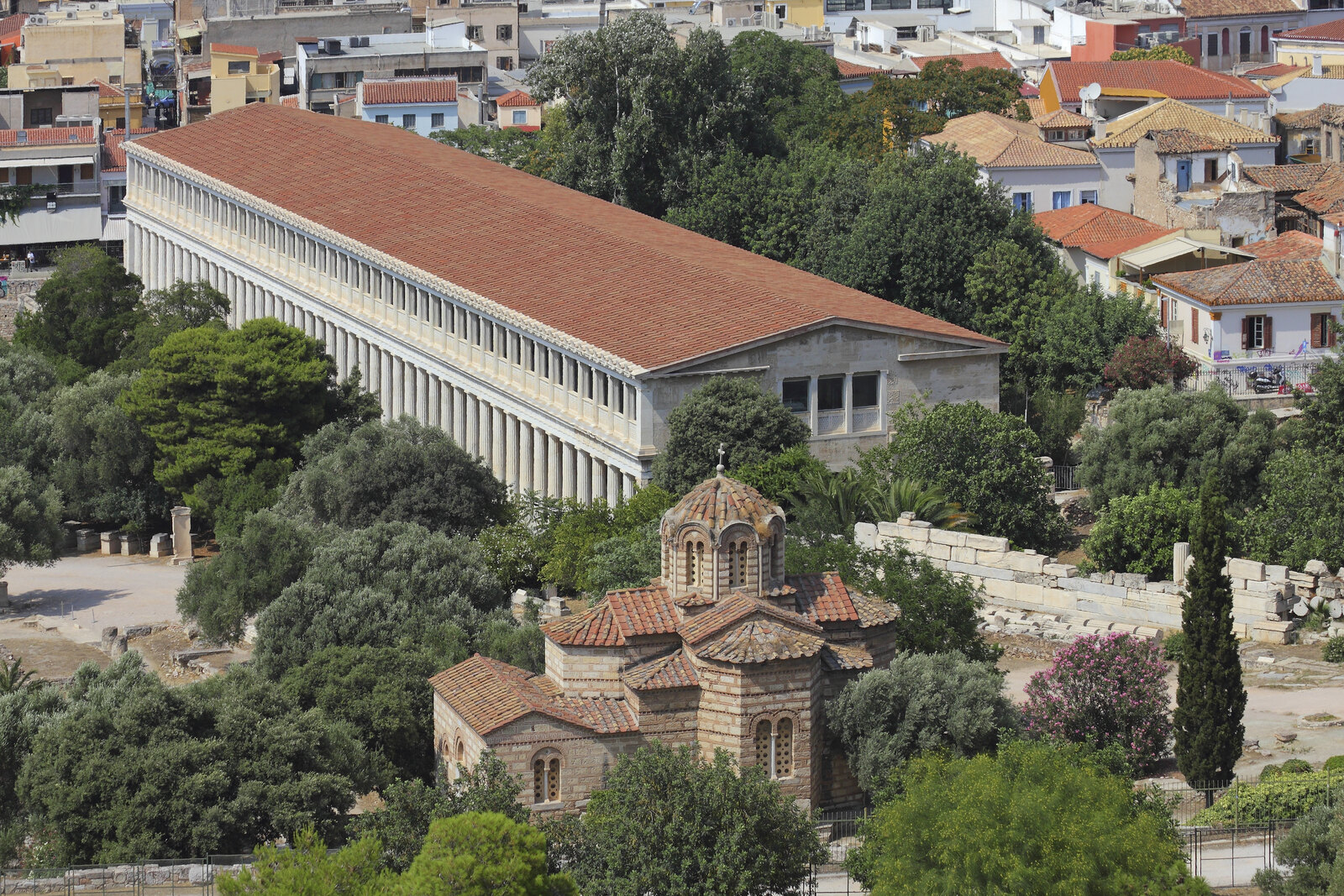
Look around first
What to notice
- Two-level colonnade
- Ancient architrave blocks
- Marble staircase
- Museum display cases
The story of the place
The two-level colonnade along the eastern edge of the Ancient Agora runs for more than one hundred meters; the museum now stands behind its facade, rather than a row of operating shops. Most of the building was rebuilt in the twentieth century after the excavations, but ancient stone parts of the architrave were returned to the facade. In antiquity, there were separate rooms on both floors, which the city rented to merchants, while the covered walkway sheltered people from sun and rain. Among the even new stone, the old blocks stand out at once and preserve the inscription we will return to shortly.
At the age of sixty-two, Attalus II became the sole king of Pergamon—a wealthy state in western Asia Minor—for the first time. Before that, he had served his older brother, Eumenes II, for decades. Now he had to preserve both the kingdom and the connections their family had acquired in Greek cities. Such connections were maintained with money: the kings of Pergamon spent income from their lands on buildings in Athens, Delphi, and other places where the donor's name could remain in view for generations.
Around one hundred fifty BCE, Attalus II paid for construction on the eastern side of the Ancient Agora. The result was a two-story covered walkway more than one hundred meters long. Colonnades ran along its facade, with separate rooms behind them on both floors. The Athenians rented most of these spaces to merchants. The townspeople gained shops, a place to meet sheltered from sun and rain, and a steady rental income. The king gained a place in the city's everyday life: people who came to shop or stopped to talk read his name above the entrance.
The architrave was inscribed: “King Attalus II, son of King Attalus and Queen Apollonis...” The continuation survives in fragments, and scholars reconstruct it differently: perhaps it listed the stoa itself, the rooms, and the workshops given to Athena. This gift is often called Attalus's gratitude for his education in Athens. The surviving inscription gives no such reason. Yet it does answer the question of the name exactly: the Stoa of Attalos is named for the king who paid for the building and ordered himself and his parents inscribed on it.
The shops operated for several centuries. In two hundred sixty-seven CE, during the attack of the Heruli, the wooden parts of the stoa burned down. The Athenians then dismantled a substantial part of the damaged building and used its stones in a late Roman defensive wall. Of the royal gift, there remained the foundation, parts of the walls and columns, and the architrave, broken into fragments, with Attalus's name.
It was only in the twentieth century that an almost complete building appeared before the ancient remains. After many years of excavations, the American School of Classical Studies at Athens needed a place for the objects found in the Agora. Homer A. Thompson, the director of the excavations, proposed rebuilding the stoa at full size and turning it into a museum. The project was expensive and controversial: archaeologists usually consolidate authentic ruins, while here they intended to rebuild the vanished floors, roof, and dozens of columns. John D. Rockefeller Jr. provided the main funding; Greek stonemasons and carpenters worked with local limestone, Pentelic marble, and Attic clay. The museum opened in nineteen fifty-six.
The builders inserted the authentic fragments of the architrave bearing the king's name into the new facade at their former height. There are no rented shops behind the columns now: judicial tokens, bronze ballots, weight measures, and other finds from the Agora are displayed there. Most of the stoa is two thousand years younger than these objects, while the name for which Attalus once paid for the market rows survives in ancient stone.
Useful on site
Follows the seasonal schedule of the Ancient Agora and Museum of the Ancient Agora; check hours and last entry on HHTicket/ODAP.
Checked: June 28, 2026. Check the official source before visiting.Do not mistake the building for a completely preserved ancient original; check access to the museum halls on site.