 Guide On Map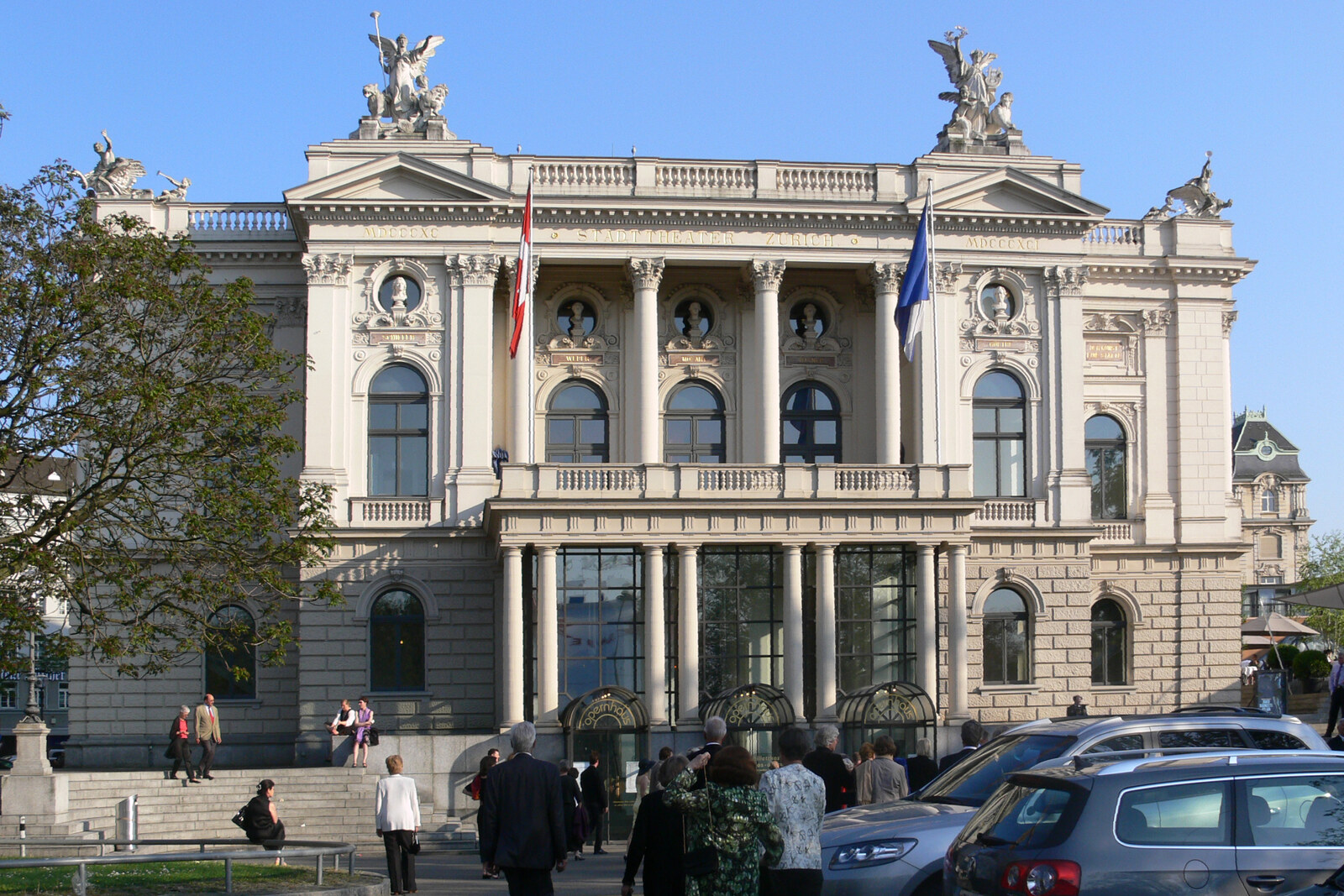
Look around first
What to notice
- Golden inscription on the side wing
- Figures on the facade
- Gilded details on the facade
The story of the place
The auditorium behind this facade still serves as the city's main stage. The lakeside site was chosen after a neighboring municipality offered the city money for the theater, expecting an audience for nearby establishments. The building itself was paid for by the owners of theater shares, while patrons added the figures and gilding to the facade. The theater received its current name later, but the stage remained the same.
On the theater's side wing, a phrase is carved in gold letters: “Dedicated to art through the goodwill of the citizens.” It records who secured the building's appearance here and paid for it.
On the night of January first, eighteen ninety, the old Aktientheater on Hirschengraben—the first permanent theater in Zurich—burned down. The chairman of the theater society led the audience out of the burning hall; no one died. After the fire, the wealthy silk manufacturer Robert Schwarzenbach, who headed the society's board and had been pressing for a new theater, rejected a temporary venue. It would have allowed officials to postpone the major construction. Schwarzenbach promised to open a new hall by the next theater season.
The society issued seven hundred fifty shares at one thousand five hundred francs each. Each entitled its holder to lease two privileged seats in the boxes or gallery. At first there were too few buyers, and the subscription deadline had to be extended, but a provincial newspaper's mockery stung wealthy Zurich residents: within a week, all the shares were taken.
Land was now needed. Heimplatz by the present-day Kunsthaus Zürich and a site on Utoquai, then called Dufourplatz, were discussed. Neighboring municipalities expected the audience to bring money to nearby establishments and began offering the city subsidies. Riesbach allocated fifty thousand francs on the condition that the theater be built by the lake. The deputies chose this site. The city paid to reinforce the marshy ground, the shareholders paid for the building itself, and patrons paid for the figures, frescoes, and gilding. Twenty-one months later, the Municipal Theatre opened here.
Forty-six years later, its stage saw a premiere that determined the fate of one of the twentieth century's major operas. The Austrian composer Alban Berg was writing Lulu during the years when Nazi officials declared atonal music degenerate and German theaters stopped staging his earlier opera Wozzeck. Berg was losing royalties and preparing an orchestral suite, hoping to interest at least a foreign stage. In December nineteen thirty-five, he died suddenly, having fully orchestrated only the first two acts of Lulu and parts of the third.
The composer's widow, Helene Berg, wanted to bring his final work to the stage. She asked Arnold Schoenberg and Anton Webern to complete the orchestration, but both refused. Then the conductor Robert Denzler undertook to stage what had been preserved here, in Zurich. On June second, nineteen thirty-seven, Bahrija Nuri-Hadžić became the first to sing Lulu. After two acts, the performers had to replace the missing third with a pantomime set to two completed excerpts from the suite.
The success of this production convinced Helene Berg that the opera could exist in the Zurich version. She began preventing other musicians from completing the score and restricted access to her husband's manuscripts. For almost four decades, theaters performed only two acts.
The composer Friedrich Cerha secretly restored the orchestration of the third act. After Helene's death, her foundation tried to stop the complete production through the courts, but lost. In nineteen seventy-nine, the three-act Lulu was performed for the first time in Paris.
The building by the lake received its current name—Zurich Opera House—in nineteen sixty-four. The main stage remains behind the same facade where the first Lulu ended with a pantomime; its true third act was heard complete only forty-two years later.
Useful on site
The exterior is accessible from outside; performances and tours only according to the Opernhaus Zürich schedule and with tickets.
Checked: June 27, 2026. Check the official source before visiting.The account concerns chiefly the building and the space in front of it, so no ticket is required. A performance or an interior tour must be planned separately.