 Guide On Map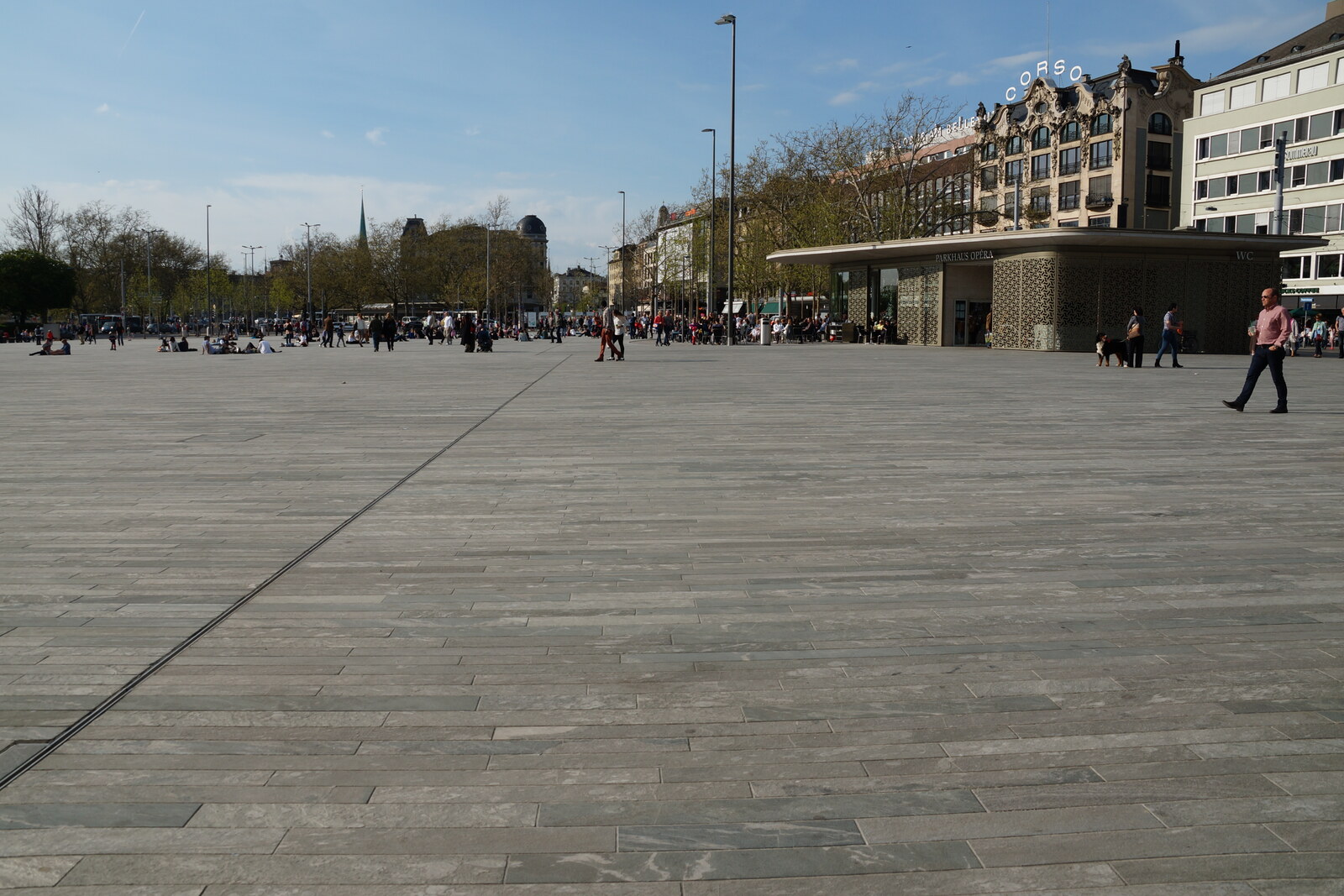
Look around first
What to notice
- The quartzite surface of the square
- The open center of the square
- Bellevue tram stops
- The former building of the Grand Hotel Bellevue
The story of the place
South of the Bellevue tram stops lies a broad square, almost entirely paved with Vals quartzite. A garage was built beneath the slabs, allowing cars to be removed from the surface and leaving a free center for large city gatherings. This site was once occupied by the old Tonhalle, a concert hall converted from a grain warehouse. At the northern edge stands the former building of the hotel from which Bellevue received its name.
Two neighboring squares meet here. The northern one, with tram stops, is called Bellevue. The broad stone rectangle to the south is Sechseläutenplatz, the square of the Bell at Six. In conversation, Zurich residents often call this entire junction Bellevue.
The bell at six originally marked working hours. Zurich's guilds—associations of craftspeople and merchants—set rules for workshops, including the length of the working day. In winter, work ended at five because of the darkness. After the spring equinox, craftspeople worked an hour longer. Since fifteen twenty-five, documents have mentioned the Grossmünster bell, which announced the first spring end of work at six.
For a workshop owner, that strike meant a very tangible change: a shoemaker, tailor, or butcher gained another hour of daylight for orders. Guild brothers marked the transition to the summer schedule with a shared meal. That is how the name Sechseläuten, meaning “bell at six,” became attached to the spring gathering.
The snowman itself appeared in this story much later. In the early nineteenth century, boys from the Kratz Quarter, which lay between the Fraumünster and present-day Bürkliplatz, wheeled straw-stuffed figures through the streets, hid pyrotechnics inside them, and burned them on spring bonfires. The word Böögg then meant a costumed or frightening figure; it was not yet necessarily a snowman.
Heinrich Cramer, a master butcher from Zunft zum Widder and the director of the city's festive processions, decided to give the boys' undertaking a lasting structure. In eighteen sixty-two, he organized the first organized children's parade. The Böögg was carried in the procession, which ended with the burning of the figure. Cramer died nine years later and did not see the main consequence of his work: in eighteen ninety-two, the Central Committee of the Zurich Guilds added the burning of the Böögg to the official Sechseläuten program. The boys' scattered bonfires and the guild festival became a single event.
It still needed a permanent square. The old Tonhalle stood where the current stone surface is now—a concert hall converted from a grain warehouse. The building was dismantled in eighteen ninety-six. The Böögg was burned on the cleared site in nineteen oh two, and since nineteen oh four, the bonfire has been held here permanently. In nineteen forty-seven, the city council replaced the name Tonhalleplatz with Sechseläutenplatz. The square received its name from the action that had been repeated there for more than forty years.
Now, on one of April's Mondays, guild columns gather here after a procession through the center. Riders circle the bonfire, and at exactly six, the organizers set fire to the hand-stacked bundles of wood. The Böögg stands on top in the form of a snowman; its head is still packed with pyrotechnics. The time until the explosion is jokingly taken as a sign of the coming summer—this is festive divination, not a weather forecast. The next day, nothing remains of the main object of celebration, but Cramer's Sunday children's parade and the Monday burning still follow one another.
For most of the twentieth century, cars were parked here between festivals. After an underground garage was built, the site was cleared and covered with Vals quartzite in two thousand fourteen. Before the Böögg is burned, city services lay a fire-resistant layer over the stone: it protects the slabs from heat and gives the horses footing. The open center is needed by the square both on ordinary days and for the few events that occupy it completely.
The name Bellevue came by another route. In eighteen fifty-six, the Grand Hotel Bellevue—“Beautiful View”—appeared at the northern edge. The hotel gave its name to the square and the transport junction. Its former building survives, although it has had no hotel rooms for a long time. That is why the tram section bears the name of the old hotel, while the stone space beside it bears the name of the bell, the working hour, and the bonfire.
Useful on site
The square is open as an urban space; access may change during Sechseläuten, the circus, markets, and other events.
Checked: June 27, 2026. Check the official source before visiting.The Böögg appears here only during the festival; there is no need to look for it on an ordinary day. When crossing the tram tracks, watch for traffic from several directions.