 Guide On Map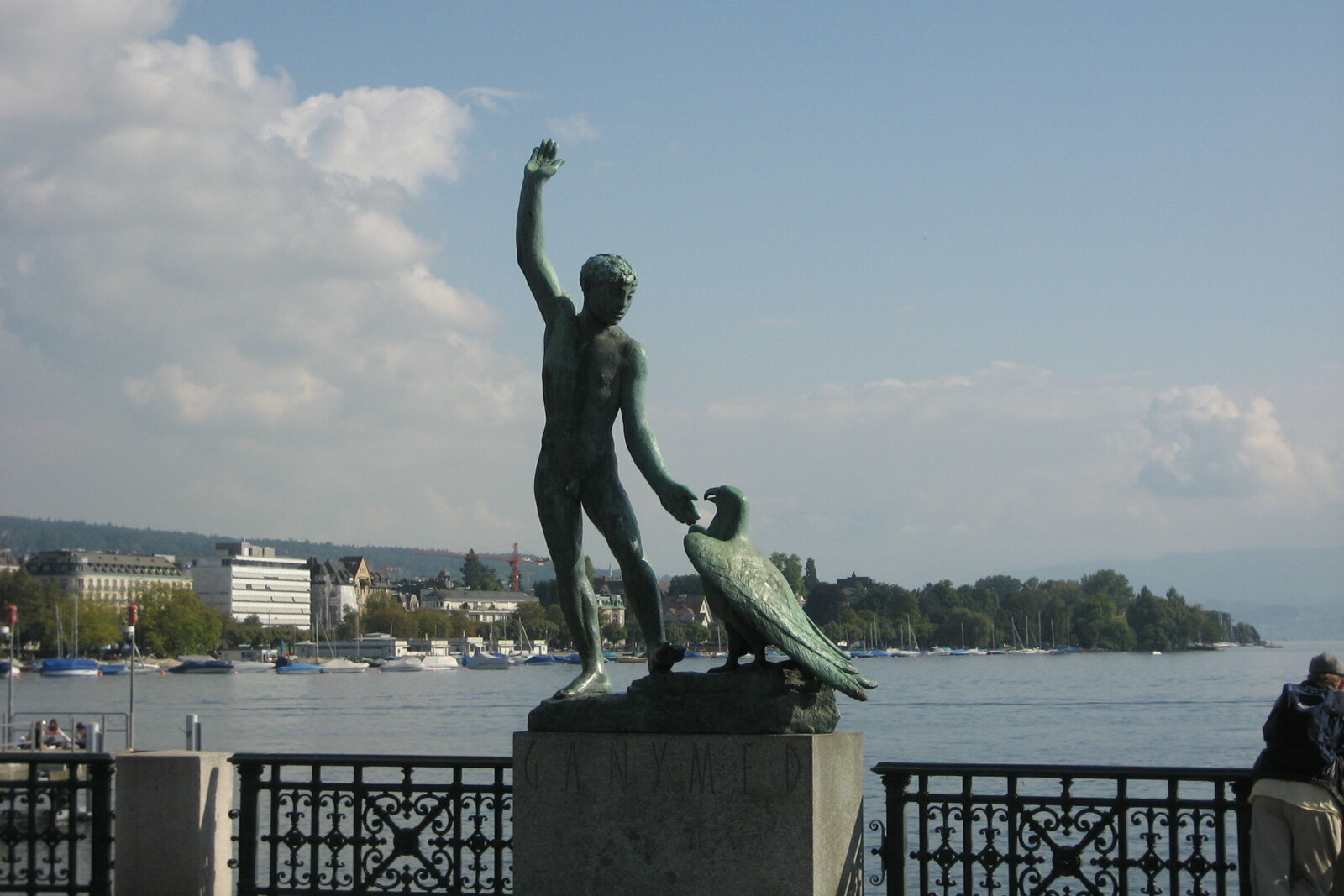
Look around first
What to notice
- Ganymede’s raised right arm
- The eagle beside the figure
- The granite pedestal
- Wölfflin’s name and lines by Johann Wolfgang von Goethe
The story of the place
At the lake-facing edge of Bürkliplatz stands “Ganymede”: the youth’s right hand is raised toward the sky, and the eagle sits beside him. The granite pedestal does not stand on the old natural shoreline: the land beneath it did not exist before. Over five years, builders filled in more than twenty-one hectares along the shore, connected the banks with a bridge, and created a promenade along the water. The square occupies part of this reclaimed land.
Bürkliplatz connects Bahnhofstrasse with the lake. Sightseeing boats depart from the piers, a food market spreads out beneath the trees on Tuesdays and Fridays, and a flea market does so on Saturdays in summer. There is room here for trade, celebrations, and transfers because almost the entire square was created on land reclaimed from the lake.
In the eighteen seventies, a private railway company planned to run tracks along the shore and complete a loop around the city’s southern edge. Zurich residents called the project the “iron ring”: trains and embankments would have cut the center off from the water. City engineer Arnold Bürkli, who earned his living designing streets, bridges, and waterworks, proposed putting the railway into a tunnel and giving the freed shore to promenades.
Between one thousand five hundred and two thousand people came to a meeting against the “iron ring.” After it, the railway company agreed to alter the route. Then the residents of Zurich and the neighboring communities of Enge and Riesbach approved the construction of the promenades, and Bürkli led the work. Over five years, builders filled in more than twenty-one hectares of land, connected the banks with a bridge, and laid out a promenade along the lake. Opened in eighteen eighty-seven, the square was initially called Stadthausplatz—the square by the city hall. It was given the name of the already deceased Bürkli in nineteen oh eight. The market, piers, and terrace occupy land that appeared as a result of the project he proposed.
At the lake-facing edge of this land stands “Ganymede.” Its history began with a letter in January nineteen forty-two. Heinrich Wölfflin, the renowned art historian and former professor at the University of Zurich, decided to give the city a sculpture. After leaving the university, he declined his professorial pension while he still had his own fortune, and he secured the commission in his will. Wölfflin set two conditions for the sculptor Hermann Hubacher: the figure had to be male—there were already enough female figures in the city, in his view—and it had to stand by the lake, with a view from Bahnhofstrasse in mind. Hubacher was free to choose the subject himself.
Wölfflin died in nineteen forty-five and did not see the finished work. Hubacher chose Ganymede, a character from Greek myth. The young Trojan prince was tending flocks when Zeus was captivated by his beauty, took the form of an eagle, and carried him off to Mount Olympus. There Ganymede became the cupbearer of the gods and the beloved of Zeus.
Hubacher changed the decisive gesture in this story. His eagle sits beside the youth and has not yet carried anyone away. Ganymede himself raises his right hand toward the sky, as if asking to be taken upward. The artist therefore called the group “Abduction to Olympus,” although he showed the moment when the hero reaches toward the coming flight of his own free will.
The city unveiled the sculpture on June twentieth, nineteen fifty-two. Wölfflin commissioned a male figure, Hubacher chose the myth, and changed the decisive gesture at his own discretion. The patron’s name is engraved on the side of the granite pedestal beside lines from Johann Wolfgang von Goethe’s “Ganymede.” The patron died seven years before the unveiling, but his name remained on the very sculpture that he had willed to be placed by the lake.
Useful on site
The square, terrace, and promenade are accessible around the clock; boats, markets, and events operate on separate schedules.
Checked: June 27, 2026. Check the official source before visiting.The sculpture stands outdoors and can be visited without separate admission. The piers can be busy, so it is more convenient to listen a little away from the boarding flows.