 Guide On Map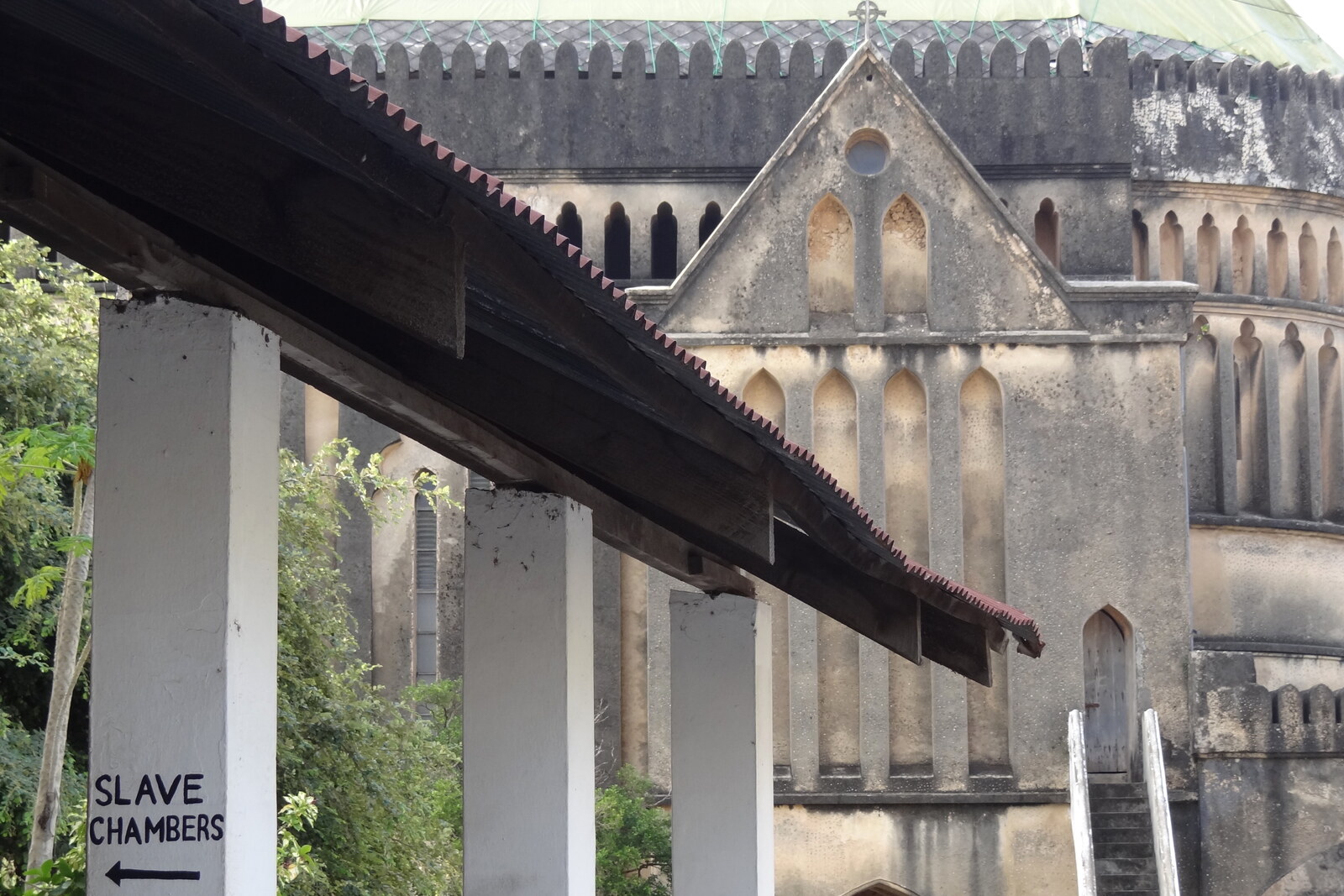
Look around first
What to notice
- Five human figures
- A shared chain around their necks
- Sunken area
- The cathedral behind the memorial
The story of the place
A small sunken area beside the cathedral marks the ground of the former Mkunazini market. Captured people brought here from the mainland were then bought for clove plantations, households, caravans, and ships; some were taken farther beyond the island. The market itself occupied an open square later taken over by the cathedral, so the depression here is not a surviving pen but a part of the memorial created for remembrance. The church behind the sculptures stands where these transactions were once made.
The five figures before Christ Church have no names. Swedish sculptor Clara Sörnäs created them with the participation of college students in Bagamoyo and installed them here in nineteen ninety-eight. They are men and women linked at the neck by a single chain. They do not depict five known people: the Slave Memorial is dedicated to all the captives sold in Mkunazini.
Trading began at around four in the afternoon. Sellers arranged people in rows according to sex, age, intended work, and price. Buyers inspected eyes and teeth, while women were subjected to a full-body inspection. One account describes a test: a stick was thrown to a person, and the way that person brought it back was used to judge their health. After purchase, some were sent to clove plantations on Zanzibar Island, others to homes, caravans, or ships, and still others were resold beyond the island.
The name of one freed child has survived: Cecil Majaliwa. His early life has been reconstructed only incompletely. According to one version, the six-year-old Yao boy was sold at the Zanzibar market itself; according to another, he was freed from a ship transporting captives. What is known for certain is that in the early eighteen seventies, Majaliwa was taken in by the Universities' Mission to Central Africa. He studied at Kiungani School and then became a teacher himself. Later, missionaries sent him to Canterbury to prepare for ordination.
On January twenty-fifth, eighteen ninety, Majaliwa was on this ground again. Christ Church already stood on the site of the market. Bishop Charles Smythies, who sought the development of an African clergy, ordained the former enslaved person here as a priest—the first African to receive this rank in the mission. Four naval chaplains took part in the laying on of hands, and the mission's schools were given two days off.
Majaliwa returned to the mainland and served among the Yao and Makonde. Six of his pupils later became priests, and another two became deacons.
The open square where trading took place no longer exists: Christ Church stands on it. The depression with the figures appeared with the memorial and is not a surviving pen for captives. Cecil Majaliwa's name is not on the sculpture. It remains in the record of the ordination performed here on January twenty-fifth, eighteen ninety.
Useful on site
Open around the clock, outdoors beside the cathedral.
Checked: date not specified. Check the official source before visiting.Do not go down to the figures, touch the chain, or use the memorial as a backdrop for staged photographs.