 Guide On Map
Mkunazini: Slavery and Memory in Stone Town
From Christ Church through Darajani Market and Hamamni Persian Baths to Tippu Tip's House
Guide On Map on your phone
Open the walk like a regular app
It takes about 10 seconds to install. No app store needed.
The whole path
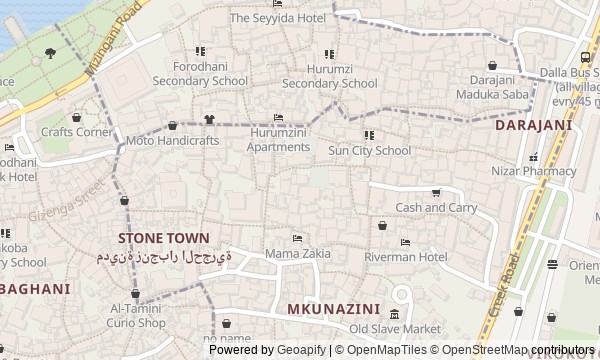
Route map
About the walk
You will begin on the site of Mkunazini market, where the cathedral, underground rooms, and five linked figures offer different ways of remembering the same past. Then you will make your way to Darajani Market. Among the stalls, you will have to look for the trace of a crossing that has long since disappeared. From the trading quarter, the route turns into Stone Town's narrow streets. Two Catholic towers will rise above the roofs, followed by the dry vaults of Hamamni Persian Baths and the carved door of a private house linked to caravan trade. Questions emerge from small details: who was paid to build the memorial to emancipation, why the museum display says nothing about the rooms beneath it, where the manuscript of the final house's owner disappeared to. The account remains calm and evidence-based. It separates tradition from document, and memorial from surviving trace. By the end, you will be able to tell apart what survived here, what was built for memory, and what remains only in the name Darajani.
Why this order
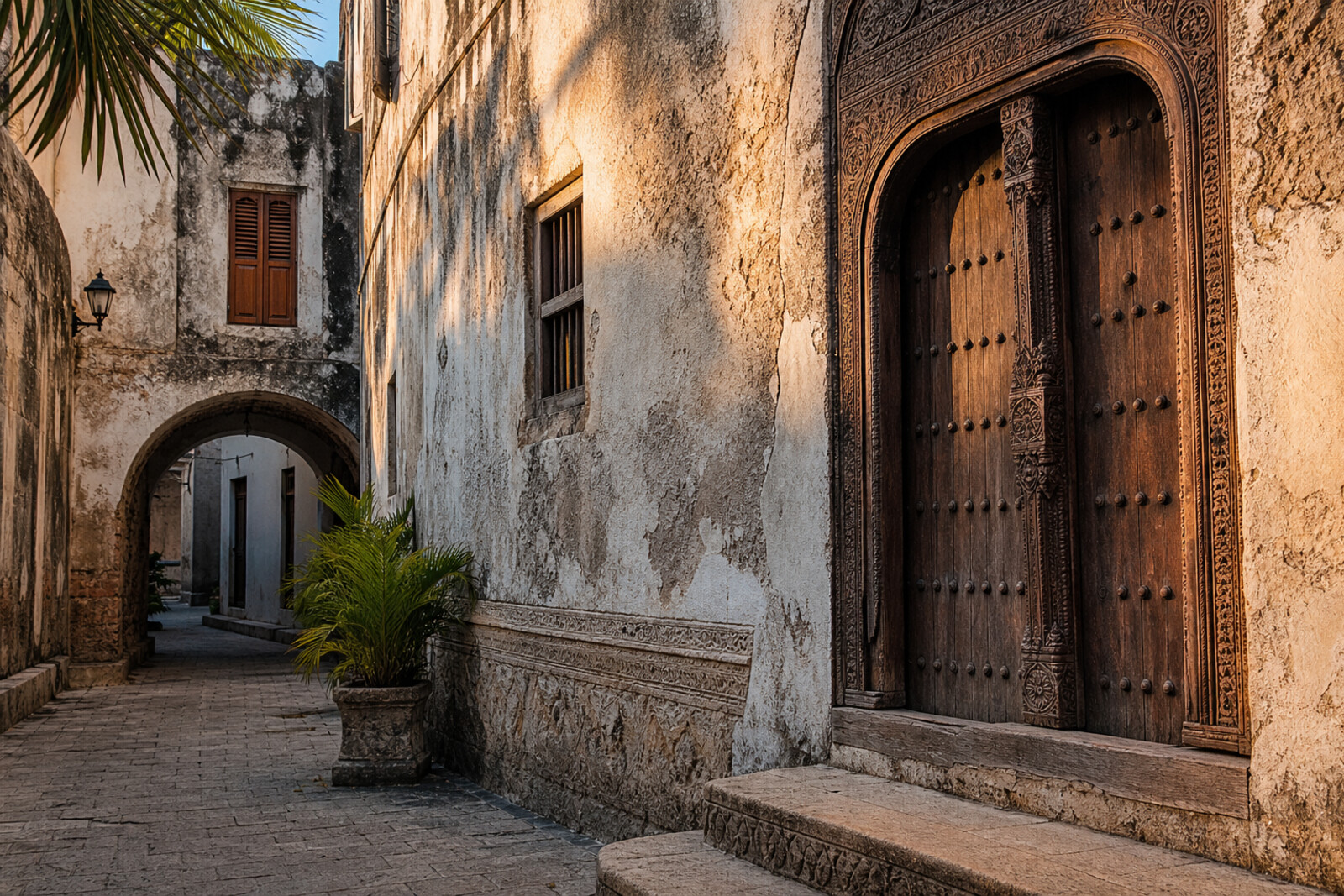
Christ Church sets the starting point: the former Mkunazini market and the memorial to its closure. From the church, the route descends beneath the neighboring St. Monica's Hostel, where ceremonial memory meets a museum legend. Back in the courtyard at the Slave Memorial, the dispute over the room gives way to the fate of one specific liberated person. The walk then reaches Darajani Market: the food market arose nearby after the former trade was ended, showing how the city's boundary changed. From the stalls, the route continues to St. Joseph's Cathedral, where the consequences of emancipation become visible in the work of another mission. Next come Hamamni Persian Baths: after the church projects, the route turns to the sultan's water system and public baths. The final walk to Tippu Tip's House connects the city's changes with a private fortune built through caravan trade, ending with a manuscript that preserved the voice of one of its participants.
Those who want to understand a difficult past without ready-made slogans Those interested in urban traces, documents, and disputed museum accounts Those ready to move between churches, an exhibition, a market, and residential streets
Those looking for an easy postcard walk through Stone Town Those who prefer to avoid the subjects of slavery and human unfreedom Those who want only an overview of architectural sights
Before you go
The route is emotionally demanding, so do not rush through the first three stops: the cathedral, basements, and memorial are close together, but they serve different purposes. The underground spaces are low and cramped; if you have claustrophobia, limited mobility, or feel unwell, it is better to listen to this part from outside. Speak quietly in active churches and do not disturb services. At Darajani Market, stay clear of working passageways, watch your step, and ask permission before photographing people. Bring water and save your energy for the crowded streets after the memorial complex.
When to go
Allow about three hours. You will need more time at the beginning, where it is important to take in three neighboring stops separately, and at Darajani Market, where the dense flow of people slows you down. A short pause between the memorial and the market is useful. If you need to speed up, limit time spent on interiors and details, but do not change the order: the move from one contested site of memory to the urban economy is the route's core.
Backup plan
If you cannot enter the cathedrals, basements, or baths, continue the walk: the towers, facades, entrances, and accessible exterior details retain part of what each stop means. Do not go beyond closed doors or join someone else's group without permission. You can listen to the underground section beside the complex, and the story of Hamamni Persian Baths by the building. In heat, fatigue, or emotional overload, take a break before heading to Darajani Market. In any case, view the final stop only from public space: Tippu Tip's House is unsafe, and its door, steps, and facade are enough to complete the route.
Route conditions
Surface. Paved — 1.2 km; unpaved — 192 m (data covers 87% of the route)
Access. Wheelchair — limited; stroller — limited
Facilities. Toilets — 4
Elevation. Ascent — 11 m; descent — 15 m
OpenStreetMap extract of July 9, 2026: database data, not a check on the ground. Data © OpenStreetMap contributors, ODbL licence
Walk plan
Open in maps ↗- 1
Christ Church
Here, the promise of freedom will collide with how people were actually hired and seated. - 2
Underground Chambers and the Slave Trade Exhibition
This stop makes it possible to compare documents, a museum display, and the story that guides continue to repeat. - 3
Slave Memorial
The unnamed figures will be given depth through the fate of a child who returned here years later to be ordained. - 4
Darajani Market
The market’s name will preserve the town crossing, of which no visible trace remains. - 5
St. Joseph's Cathedral
This stop explains why construction had to be interrupted and what allowed the missionaries to return decades later. - 6
Hamamni Persian Baths
The empty rooms show how a public water project became housing and gave its name to an entire neighborhood. - 7
Tippu Tip's House
The finale will connect private wealth with a manuscript that spread around the world without its original.
Route features
Everything you need stays in the browser
Progress, saves and your trip plan are stored on this device.
Add Guide On Map to your home screen so the walk opens outside the browser.
How we handle sources, maps and corrections: our editorial standards