 Guide On Map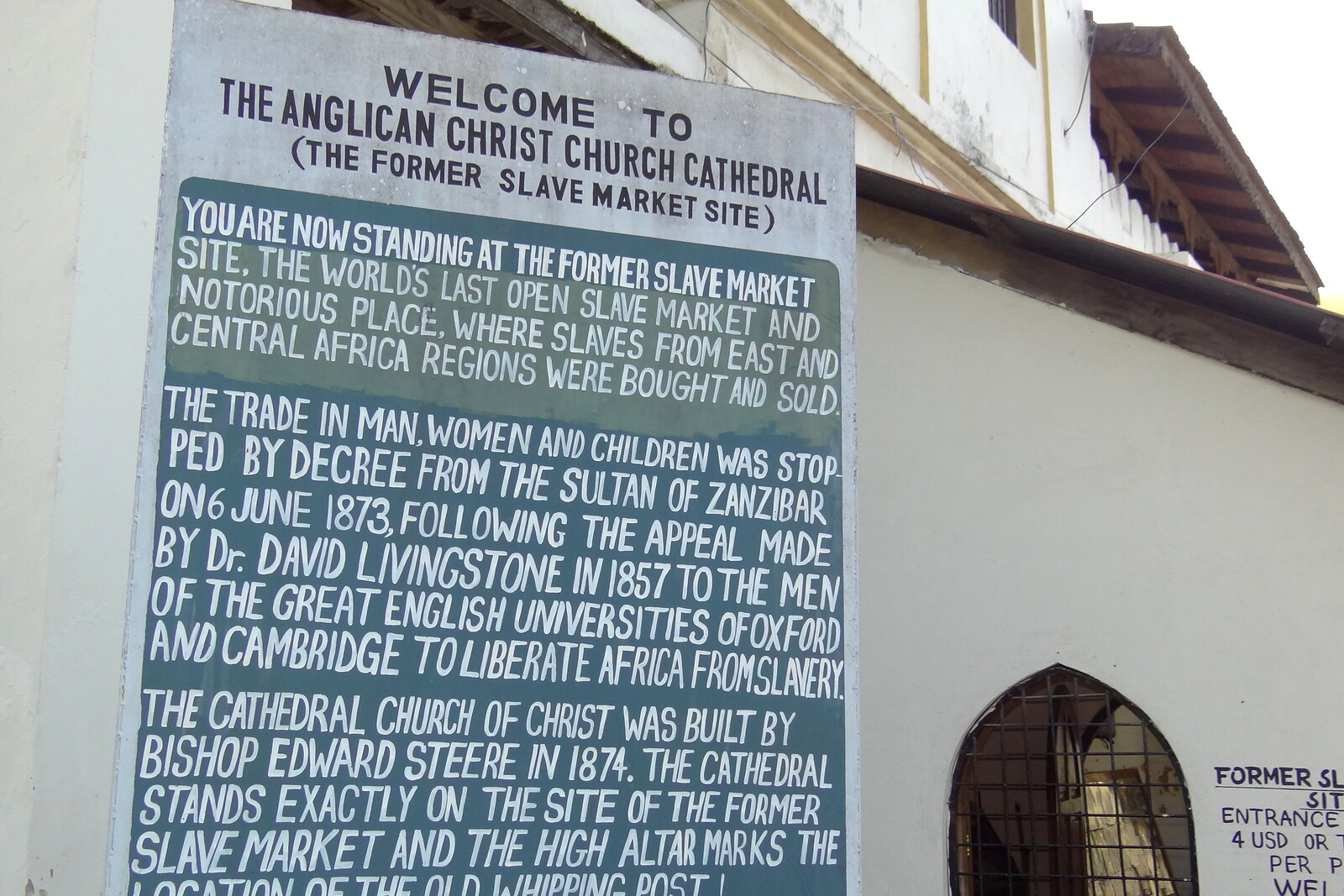
Look around first
What to notice
- Two underground rooms
- A small window
- A drain in the floor
- The exhibition's metal panels
The story of the place
A permanent exhibition about the East African slave trade now operates on the site of the Mkunazini market. People captured on the mainland were brought here, and buyers were interested in plantations on Zanzibar Island and Pemba or resale across the Indian Ocean. When the market closed, Anglican missionaries built St. Monica's Hostel as a hospital; medicines and supplies were kept in its lower rooms, sheltered from the heat behind thick walls. The new exhibition was installed both in the former café and in utility rooms, with its metal panels suspended from steel beams.
A narrow staircase from the exhibition leads down to two cramped underground rooms, separated by a short passage. A small window has been cut into one wall, a drain runs along the floor, and replicas of chains are displayed nearby. Guides say that before the auction, seventy-five women and children were held here, and fifty men in the neighboring chamber; people were supposedly locked in for three days, while the ocean tide flushed the drain. This is a later museum legend, not an established fact.
Historian Jonathan Glassman decided to check the tourist account against mission documents and the history of the buildings. The slave market in Mkunazini was closed in eighteen seventy-three. St. Monica's Hostel, beneath which the rooms are located, was built by Anglican missionaries about twenty years later as a hospital. In its basement, they stored medicines and provisions: the thick walls protected the supplies from heat and sunlight. During the slave trade, these rooms did not yet exist.
The market itself really was here. Traders brought to Zanzibar Island men, women, and children captured on the mainland and sold them in an open area. Buyers sent some to clove plantations on Zanzibar Island and Pemba, while others were resold farther across the Indian Ocean. The mistake concerns the basement, not the fate of the people sold in Mkunazini.
In two thousand thirteen, the Anglican Diocese of Zanzibar and the Government of Zanzibar commissioned the World Monuments Fund to restore the complex and create a permanent exhibition here. Its development was led by Maria Kovacevich, a designer who had to tell the story of the East African slave trade in a building without air conditioning and with unreliable electricity. Money and specialists were scarce, so she simultaneously handled historical research, texts, graphics, lighting, and installation. A former café became the first gallery, and a utility room and toilet became the second. The explanatory panels were printed on metal sheets with a protective coating and suspended from steel beams.
Before the opening, the team consulted historians and learned of Glassman's conclusion. In the exhibition, which opened on June fifteenth, two thousand sixteen, the route begins with a person's life before capture, then moves through captivity, the caravan, sea transport, sale, forced labor, emancipation, and its consequences. The panel devoted to the Mkunazini market does not mention the underground chambers.
The basement nevertheless remained on the guided route. From two thousand thirteen to two thousand seventeen, anthropologist Marie-Aude Fouéré, who studied how slavery is discussed here, went on about fifty guided tours. Even after the new exhibition opened, guides continued to repeat the story of one hundred twenty-five captives, three days without light, and the tide in the drain. She recorded that the metal panels had already corrected the chronology, while the spoken account remained unchanged.
There are no chambers on the market display. They begin beyond the staircase: two storerooms of the former hospital to which guides gave a different past.
Useful on site
Daily 08:00–18:00. Last entry 30 minutes before closing. Combined ticket with the cathedral.
Checked: date not specified. Check the official source before visiting.It is cramped inside, and you need to watch the ceiling height. If enclosed spaces cause anxiety or your mobility is limited, it is better to skip the descent.