 Guide On Map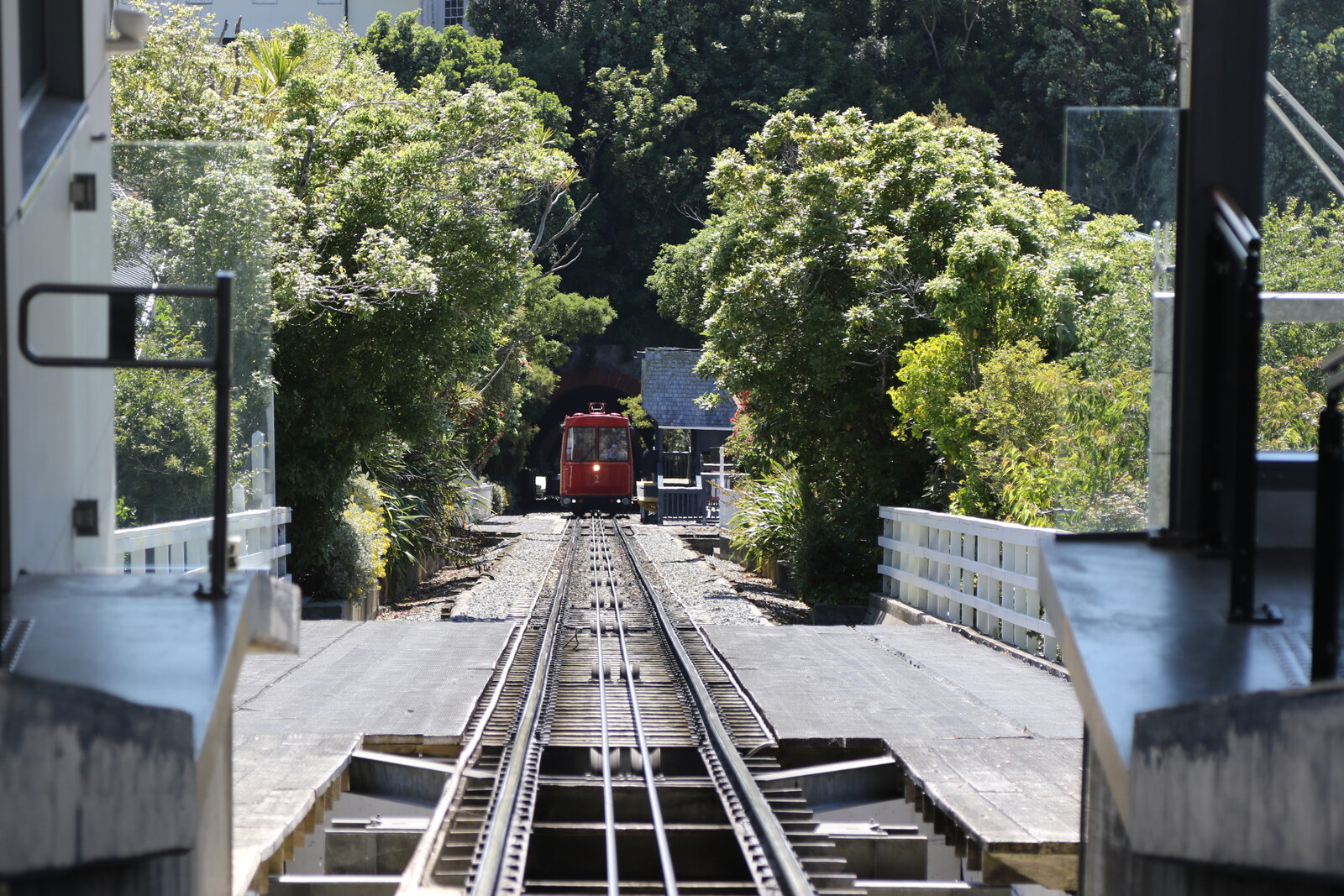
Look around first
What to notice
- The narrow passageway of Cable Car Lane
- The lower platform
- Red cars
The story of the place
A narrow Cable Car Lane, a passageway between commercial buildings, leads from Lambton Quay to the lower platform. Lambton Quay was laid out along the former shoreline and is named after John Lambton, Lord Durham, chairman of the New Zealand Company. The terminal’s position deep inside the block is the result of a deal without which the cable line might have remained a drawing.
In the mid-eighteen nineties, a group of Wellington entrepreneurs bought Upland Farm on the hills above the business district. They planned to divide the land into plots and sell them for houses. They named the future district Kelburn after Viscount Kelburn, the son of the then governor, Lord Glasgow. Buyers were offered a prestigious address, but a steep slope stood between that address and the offices on Lambton Quay.
Martin Kennedy, an entrepreneur interested in developing neighboring land near Salamanca Road, offered a solution. He had made his fortune in coal mines, then managed a Wellington brewery and leased a plot of about two hectares on the hill. The more convenient the ascent became, the higher the income from his plots could be. Kennedy already chaired a tramway company on the West Coast of the South Island and proposed building a cable tramway to the new district.
The farm owners had to invest at once in housing and in a complex transport project. Public interest was also weak: of the ten thousand shares offered, only one thousand six hundred were sold. Finding a site for the lower station was even harder. Land on Lambton Quay was among the most expensive in the country, and the tramway company could not buy it on its own.
Kennedy also sat on the board of directors of the New Zealand Times. The newspaper happened to need a new building. He persuaded the other directors to buy the Lambton Quay site of Mills’s commercial firm, and then to separate a small plot from the purchase for the terminal. The newspaper gained real estate on the main street, the developers gained access to the business district, and Kennedy gained a lower point for his planned line. This separated piece of land is at the end of Cable Car Lane.
After the deal, the farm owners founded the Kelburn & Karori Tramway Company. Engineer James Fulton was to take the route straight uphill from the cramped city plot, without crossing streets. He laid the line through three tunnels and over three viaducts; during the short journey, the car climbed almost one hundred twenty meters.
On February twenty-second, nineteen oh two, the first passengers set off from here. About four thousand people used the line over its opening weekend. Prospective buyers of Kelburn plots were given free tickets: the trip served as a display of the land before its sale. In its first year, the cars made four hundred twenty-five thousand passenger journeys, and house construction on the hill accelerated.
By nineteen forty-seven, the city had bought out the private company and incorporated the line into public transport. Now two red cars are permanently connected by cables and move in opposite directions: while one sets off from here toward Kelburn, the other descends toward Lambton Quay. The lower platform still occupies the small plot that Kennedy had ordered separated from the newspaper’s purchase, and the narrow Cable Car Lane still leads to it.
Useful on site
Usually every 10 minutes; hours depend on the day of the week.
Checked: June 26, 2026. Check the official source before visiting.Before boarding, prepare for the short ride and put away items that could get in other passengers’ way. Check travel conditions with the operator.