 Guide On Map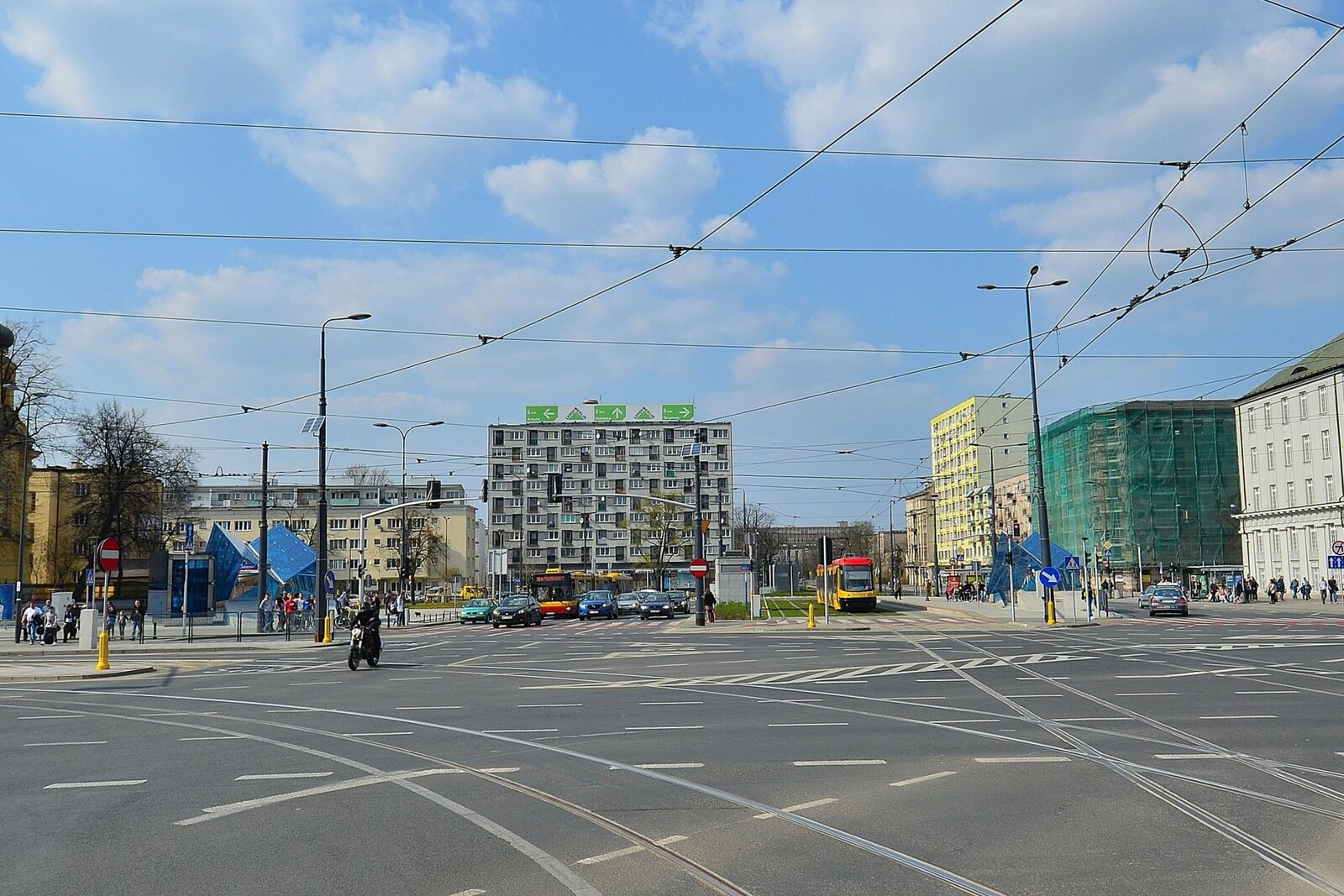
Look around first
What to notice
- Warszawa Wileńska railway station
- Metro entrances
- Tram tracks on Targowa Street
The story of the place
Warszawa Wileńska railway station, the metro entrances, and the tram tracks on Targowa Street converge at one square; regional trains terminate inside the shopping center. The passenger station was moved to the present-day square after the First World War, when new borders cut through the old main line. Long-distance trains disappeared, but the connection with Vilnius remained: its name is now borne by a street, a square, a railway station, and a metro station.
In the summer of eighteen sixty-four, Benedykt Dybowski was taken from St. Petersburg Railway Station to penal servitude. This station was the predecessor of today’s Warszawa Wileńska railway station and stood farther along Wileńska Street, near its intersection with present-day Zaokopowa Street.
Dybowski taught zoology and comparative anatomy at Warsaw Main School. During the January Uprising—a Polish revolt against the Russian Empire—he joined the underground National Government and traveled on assignments, helping organize the uprising beyond Warsaw. The police uncovered his connections in early eighteen sixty-four. During the investigation at Warsaw Citadel, Dybowski refused to betray his associates and received twelve years of penal servitude.
St. Petersburg Railway Station was exactly suited to such a departure. Russian military planners designed the railway between Warsaw and St. Petersburg with a possible Polish uprising in mind: trains would make it possible to bring in soldiers and supplies quickly. Service along the entire line, through Białystok and Vilnius, opened in May eighteen sixty-two. Eight months later, the uprising began. After its defeat, convicts were sent east along the same route.
Before his arrest, Dybowski lived on a teacher’s salary and held a medical degree. The sentence stripped him of his position, civil rights, and the legal right to practice medicine. Still in the citadel, he obtained a first-aid kit and equipment for collecting animals through secret correspondence. The plan was quite practical: the exiles would sell zoological specimens in order to buy food and tools.
From St. Petersburg Railway Station, a group of convicts left by train through St. Petersburg and Moscow, then made their way to Transbaikalia. At penal servitude, Dybowski was assigned to cut and raft timber. Other prisoners traded work with him so that he could treat people. At the same time, he gathered hunters and naturalists around him: they collected specimens for the Warsaw Zoological Cabinet and received small sums of money for them.
Later, Dybowski studied Lake Baikal, described more than one hundred species of local crustaceans, and became one of the founders of the science of freshwater life. In eighteen seventy-seven, he was allowed to return. Just a year later, he voluntarily traveled in the same eastern direction—this time as a doctor and researcher of Kamchatka.
St. Petersburg Railway Station, where his journey to penal servitude began, no longer exists. Retreating Russian troops destroyed the building in nineteen fifteen. After the First World War, new borders divided the former main line, long-distance trains to St. Petersburg disappeared, and Vilnius remained the principal destination. In nineteen twenty, railway workers moved the passenger station closer to today’s square; soon it became Wileńska.
Now regional trains terminate inside the shopping center, the metro runs beneath the square, and trams travel along Targowa Street. The name of Vilnius remains on a street, a square, a railway station, and a metro station.
Useful on site
Around the clock, a public square and transport hub.
Checked: June 29, 2026. Check the official source before visiting.Look around from the sidewalk and do not linger in passengers’ way: this is first and foremost a busy transport interchange.