 Guide On Map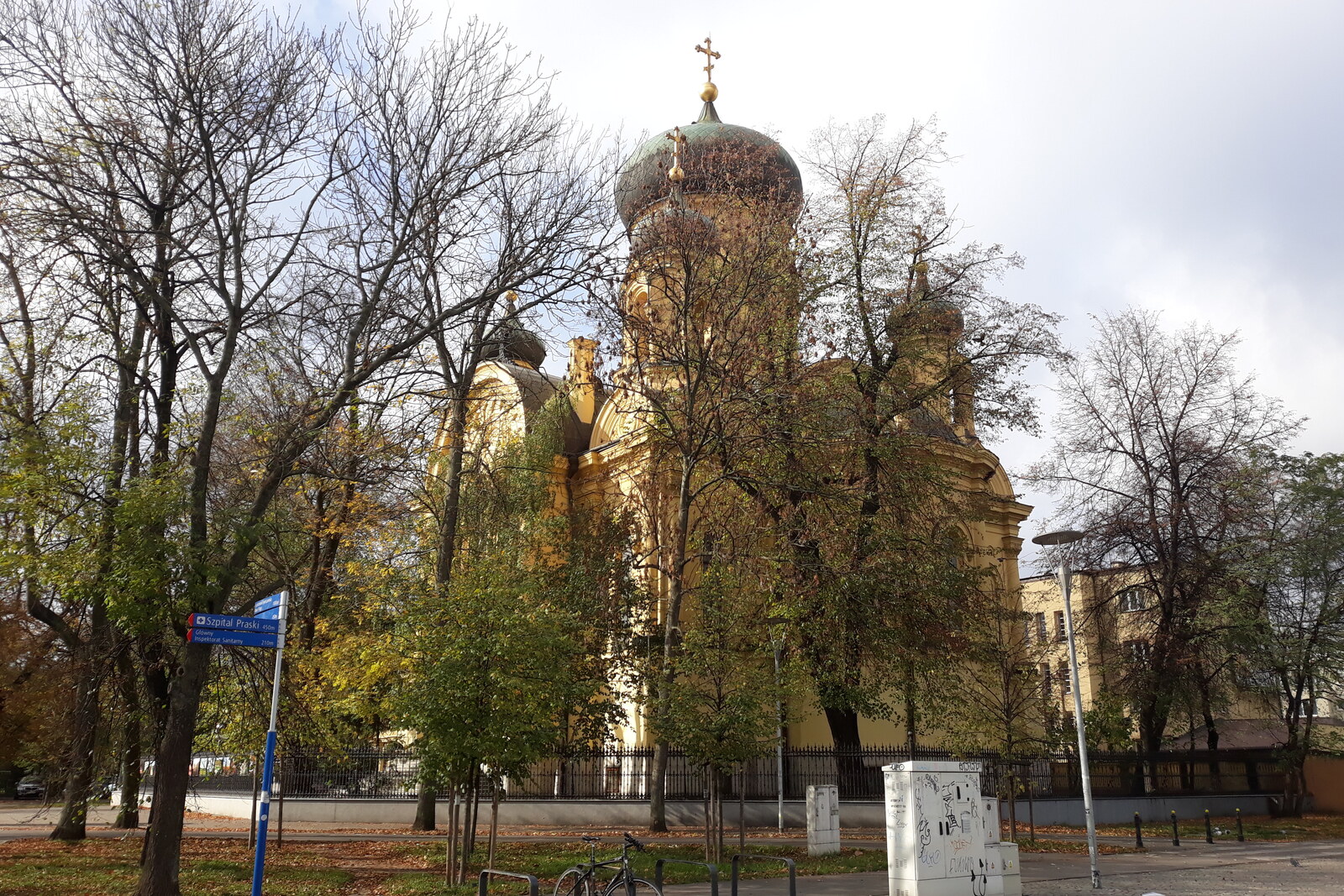
Look around first
What to notice
- Five domes
- The main icon of St. Mary Magdalene
- The portrait of Metropolitan Jerzy on the western wall
The story of the place
The cathedral’s five domes are clearly visible from afar, and inside is an icon of Mary Magdalene given by a Russian empress. The dedication to this saint links the Gospel message of the Resurrection with the memory of the donor of the icon. Next door is still the residence of the Metropolitan of Warsaw, and on feast days the cathedral gathers clergy from all over Poland. On the western wall hangs a portrait of Metropolitan Jerzy Jaroszewski, who worked in the house beside the church.
After the January Uprising was suppressed, Prince Vladimir Cherkassky, who oversaw the internal and church affairs of Congress Poland, secured the construction of a new Orthodox church in Praga. Russian officials and military personnel lived here, and two railways brought many Orthodox employees. Governor Fyodor Berg chose a site opposite St. Petersburg Railway Station—today’s Warszawa Wileńska railway station. A passenger from St. Petersburg stepped off the train and saw five Orthodox domes as the first large building on the way to Warsaw.
The church was consecrated in eighteen sixty-nine in honor of Equal-to-the-Apostles Mary Magdalene—a disciple of Christ who, according to the Gospel, was the first to tell the apostles about the Resurrection. The choice of heavenly patron also referred to Empress Maria Alexandrovna, the wife of Alexander II. She gave the church its main icon of the saint. Thus, the name above the entrance reflected both church tradition and the courtly design of the builders.
After Poland regained independence, the church acquired a different role. From nineteen twenty-one, it became the seat of the metropolitan, the head of the Orthodox Church in the country. He lived in the neighboring house, received clergy, and handled church affairs. It was there that the dispute unfolded whose outcome would determine whom the Orthodox dioceses within Poland’s new borders would answer to.
Metropolitan Jerzy Jaroszewski sought autocephaly—the right of the local church to choose its own leadership and govern its own dioceses. He arrived in Warsaw as a representative of Patriarch Tikhon of Moscow, but ties with Moscow were collapsing: the patriarch was under arrest, church administration was in disarray, and state borders had divided the former dioceses.
Jerzy’s main opponent was Archimandrite Smaragd Latyszenko, a senior monastic priest and seminary teacher. He regarded separation from the Moscow Patriarchate as a violation of church rules. The dispute also carried a personal cost. Jerzy had prevented Smaragd’s appointment as bishop and then barred him from serving after a long absence caused by caring for his ill father. Smaragd was convinced that he had lost his clerical rank and future see because of his position.
On February eighth, nineteen twenty-three, Smaragd came to the house beside the cathedral and spent two hours persuading the metropolitan to renounce autocephaly. Jerzy did not yield. Then the archimandrite pulled out a revolver and fired three times. The secretary detained him at the scene. Jerzy died, while Smaragd was stripped of his clerical rank and spent twelve years in prison.
The murder did not stop what had begun. Jerzy’s successor, Metropolitan Dionizy Waledyński, continued the negotiations. In nineteen twenty-four, the Patriarch of Constantinople issued a tomos—a charter of ecclesiastical independence. On September seventeenth, nineteen twenty-five, it was solemnly proclaimed here, in the Cathedral of St. Mary Magdalene.
Today this is the principal church of the Polish Autocephalous Orthodox Church; on feast days, services here are led by the Metropolitan of Warsaw and All Poland. His residence is still nearby, and a portrait of Jerzy Jaroszewski hangs on the cathedral’s western wall.
Useful on site
An active Orthodox cathedral. A tourist schedule has not been confirmed in open sources; enter only if the church is open and a service is not disturbed.
Checked: June 29, 2026. Check the official source before visiting.Enter only when the doors are open and without disturbing a service; it is appropriate to arrange photography and viewing the interior on site.