 Guide On Map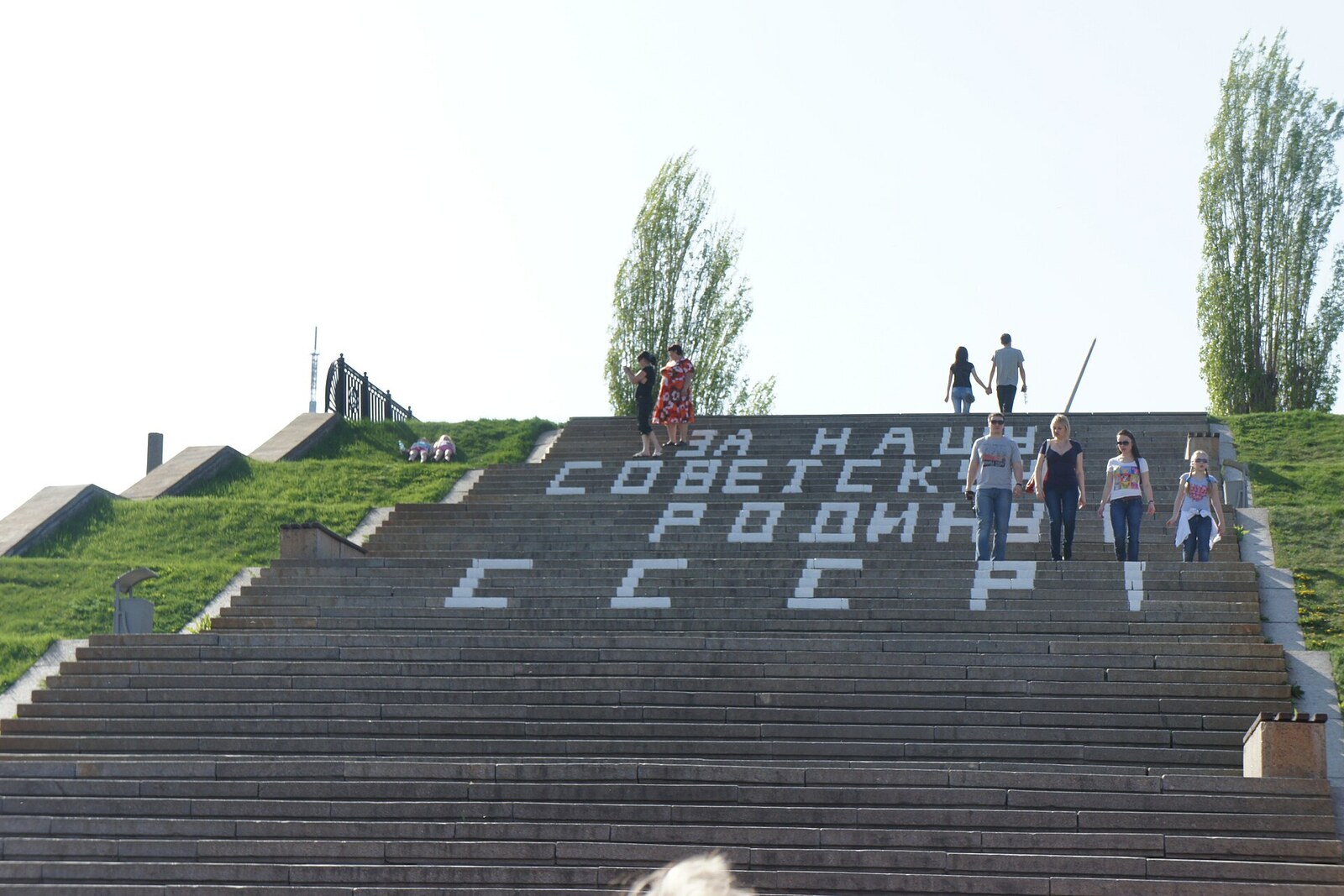
Look around first
What to notice
- Stand to the Death! sculpture
- Left ruined wall
- Right ruined wall
- Staircase to the summit
The story of the place
The square's name preserves the memory of the defenders who held the eastern slope of Mamayev Kurgan. The space itself was built as part of the memorial: a sculpture of a soldier stands at its center, while walls rise on either side, deliberately made to resemble shattered city houses. The sculptor gave the soldier's face the features of Vasily Chuikov, who commanded the 62nd Army, but the figure does not depict one specific person. A staircase runs between these walls, continuing the route up the kurgan.
In January nineteen forty-three, Colonel Nikolai Batyuk, commander of the 284th Rifle Division, had to take the summit of Mamayev Kurgan from the German units. He did not send a battalion there in a general attack: on the open slope, that would have meant losing men before they even reached the first trenches.
On front-line maps, the height was marked with the number one hundred two. There were higher hills in the city, but from here one could see the Volga crossings, the northern factories, the railway, and the river port. As long as German observers remained on top, everything that kept the 62nd Army going was under aimed fire: boats carrying reinforcements, vehicles with ammunition, and stretchers with the wounded. Food and equipment were brought up at night; the wounded were also taken away then whenever possible.
From late September, Batyuk's division held the eastern slope, where this square was later created. German units occupied the summit and two massive water tanks converted into fortified firing positions. In late November, a Soviet assault group burst into one tank but could not hold its position. Batyuk admitted that after this, the tanks gave him no peace even in his sleep.
On January tenth, Operation Ring began—the final offensive against the encircled German army. The next day, soldiers of the one thousand forty-third and one thousand forty-fifth Rifle Regiments drove the enemy out of the tanks in grenade fighting. Six counterattacks followed that day. The regiments held on, but several trenches still lay between them and the summit.
Batyuk divided forty fighters in white camouflage smocks into small groups. Five guns moved behind them and, on prearranged signals, fired directly at the firing positions. This was how the summit was retaken over several days—trench by trench, in frost approaching thirty degrees below zero. Among the last to die was Senior Lieutenant Zhidkikh, the battalion commander who had been striving to reach the summit. The officer who replaced him became the fifth commander of that battalion during the fighting on the kurgan.
On January sixteenth, a red flag was raised over the height. The German observers lost the summit, and the division gained a route to the western slope. Ten days later, its soldiers met there with units of the 21st Army advancing from the west. The encircled German force was split into two parts.
The square's name refers to the defenders who held this slope. The central sculpture is called Stand to the Death!, while the square itself is the Square of Those Who Stood to the Death. Sculptor Yevgeny Vuchetich gave the soldier's face the features of Vasily Chuikov, commander of the 62nd Army, who sought to hold the last section of the city by the Volga. The figure, however, depicts a generalized defender of Stalingrad, not a portrait of a single army commander.
The walls above the square have not survived from the fighting. They were built together with the memorial and deliberately made to resemble shattered city buildings. The left wall is dedicated to defense and the words “Not a Step Back!”, while the right is dedicated to the offensive and the words “Forward Only!” The actual water tanks for which Batyuk's regiments fought have disappeared. Now the staircase between the built ruins leads from the defended eastern slope to where the forty fighters retook the summit.
Useful on site
The memorial complex is open around the clock; official tours usually run from 10:00–15:30.
Checked: June 24, 2026. Check the official source before visiting.Walk through the corridor without headphones and leave pauses: the built-in sound is designed for visitors in motion.