 Guide On Map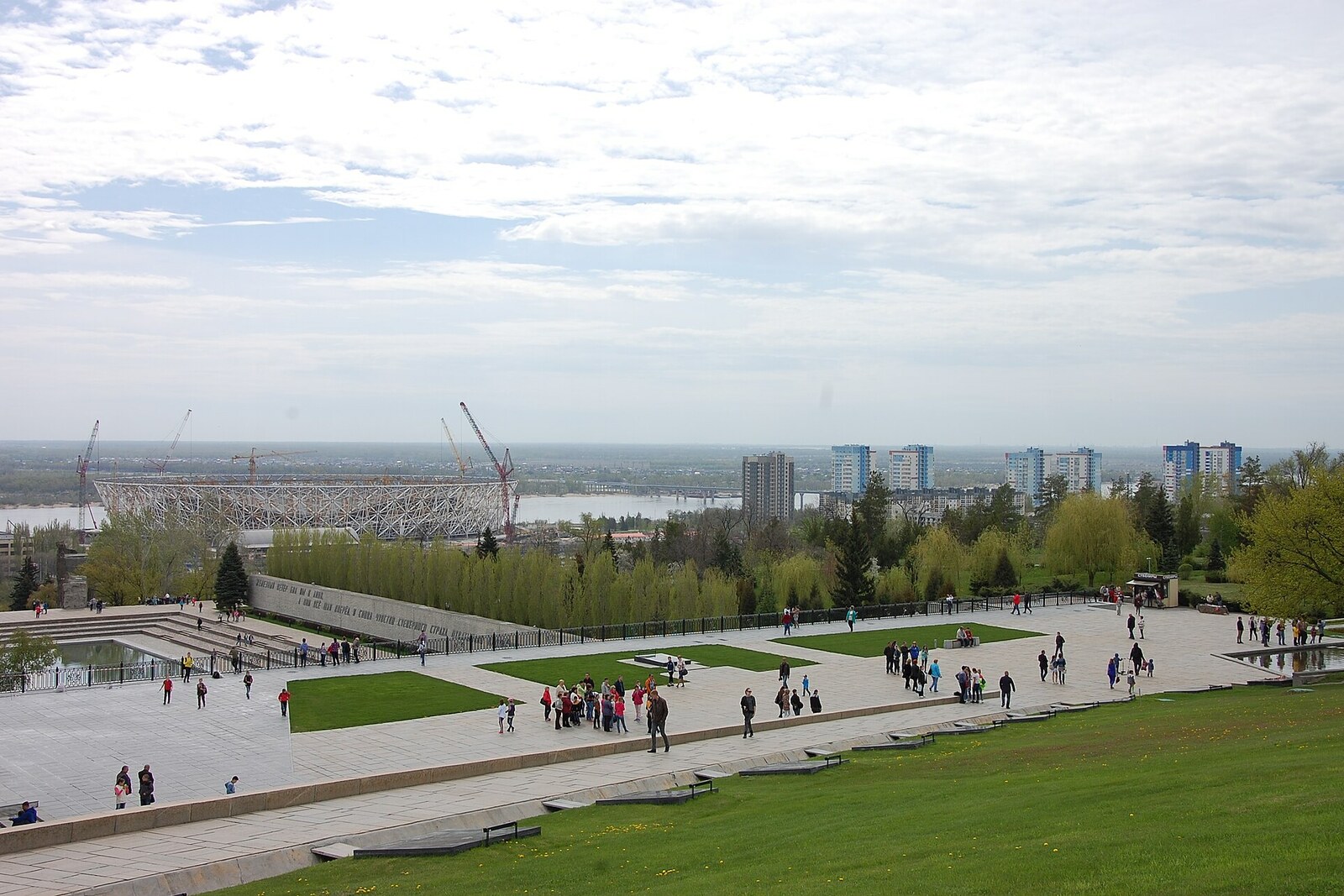
Look around first
What to notice
- The Mourning Mother
- Vasily Chuikov’s grave
- Hall of Military Glory
- The Motherland Calls!
The story of the place
The upper part of Mamayev Kurgan became the base for The Motherland Calls!, but beneath the statue there is also a large military burial. For the eight-thousand-ton figure, one hundred fifty thousand tons of earth were added to the clay slope, covering three old terraces of mass graves. During construction of the ensemble, the remains of thirty-four thousand five hundred five defenders of Stalingrad were moved to the eastern side of the hill. The thirty-seven slabs near the summit do not form a single cemetery: some stand over graves, while others commemorate people buried elsewhere.
In the summer of nineteen eighty-one, the gravely ill Vasily Chuikov summoned his son Alexander. The former commander of the 62nd Army wanted to warn him: his final request had already been sent to the country’s leadership—to bury the marshal on Mamayev Kurgan, beside the soldiers he had commanded in Stalingrad.
For a twice-awarded Hero of the Soviet Union of his rank, burial in Moscow, by the Kremlin Wall, was expected. Chuikov refused it. According to his son’s recollections, the decision had taken shape back in the nineteen fifties, when the marshal was writing a book about the Battle of Stalingrad. He dreamed of the dead officers and soldiers of his army. In his will, he also specified the exact location: here, by the kurgan, his command post had been set up on September twelfth, nineteen forty-two.
Chuikov died in March nineteen eighty-two. His request was fulfilled: an individual grave appeared on Square of Sorrow, near The Mourning Mother. Beneath the banner in her hands, the face of her dead son is hidden—the sculptor Yevgeny Vuchetich deliberately gave him no portrait features. Here they mourn all those whom it is impossible to show one by one.
This meaning is reinforced by an actual burial. In the eastern slope of the man-made hill lie the remains of thirty-four thousand five hundred five defenders of Stalingrad, moved here during construction of the ensemble. The thirty-seven slabs near the summit are arranged differently: some mark actual graves, while others were erected in memory of people buried elsewhere. The names on them do not yet mean that ashes lie beneath every slab.
Until his own death, Chuikov took part in creating the memorial as Vuchetich’s chief military consultant. The sculptor had intended to end the ascent with an entirely different composition: a woman held the Victory Banner and a sheaf of grain, while before her a soldier knelt and kissed the grain. It made for a peaceful resolution.
Vuchetich and his staff were not satisfied with it. Victory at Stalingrad changed the course of the war, yet more than two years remained before it ended. The sculptor went to Moscow to seek a new solution. When he returned, he showed his colleagues a one-meter plaster model of a woman who had stepped forward and raised a sword. This is how the name The Motherland Calls! arose: the country still faced war, and the figure addressed those who would have to continue the offensive.
Replacing the model changed the kurgan itself. The foundation had already been built, while the new statue weighed more than twice as much as the earlier composition. Engineers under the leadership of Nikolai Nikitin had to keep the eight-thousand-ton figure on the clay slope. They added one hundred fifty thousand tons of soil to the hill. The fill covered three former terraces of mass graves and required new retaining walls at Square of Sorrow. That is why today’s summit is both the statue’s base and a large mass grave.
In the Hall of Military Glory, seven thousand two hundred names appear on thirty-four red mosaic banners. This is a selection, not a complete list of the dead. At the center, the hand of a fallen fighter holds the torch of the Eternal Flame; beside it, soldiers of the Volgograd garrison stand an honor guard and change every hour.
Chuikov’s grave remained between this hall and the mound containing the remains of his soldiers—beneath the figure he helped Vuchetich create.
Useful on site
The memorial complex is open around the clock; official tours are usually 10:00–15:30, tour bookings 9:00–17:00.
Checked: June 24, 2026. Check the official source before visiting.Please keep quiet in the hall and near the burials; on the open summit, take the wind and the condition of the steps into account.