 Guide On Map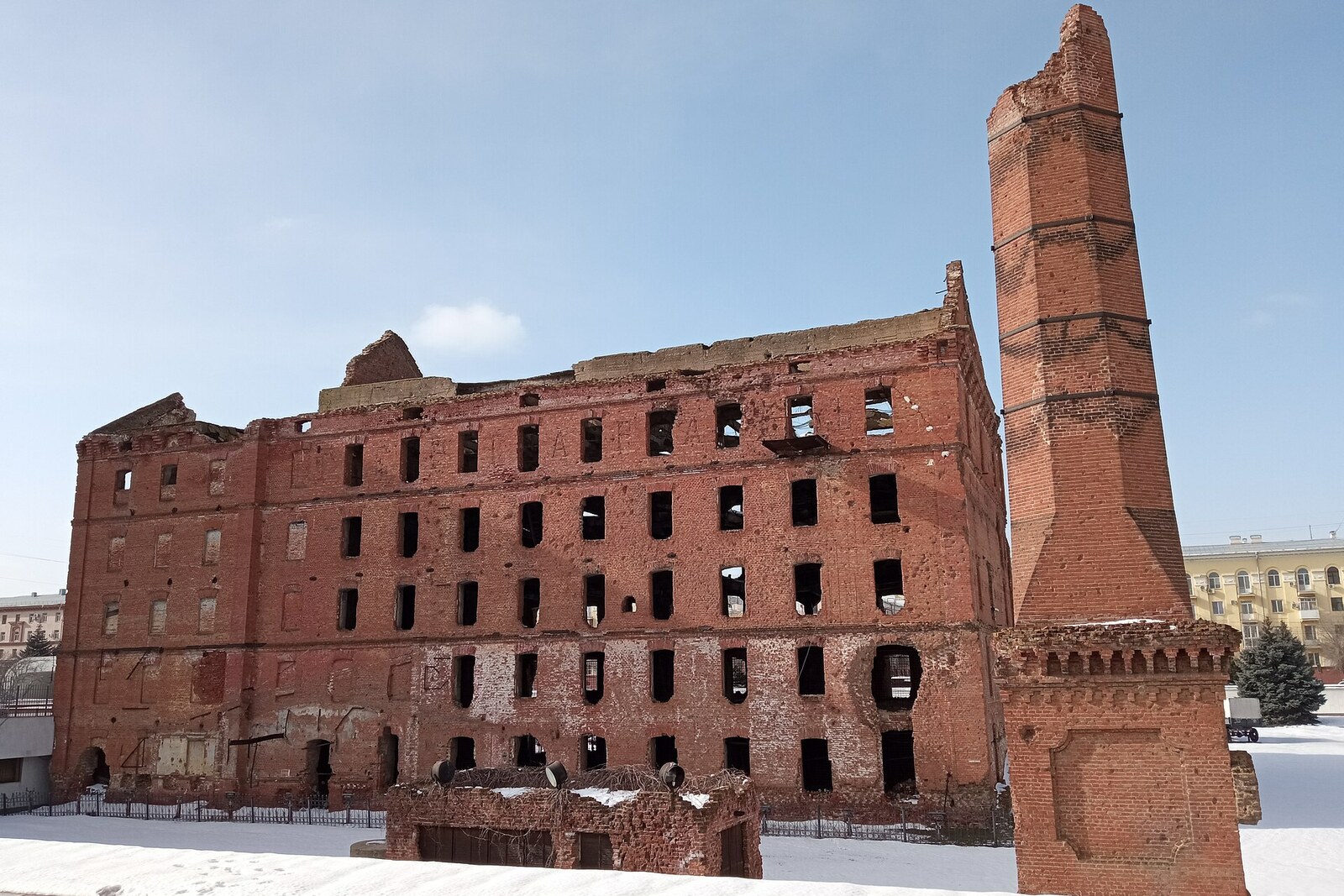
Look around first
What to notice
- The “Gerhardt” inscription
- The reinforced-concrete frame
- Window openings and breaches
- The wall facing the Volga
The story of the place
The brick building on the bank of the Volga is what remains of a large mill; wooden warehouses, an office, and outbuildings once stood around it. They are gone now, and the former industrial yard can be made out only from the walls and the empty rectangles of the windows. The river facade has survived noticeably better, while the other three walls are riddled with holes.
High on the brick wall, the surname “Gerhardt” has survived. Alexander Gerhardt, a Volga German and co-owner of a trading house, established a flour-milling operation here beside the Volga: a railway spur ran to the pier, and grain was hoisted into the production building. After the fire of nineteen oh seven, the Gerhardt family rebuilt the mill. Heavy machinery made the floors sway, so the builders assembled a reinforced-concrete frame inside, designed for constant vibration. Thirty-four years later, this design kept the walls standing under aerial bombs and artillery fire.
The name “Grudinin Mill” is connected with another man. Beginning in nineteen twenty, Konstantin Grudinin earned his living here as a turner and headed the enterprise’s Communist cell. On May twenty-sixth, nineteen twenty-two, the worker Alexander Gerlinger shot him in the back of the head in the mill’s weighing room. According to the criminal case materials, Gerlinger maintained that he had been fooling around with a revolver and had not intended to fire; the court sentenced him to one and a half years in prison. Seven years later, the nationalized enterprise was named after the slain Grudinin. That is why the owner’s surname remained on the wall, while the official name bears the surname of the worker killed inside this building.
On September fourteenth, nineteen forty-two, high-explosive bombs punched through the roof, a fire began, and production stopped. That same night, the Thirteenth Guards Rifle Division was crossing the Volga. Zakhar Chervyakov, commander of the First Battalion of the Forty-Second Guards Regiment, had to push German units back from the pier and break through to the encircled defenders of the railway station.
Chervyakov’s battalion occupied the burning mill, left it in its rear, and moved on toward the station. For five days, the soldiers tried to establish themselves there, but they could not hold the line. Chervyakov was seriously wounded and transferred back across the Volga. The remnants of the battalion withdrew to the very building from which they had begun the attack. After the failure at the station, the mill became the last major building on the riverbank still held by Soviet units.
By September twentieth, the Third Battalion of the same regiment had taken up the defense here. Ivan Yelin, the regiment’s commander, sought to preserve the narrow strip between the German positions and the Volga: losing the mill would open the way to the pier, through which people and ammunition arrived at night. Yelin set up his observation post in the building. Observers from the division, battalion, and company were also stationed in different rooms and on different floors—at times, only one reinforced-concrete floor separated several commanders.
Buildings occupied by German units surrounded the mill on three landward sides. The Volga remained behind it. The garrison used window openings and breaches as firing positions, and sent ammunition through the trenches to fortified houses farther forward. The Gerhardts’ wooden warehouses, office, and outbuildings burned down or were torn apart by explosions. The reinforced-concrete skeleton continued to shelter the soldiers.
The Forty-Second Guards Regiment held this strip until January nineteen forty-three, when the division launched an offensive from here. Noticeably less damage remains on the mill’s side facing the Volga. The other three walls, in front of which the German positions stood, are battered by shells, bullets, and shrapnel across almost their entire surface. Gerhardt’s name is still legible above them; in museum records, the ruin is listed as Grudinin Mill.
Useful on site
Exterior viewing is available around the clock; entry into the ruins is closed.
Checked: June 24, 2026. Check the official source before visiting.View the building only from the authorized exterior viewing area, and do not try to enter the ruins.