 Guide On Map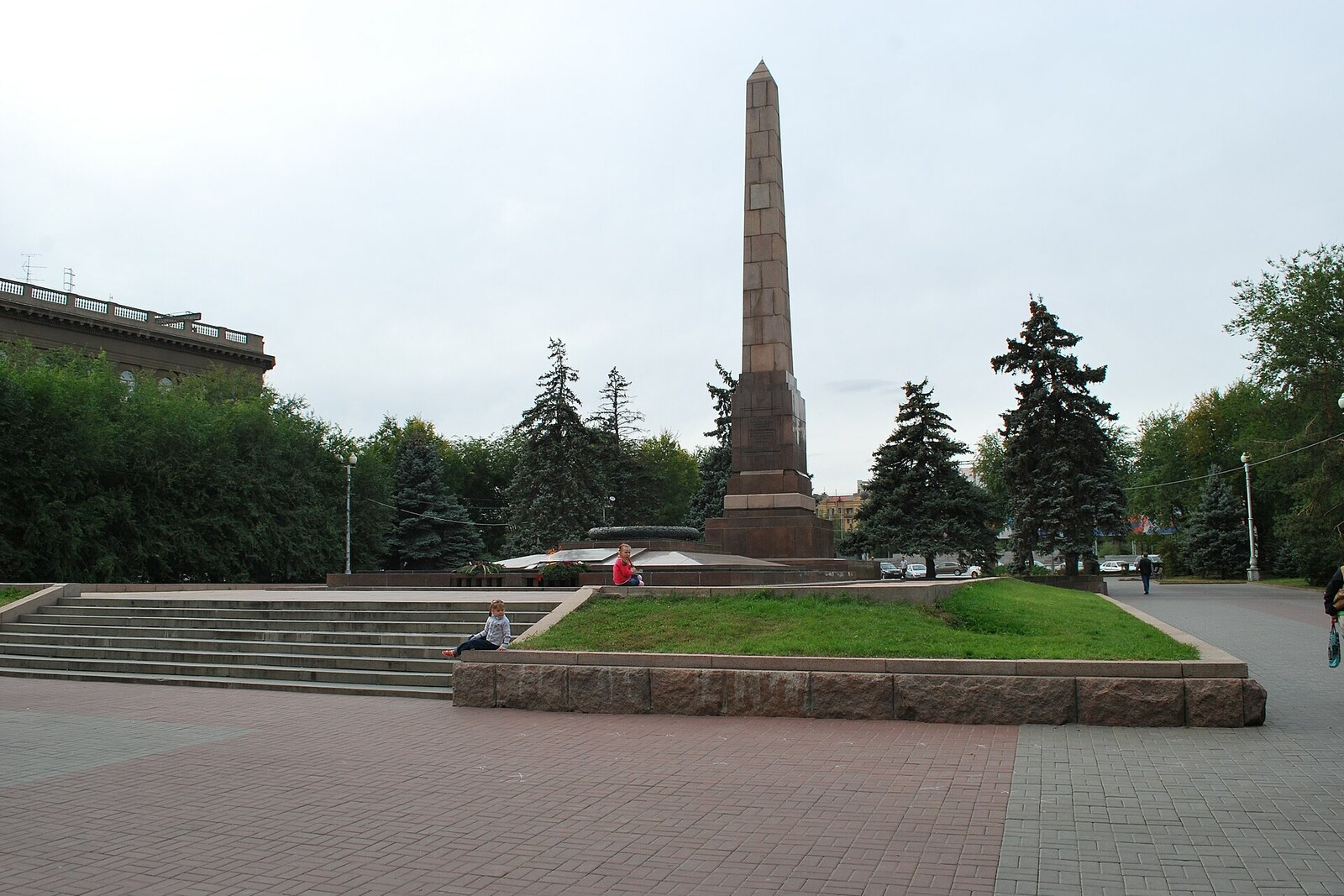
Look around first
What to notice
- Eternal Flame
- Twenty-six-meter obelisk
- School honor guard post
The story of the place
The twenty-six-meter obelisk at the center of the square was erected in nineteen fifty-seven above one of the common burials. The inscriptions on its faces connect the defenders of Red Tsaritsyn with soldiers of the 62nd Army and 64th Army. There was also a common grave on the opposite side, but its exact location gradually disappeared from the city's memory.
School honor guards change shifts at the Eternal Flame, and wreaths and flowers are brought to the granite platform. For Volgograd, this is the main place of official commemoration: the flame burns above a common grave. The square received its name twenty-three years before the end of the Battle of Stalingrad. The city was then called Tsaritsyn, and the square was Alexander Square.
During the Civil War, Tsaritsyn changed hands several times. In the summer of nineteen nineteen, units of the White Caucasian Army occupied the city. Victims of the Red Terror—people killed by Bolshevik authorities as opponents—were buried by Alexander Chapel in the square. In January nineteen twenty, the Red Army returned. A few days later, a commission began searching for those who had been executed under the Whites.
The commission found fifty-five bodies. It was able to identify eighteen people. The list included Vasily Gursky, a worker at an artillery plant; Vasily Arzamastsev, an army adjutant; and the Tsaritsyn residents, sisters Evdokia and Olga Levchenkova. The names of the other thirty-seven could not even be established. For them, the outcome of the Civil War was a common grave, with no possibility of telling their families exactly whom had been found.
The funeral took place on February eighth. Representatives of the Union of Transport Workers carried fifty-five coffins through the center. Children carrying wreaths walked in front, followed by standard-bearers and residents from different parts of Tsaritsyn. One military guard was posted at the city mausoleum; another waited here, by the prepared grave. After speeches, the coffins were lowered into the ground. That same day, city leaders renamed Alexander Square Fallen Fighters Square. The new name referred specifically to those buried here: city residents and Red Army soldiers whom the commission called victims of the White Terror.
But this was already the second common burial in the same square. The first, containing victims of the Red Terror, lay on the opposite side. It was forgotten, and its exact location was lost over time. The modern obelisk grew out of the second funeral—the one after which the square received its present name.
At first, a small wooden obelisk was placed over the grave. Three years later, it was replaced by a tall stele. It survived the Battle of Stalingrad, after which fallen defenders of the city were buried nearby. By April nineteen forty-seven, documents recorded the old grave, two more common graves, and two individual burials here—a total of eight hundred thirty-four people.
In nineteen fifty-seven, builders erected the present twenty-six-meter obelisk. The inscriptions on its faces name together the defenders of Red Tsaritsyn and soldiers of the 62nd Army and 64th Army who defended Stalingrad. On February first, nineteen sixty-three, a flame was brought here from the Volga Hydroelectric Power Station and lit above the common grave.
Two years later, Lyudmila Korotenko, secretary of the city Komsomol, secured the posting of schoolchildren at the flame: the guard duty was meant to give them a sentry's sense of responsibility. The first to take up the post were seventh-graders Sasha Vorobyov and Borya Shkolnikov. The boys did not yet have uniforms; they held training carbines in their hands.
Today's schoolchildren take up the post at the place where, in February nineteen twenty, children walked ahead of fifty-five coffins carrying wreaths. On the opposite side of the square, nothing marks the site of the earlier grave.
Useful on site
Open around the clock as a city square; access may be restricted during ceremonies and road closures.
Checked: June 24, 2026. Check the official source before visiting.Walk around the square and read the inscriptions at each burial site: they are different layers of history.