 Guide On Map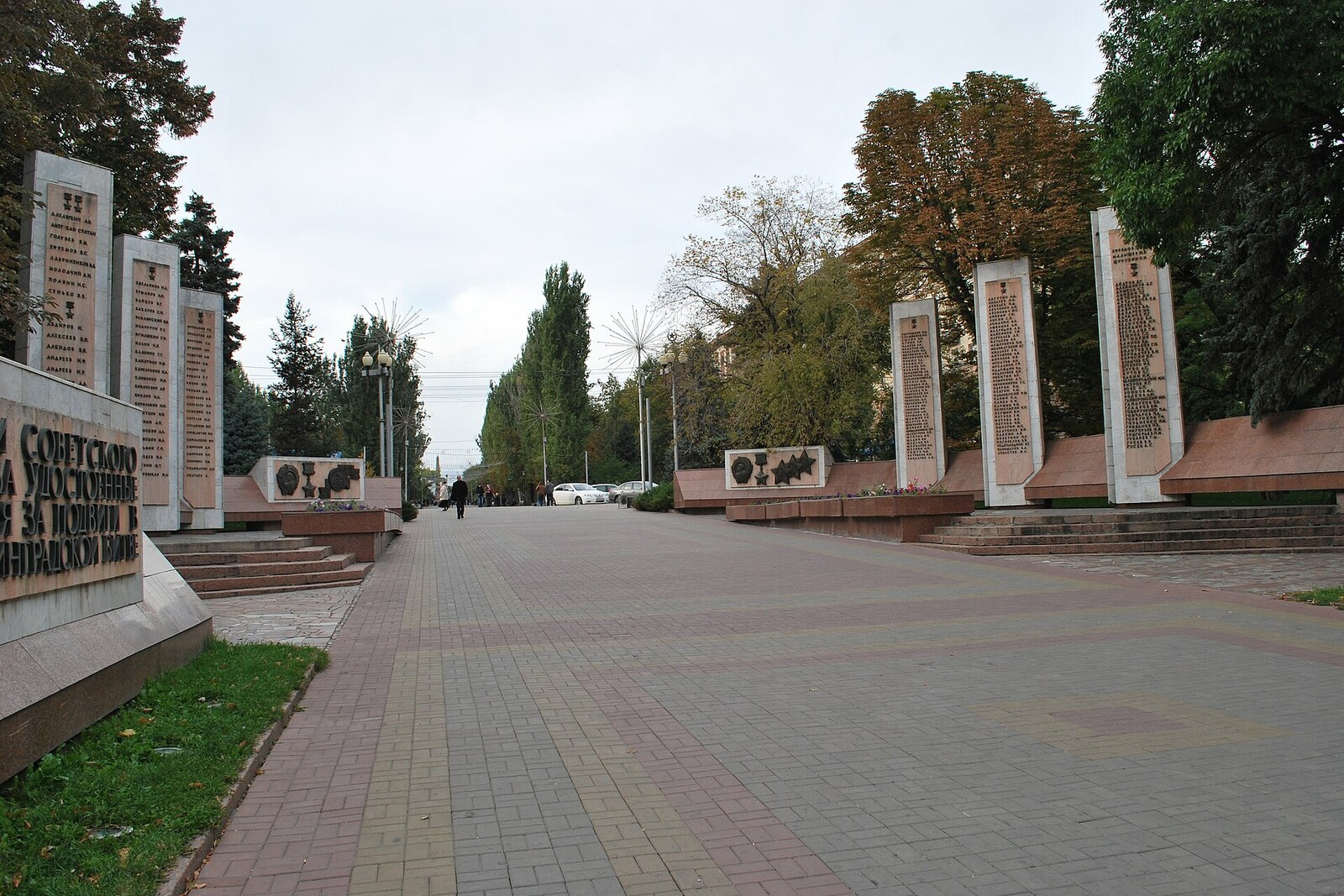
Look around first
What to notice
- Granite stelae with names
- A broad boulevard leading to the Volga
- A memorial plaque on the medical university building
The story of the place
People arrange to meet along the Alley of Heroes, stroll between the center and the Volga, and on commemorative days bring flowers to the granite stelae. This open space appeared only after the war. City planners did not restore the three small streets that had run through the ruined blocks; instead, they laid out a broad boulevard from Fallen Fighters Square to the riverbank. On August twenty-fifth, nineteen fifty-four, it received its present name.
The names on the stone appeared thirty-one years later. Listed here are one hundred twenty-seven Heroes of the Soviet Union awarded the title for feats in the Battle of Stalingrad, one hundred ninety-two natives of Volgograd Region with the same title, and twenty-eight full holders of the Order of Glory—soldiers who received all three classes of this award in succession. This is a list based on award records. It does not include everyone who took a decisive step in the fighting for the city center.
One such person was here on the morning of January thirty-first, nineteen forty-three. Volgograd was then called Stalingrad. By the end of January, the encircled German Sixth Army had split into two isolated groups. The southern group was being pressed toward the central square; its headquarters had taken shelter in the basement of a department store. The day before, the army commander, Friedrich Paulus, had received the rank of field marshal—the highest in the German army. Before him, no German field marshal had surrendered into captivity. The promotion left Paulus a choice between continuing hopeless resistance and death, but he chose neither.
Ivan Burmakov, commander of the Thirty-eighth Motor Rifle Brigade, was working to ensure that Paulus's headquarters lost contact with its remaining units. On the night of January thirty-first, his fighters occupied buildings near the upper end of what is now the Alley of Heroes, including the regional Party Committee building that stood here, and blockaded the department store on the opposite side of the square.
In the morning, a German officer showed a white flag. Senior Lieutenant Fyodor Ilchenko, the brigade headquarters' deputy chief, ordered the firing to cease and went to the department store with a signalsman, Alexei Mezhirko, two submachine gunners, and a captured German officer taken along as an interpreter. The approaches were mined, so the group went around the building via Ostrovsky Street. At the entrance, the Germans demanded that they leave their weapons. Ilchenko refused: he was going down into a basement full of armed officers, not knowing whether negotiations or gunfire would begin there.
Paulus lay without a uniform on an iron cot. At first, the German generals would not speak with a Soviet senior lieutenant and demanded a more senior commander. Ilchenko returned to Burmakov. Burmakov ordered him not to let the headquarters leave the encirclement and to continue negotiations. Soon officers of the 64th Army arrived in the basement, followed by its chief of staff, General Ivan Laskin, authorized to demand the complete capitulation of the southern group. The German generals accepted the terms. Paulus was taken away as a prisoner, and his soldiers began laying down their weapons. The northern group continued to resist for another two days.
In his nighttime report, Burmakov singled out Ilchenko and about fifty other soldiers and officers who had taken part in encircling the department store and capturing the headquarters. Many years later, Volgograd awarded Ilchenko the title of honorary citizen, but his surname is not on the stelae of the Alley of Heroes: he did not belong to any of the award categories by which the stone lists were compiled.
The basement that Ilchenko entered with the submachine gunners and the captured interpreter has been preserved beneath the restored department store as the Memory Museum. At the upper beginning of the alley, a plaque on the medical university building states that the defeat of the southern group was completed here and that a red banner was raised.
Useful on site
Open around the clock as a pedestrian urban space.
Checked: June 24, 2026. Check the official source before visiting.Do not try to read all the inscriptions in sequence: choose a few names and pause by a tree.