 Guide On Map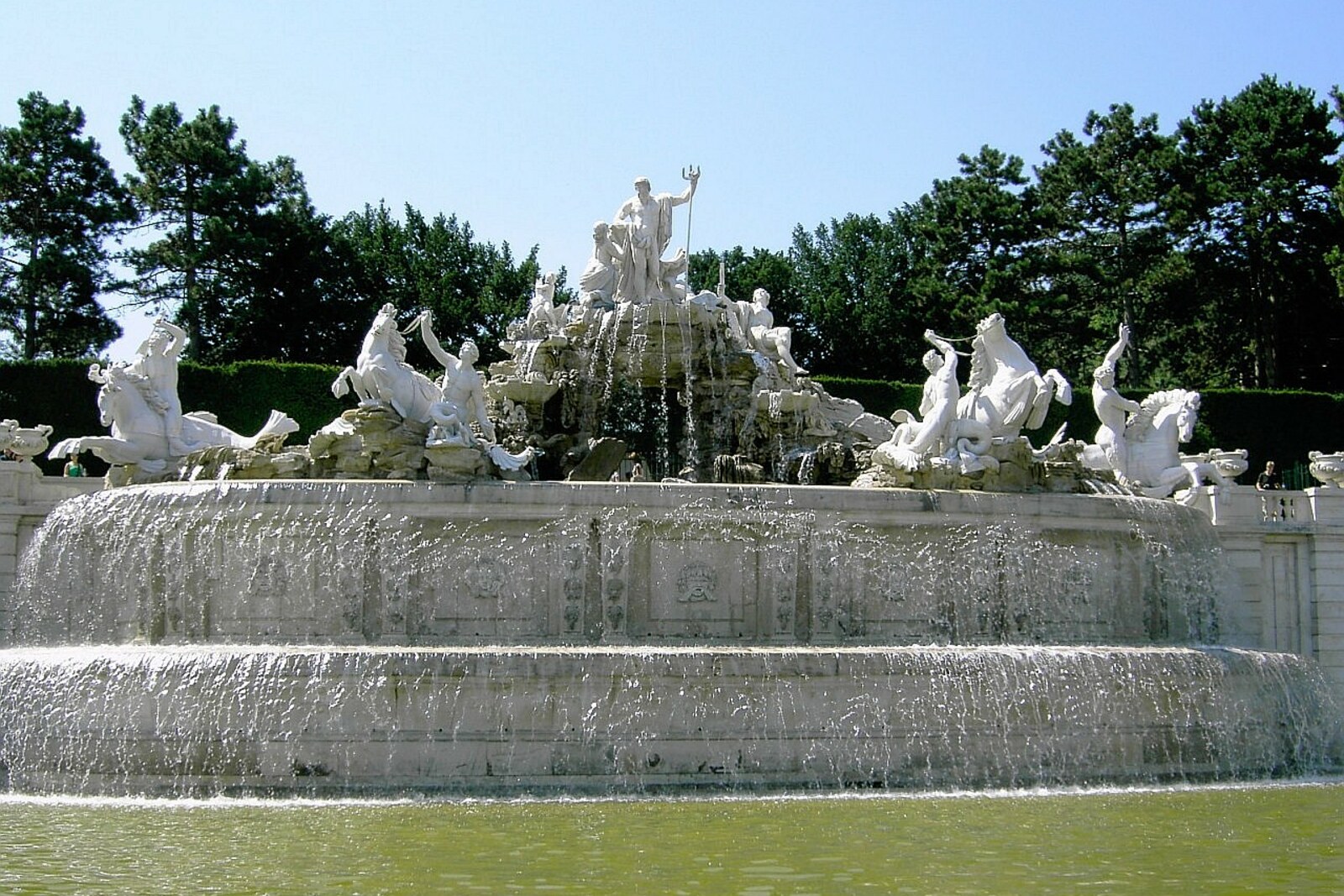
Look around first
What to notice
- Neptune with a trident
- Shell-shaped chariot
- Kneeling Thetis
- Tritons and sea horses
The story of the place
Behind the marble group lie a brick vault and a tunnel leading to a pond on the hill. Without this structure, Neptune Fountain could not have appeared here: Schönbrunn was constantly short of water.
When work began in seventeen seventy-six on digging basins for the new garden, the builders discovered that it was impossible to supply the planned fountains with water. Twelve basins that had already been dug had to be filled in. Maria Theresa, ruler of the Habsburg lands and patron of the rebuilding, knew that her son and co-ruler Joseph II took almost no interest in Schönbrunn. She even wrote about this to her daughter Marie Antoinette. If the garden were not completed during her lifetime, there might be no continuation.
Richard van der Schot, the court gardener whom Maria Theresa and Joseph II personally trusted, was tasked with saving at least the main water feature. He intended to put an end to the water shortage once and for all. In Lainzer Tiergarten, west of the palace, van der Schot created a large collecting basin. Rainwater gathered there was carried through a pipeline more than four kilometers long to reservoirs at the top of Schönbrunn Hill. From there, it could flow down by gravity to the basin here.
The fountain was completed in seventeen eighty, shortly before Maria Theresa’s death. Joseph II ordered that Schönbrunn be left as he had received it. Van der Schot’s pipeline remained in service until nineteen sixty-three, when the streams that supplied it began to dry up. Even before then, the fountain was turned on only for special occasions, and after both world wars it stood without water for long periods. During the restoration completed in two thousand two, a closed water-circulation system was installed. Now pumps return the same water to the top.
Above this system stands the one to whom ancient myth gave the sea: Neptune, the Roman god. He holds a trident and rides in a shell-shaped chariot. Tritons, creatures with human bodies and fish tails, hold back the sea horses. Beside him kneels Thetis, Achilles’ mother. She asks Neptune to help her son on his sea voyage to Troy. According to the myth, Achilles reached the war, killed Hector, the Trojan prince, and died before the Greeks captured the city.
The image of Neptune ruling the sea served as a sign of a sovereign directing the country’s fate. That is why he was placed at the center and why the fountain was named after him. Thetis still kneels before Neptune; Achilles, for whose sake she pleads, is not among the marble figures.
Useful on site
The fountain is accessible as part of the park. The water does not run from mid-October to mid-April; during the season, the hours listed for Neptune Fountain are 10:00—16:00.
Checked: June 29, 2026. Check the official source before visiting.It is worth viewing the composition both from a distance and up close; even without the water jets running, its story can be read from the figures.