 Guide On Map
Schönbrunn: Palace and Imperial Park
From the main gates through the Gloriette to the Crown Prince Garden
Guide On Map on your phone
Open the walk like a regular app
It takes about 10 seconds to install. No app store needed.
The whole path
Route map
About the walk
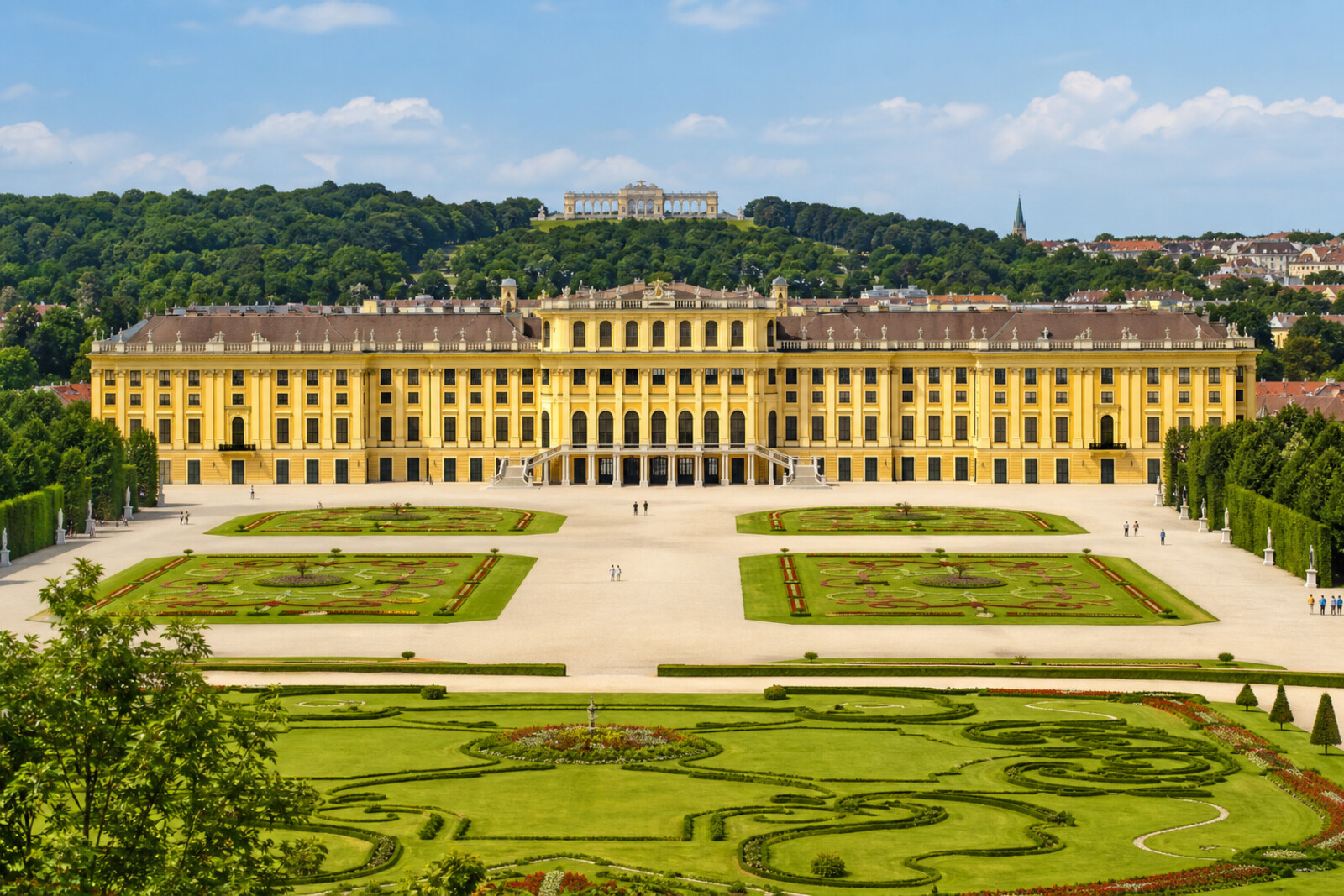
You will enter Schönbrunn through the ceremonial courtyard, walk around the palace, and follow the straight line of the Great Parterre toward the hill. Beyond Neptune Fountain, the path rises to the Gloriette, then descends to the glass Palm House and ends in the intimate Crown Prince Garden.
At first, there will be symmetry, marble, and an open view. Then come a tunnel beneath the fountain, an arch at the summit, the iron and glass of the greenhouse, and the low windows of the family wing.
In these stories, you will notice the failures in courtly order. Why did a merchant's apprentice come to a ticketed parade with a kitchen knife? Why did the ancient heroes never form a single sequence? Why did an emperor see a new greenhouse without a single plant?
The narration will be calm and precise, with no courtly admiration. By the end of the walk, you will be able to point out where Schönbrunn's order was disrupted: in the rows of statues, beneath Neptune's basin, above the arch of the Gloriette, and behind the glass of the Palm House.
Why this order
The ceremonial courtyard first shows courtly order at work: the gates, open square, and staircase create a setting for public ceremony. After it, the Great Parterre carries the same arrangement into the garden, but the rows of statues reveal the first break in the intended order. Neptune Fountain stands at the end of this view and explains the reason for it: a shortage of water forced the planners to abandon the pools beside which the figures were meant to stand. The climb from Neptune to the Gloriette leads to an arch with a paired inscription and military trophies, crowning the same garden line. The descent into the western part of the park, toward the Palm House, moves the route a century forward: ancient subjects give way to iron, glass, and three separate climates. The walk along the palace to the eastern Crown Prince Garden closes with a family story: the court's fascination with the natural sciences continues beyond the windows of the heir's rooms.
Those who want to see Schönbrunn beyond the palace rooms Those interested in human conflicts within the imperial family Lovers of garden architecture, engineering, and historical detail
Those not prepared for a climb up the hill Those looking only for biographies of monarchs and ceremonial interiors Those who need a short walk without crossings through a large park
Before you go
Choose comfortable shoes for gravel paths and the uphill stretch; in hot weather, bring water and sun protection, since the central axis offers almost no shade. Check access conditions for the Palm House and other indoor or restricted areas in advance: the park's opening hours do not mean they are open at the same time. It is best to listen a little away from the main flow of visitors, especially by the palace, Neptune, and the Gloriette. The route focuses on outdoor spaces, so you do not need to enter the palace to follow the story.
When to go
Do not place this walk too tightly between other plans: the central axis looks short only from a distance, while the climb, the walk to the Palm House, and the return to the eastern facade add noticeably to the route. For a shorter version, keep the courtyard, parterre, Neptune, and the Gloriette; the full route is best done without rushing, with separate extra time for the greenhouse.
Backup plan
If the climb is too demanding or the weather worsens, finish the central section at Neptune Fountain: the Gloriette will still be visible as the high point of the composition. If the Palm House is inaccessible, look at its iron frame and three connected pavilions from outside, then continue to the Crown Prince Garden. If time is very short, focus on the first three stops—they form a complete story about public power, mythological language, and a design that ran out of water.
Route conditions
Elevation. Ascent — 52 m; descent — 55 m
OpenStreetMap extract of June 18, 2026: database data, not a check on the ground. Data © OpenStreetMap contributors, ODbL licence
Walk plan
Open in maps ↗- 1
Main Gate and Courtyard
This stop will show how a paid spectacle at the palace staircase led to a reconsideration of access to the emperor. - 2
The Great Parterre and the Marble Statues
Here you will see how a shortage of water disrupted a unified arrangement and left only separate mythological pairs. - 3
Neptune Fountain
This stop links the ceremonial sculpture with the engineering without which water could not have reached the garden’s main basin. - 4
Gloriette
Here, the route examines the language of imperial victory through the inscription, military trophies, and stone from a dismantled palace. - 5
Palm House
This stop takes the route into the age of iron and glass and shows how three climates were divided beneath one roof. - 6
Crown Prince Garden
The finale will tie the garden’s history to the upbringing of the child whose rooms gave this area its current name.
Route features
Everything you need stays in the browser
Progress, saves and your trip plan are stored on this device.
Add Guide On Map to your home screen so the walk opens outside the browser.
How we handle sources, maps and corrections: our editorial standards