 Guide On Map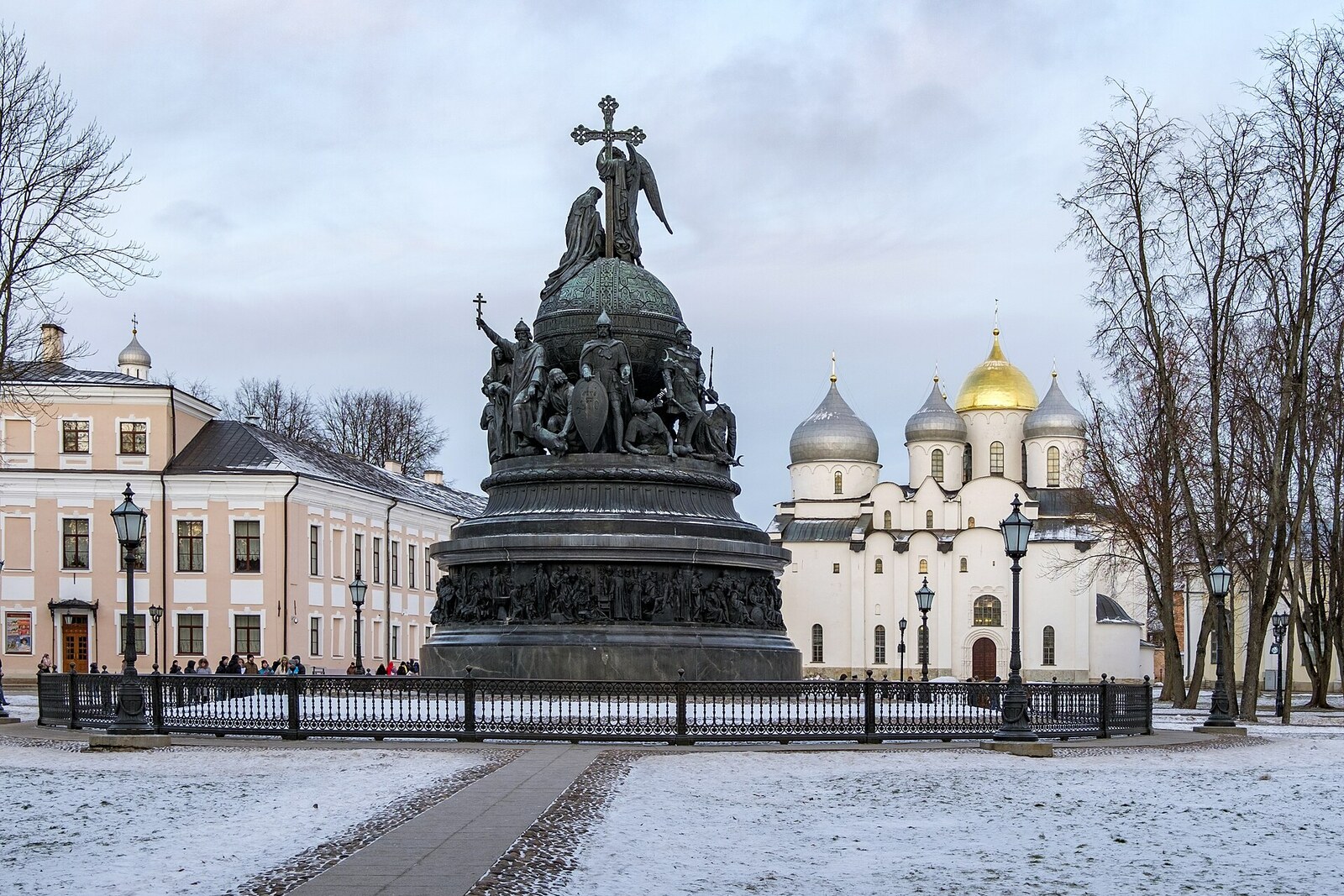
Look around first
What to notice
- Figures on the middle tier
- Lower row of figures
- Recreated fence and lamps
The story of the place
In the Novgorod Kremlin, this bronze monument was erected for the thousand-year jubilee of the state. It was arranged as a crowded roster: six groups of rulers are gathered on the middle tier, while military leaders, writers, artists, and educators stand below. The commission and the emperor determined the composition of this roster, so not only those who made it into bronze matter: one tsar is deliberately absent after the massacre of Veliky Novgorod.
In the winter of nineteen forty-four, bronze figures of Rurik, Peter I, Alexander Pushkin, and dozens of other people lay in the snow around the empty pedestal. The German occupation administration ordered the monument dismantled and sent to Germany. A narrow-gauge railway was laid directly into the Novgorod Kremlin for the heavy sculptures. The lamps and bronze fence were taken away; the figures were thrown down, numbered, and prepared for loading, but the shipment was not completed.
What was dismantled was precisely what the monument had been placed here for. Emperor Alexander II wanted to mark a thousand years of the state and chose as the starting date, in eighteen sixty-two, the chronicle account of events a thousand years earlier: the calling of the Varangian prince Rurik to Veliky Novgorod. That is why the jubilee monument stood in the Novgorod Kremlin.
The competition was won by twenty-four-year-old Mikhail Mikeshin. He earned his living as a battle painter and had never created monuments before; experienced sculptors modeled the bronze figures from his drawings. This commission made Mikeshin an author of major state monuments.
The commission and the emperor decided who would be admitted into the thousand-year history. Six groups, from Rurik to Peter I, were placed on the middle tier. Below them were rulers, military leaders, educators, writers, and artists. One Russian tsar is not among them. In fifteen seventy, Ivan IV sent the oprichniki to ravage Veliky Novgorod; the compilers decided that the city could not be given his figure after that massacre. No empty space was left for Ivan IV: his absence becomes apparent only when you begin to sort through the bronze roster name by name.
After the liberation of Veliky Novgorod on January twentieth, nineteen forty-four, the figures still lay where they had been thrown. Mikhail Yudin, chairman of the city executive committee, who had sought to preserve the dismantled bronze, ordered it fenced off with barbed wire. A round-the-clock guard was posted at the monument; entry beyond the fence was permitted only when accompanied by the museum director.
In April, while the war continued, officials decided to reassemble the monument. The work was assigned to the construction administration that was then building airfields in the region; professional craftsmen were among those carrying it out. They erected scaffolding and a sloping ramp, laid another narrow-gauge railway, and raised the figures along it, each weighing up to three tons. More than one and a half thousand lost bronze parts were cast in Leningrad, and about one hundred fifty meters of seams were filled on the monument.
On the evening of November second that same year, the monument was unveiled for the second time by the light of automobile headlights. The present figures have stood in their places since that reassembly. The fence and lamps appeared much later: restorers made them anew because the original ones that had been taken away never returned.
Useful on site
The monument stands outdoors within the Novgorod Kremlin, which is open daily from 06:00 to 24:00.
Checked: date not specified. Check the official source before visiting.Walk around the monument: from a single point, the many figures and the overall design cannot be taken in.